Korea Insurance Research Institute seminar on 2027 insurance industry outlook
Total premiums forecast at 299 trillion won; 89% of growth concentrated in protection and long-term products
Weak core underwriting masked by investment gains; analysts urge expansion into health, pension segments
Premium growth in South Korea's insurance industry is forecast to slow to 3.5 percent next year — less than half this year's projected rate of 8.0 percent. Insurance company CEOs identified monetary policy uncertainty and interest rate volatility as the biggest threats to their businesses next year, as slowing top-line growth combines with turbulence in financial markets to put pressure on both profitability and financial soundness.
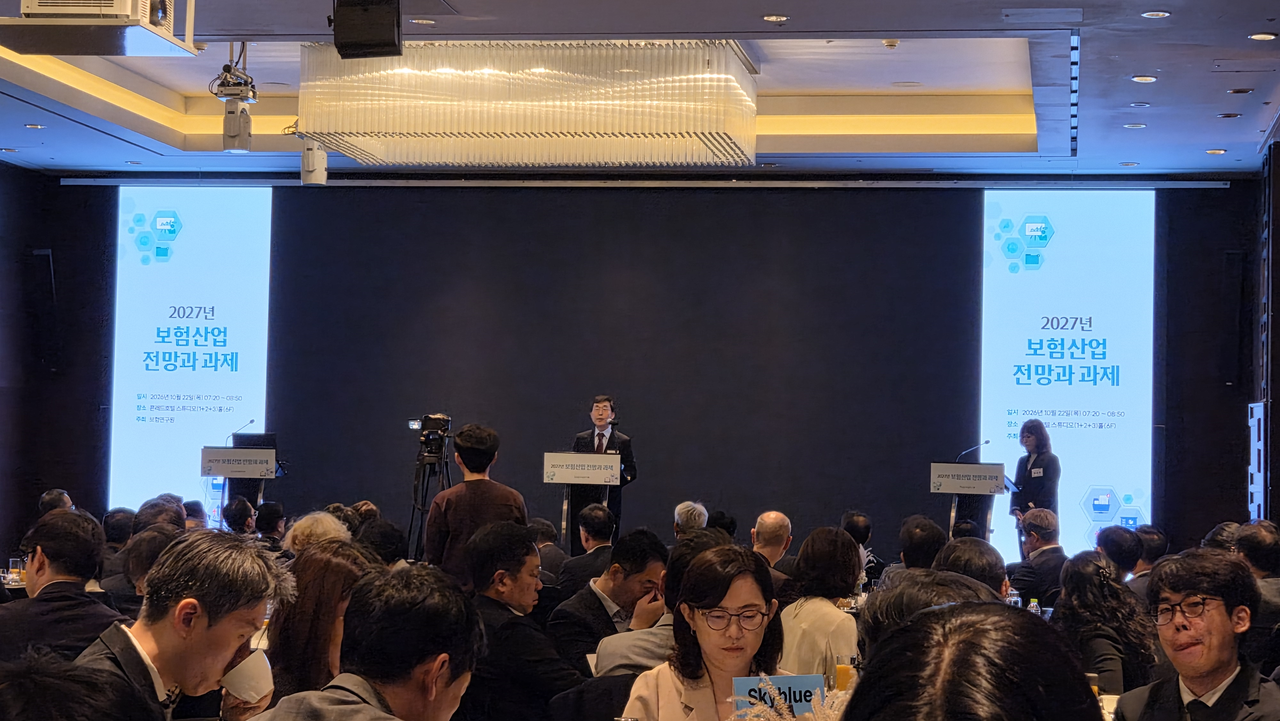
The Korea Insurance Research Institute presented the outlook Thursday at a breakfast seminar titled "2027 Insurance Industry Outlook and Challenges," held at the Conrad Seoul hotel in Yeouido. The institute projected total premiums next year at 299 trillion won ($226 billion), a 3.5 percent increase from this year. Life insurance premiums are expected to rise 2.3 percent to 142 trillion won, while non-life insurance premiums are forecast to grow 4.5 percent to 157 trillion won.
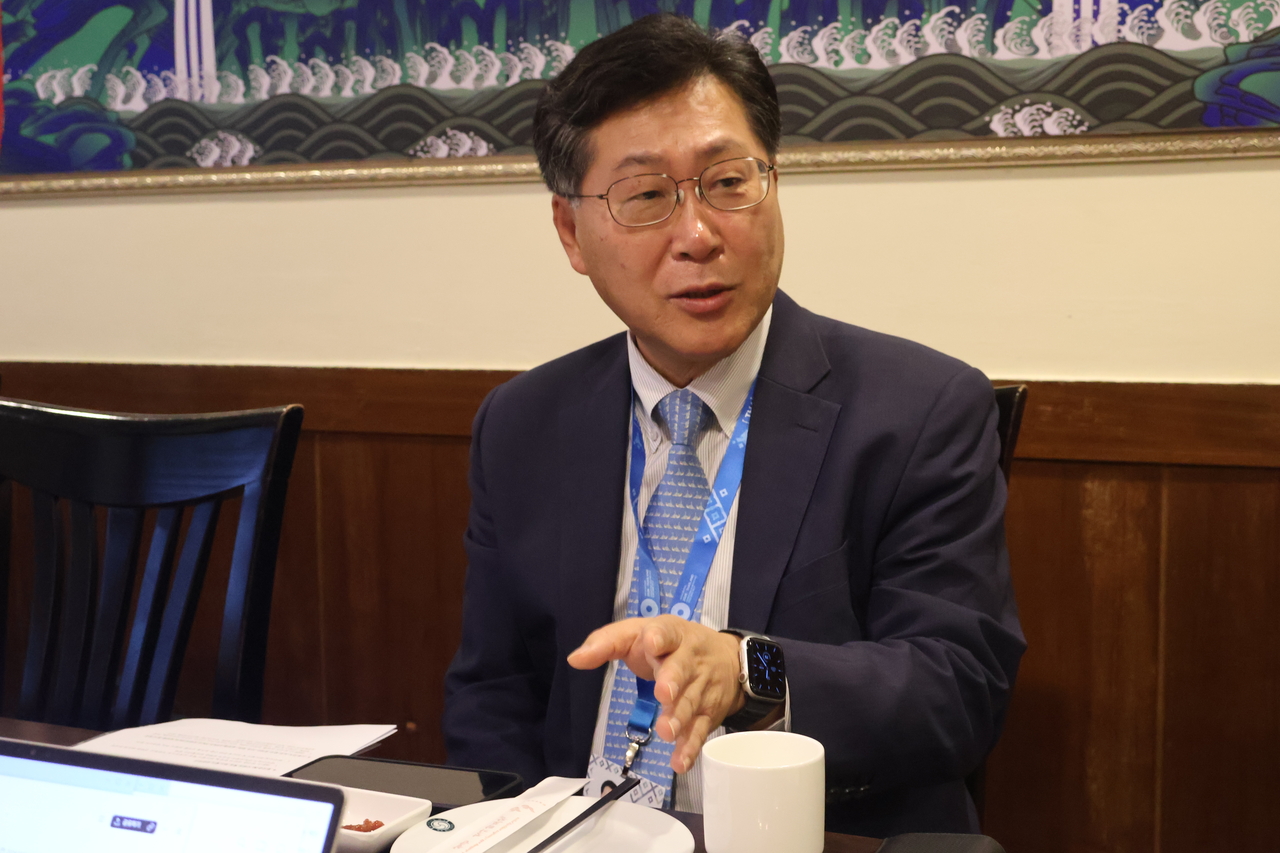
"Premium growth next year is expected to slow to less than half this year's rate," said Kim Dong-gyeom, head of the institute's financial market analysis division. "This is not a pessimistic view — it simply reflects the structural constraints on growth."
In life insurance, savings-type products, variable insurance and retirement pension premiums are all expected to decline. In non-life insurance, auto insurance growth is forecast to be limited to around 3 percent as the effect of this year's premium increases fades. The institute estimated that 89 percent of the total increase in premiums will be concentrated in life insurance protection products and non-life long-term insurance. "Much of this year's high growth rate was driven by one-off factors," Kim said.
The institute also urged a closer look at the improvement in net profit and the Korean Insurance Capital Standard solvency ratio in the first half of this year. Investment gains drove the rise in net profit, but underwriting profit — the core insurance business — actually declined. The mortality and morbidity margin, which measures the gap between risk premiums collected and claims paid, turned negative around the fourth quarter of 2024 for both life and non-life insurers and has yet to recover, the institute said.
Available capital at life insurers rose 94 trillion won over the past year, but 81 trillion won of that came from other comprehensive income, while retained earnings grew by only 6 trillion won. "The valuation gains that boosted capital in the first half are now working in reverse in the second half," Kim said. "Full-year earnings and the year-end solvency ratio could look quite different from the first-half picture."
Sales practices also drew criticism. "Insurers are selling the same products through the same channels at higher cost," Kim said. "Both sales and expenses have gone up, but margins have shrunk." The overhaul of the sales commission structure and new core capital regulations set to take effect next year were also flagged as factors that could constrain near-term growth.
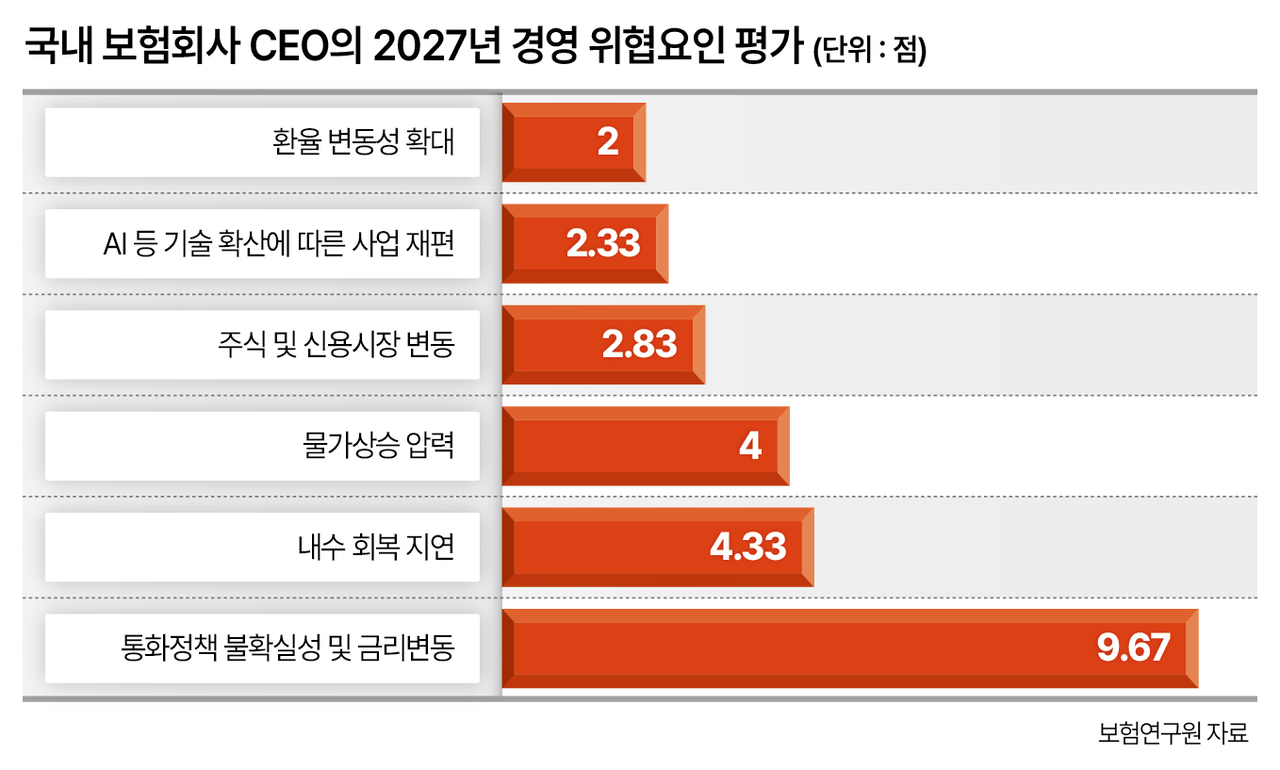
In a survey the institute conducted earlier this month, CEOs rated the industry's growth prospects, profitability and financial soundness all below neutral — a score of 3 — for next year. Their assessments of their own companies, however, were at or above neutral. The gap between company-level and industry-level outlooks was widest for life insurers on growth and soundness (0.54 points) and for non-life insurers on growth (0.57 points).
Kim interpreted the divergence as reflecting "either each company's confidence in its own capabilities, or a belief that industry-wide risks will affect their own firm less." The threat CEOs ranked highest was "monetary policy uncertainty and interest rate volatility," scoring 9.67 points — more than double the second-ranked concern, "delayed recovery in domestic demand," at 4.33 points.
Kim Hae-sik, head of the institute's research coordination division, said premium increases alone cannot absorb rising costs and urged insurers to expand into health, pension and corporate risk segments. In the retirement pension market in particular, he said insurers would struggle to compete unless they can offer longevity guarantees as part of their products.
Financial Supervisory Service Vice Chairman Park Ji-sun said in congratulatory remarks that the insurance industry must "catch two rabbits at once — profitability and financial soundness" next year. On the new core capital regulations, she said the FSS was "well aware of how burdensome this is for the industry" and pledged to work with the Financial Services Commission to find ways to ease the burden while ensuring a smooth transition.
Korea Insurance Research Institute President Kim Heon-su said next year could bring even greater volatility than this year. "Insurers can pursue top-line growth, but they must also secure the back door — only then can they provide consumers with the coverage they need," he said.
won@heraldcorp.com