Bottom-up for individual tasks, top-down for large-scale innovation
AI governance TF targets June next year for dissolution
Saemangeum GPU farm, Google TPU to diversify chip supply
Hyundai Motor Group is pursuing a group-wide initiative to cut new vehicle development time from 43 months to 30 months using AI. The plan combines a bottom-up approach — in which employees freely experiment with AI to improve their own work — with a top-down approach in which the company identifies specific problems first and then deploys AI to solve them, with the goal of translating AI transformation, or AX, into tangible business results.
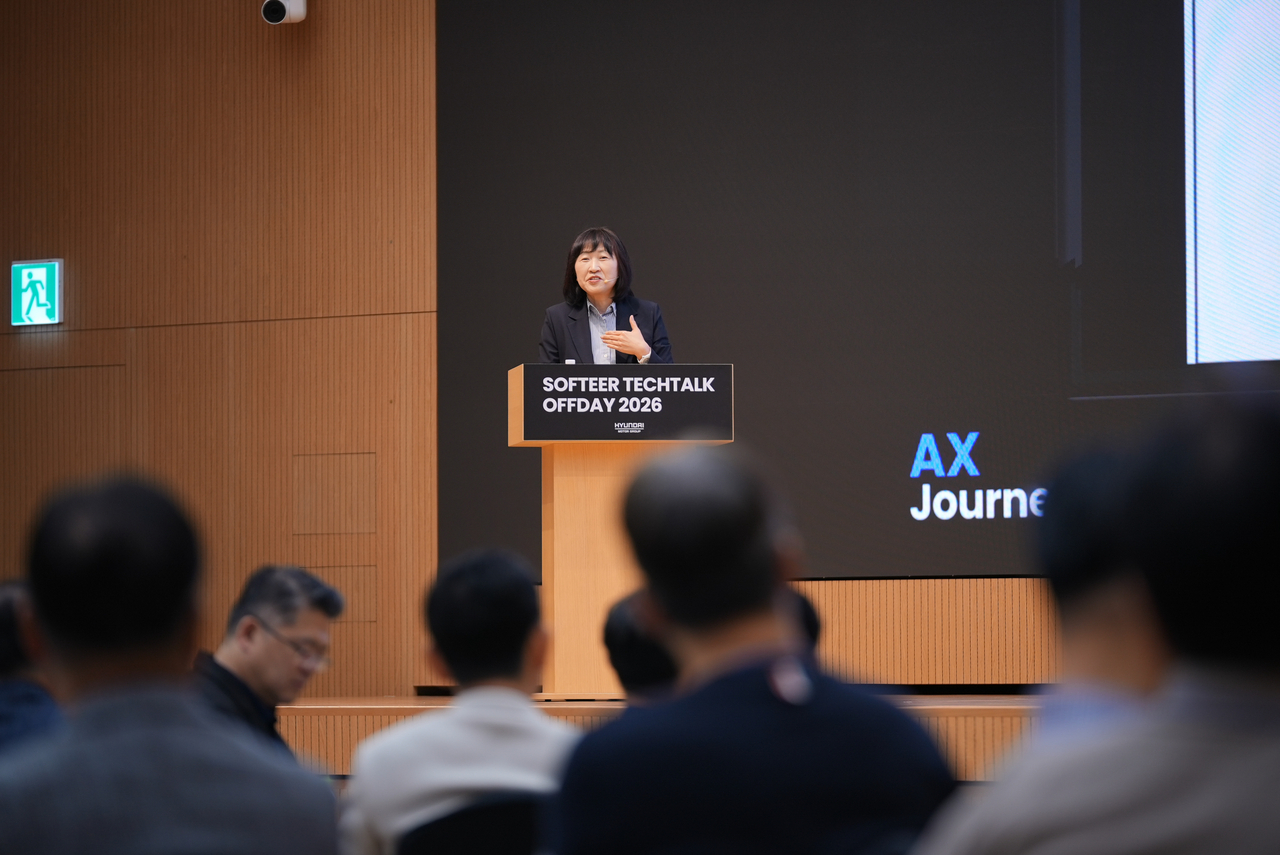
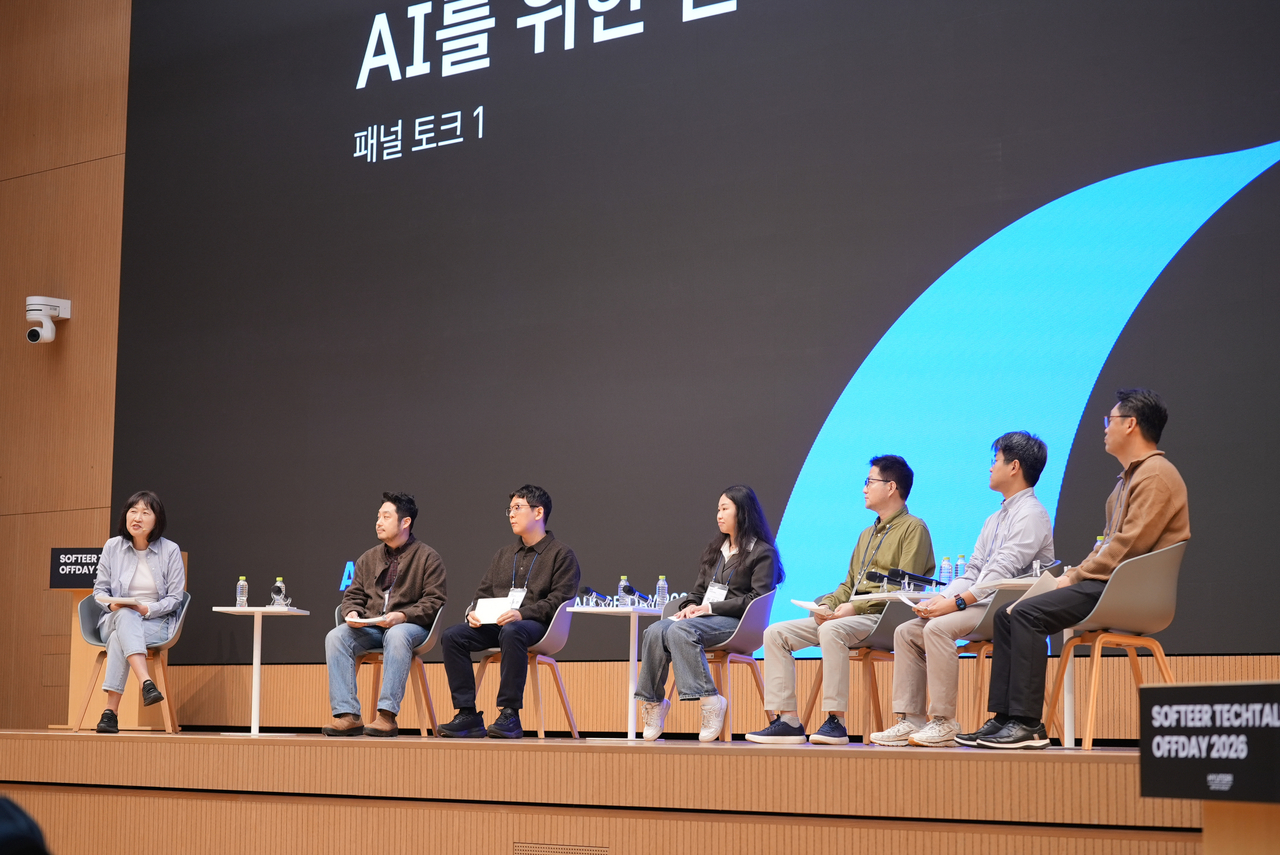
Hyundai Motor Group held a technology conference, "Softeer Tech Talk Off Day 2026," at its Yangjae headquarters in Seocho-gu, Seoul, on Wednesday, presenting the progress, achievements and remaining challenges of its AX drive to IT leaders from Korean companies and members of the media. The Softeer Tech Talk has been held as an internal event since 2023; this year's fourth edition was the first to be opened to outside audiences.
Jin Eun-sook, president and head of ICT at Hyundai Motor and Kia, said in her keynote address that the company's goal is to bring vehicle development time down to 30 months, adding that achieving it would require not only the research and development organization but also procurement, production and other divisions to move together. The target is to gradually reduce the current 43-month development cycle to a level comparable to Chinese automakers.
Using AI to match China's speed — non-developers show results with vibe coding
Hyundai Motor Group has until now focused on a bottom-up approach, providing employees with free tokens to experiment freely with AI. Employees can conduct proof-of-concept work in a closed network environment.
Jin said, however, that relying solely on the bottom-up approach made it difficult to gauge any company-wide change. As a result, the group is now pursuing both tracks simultaneously: continuing the bottom-up approach for individual workflow improvements while applying a top-down approach — one that sets specific problems and quantitative targets in advance — for large-scale process innovation involving multiple organizations.
Shortening vehicle development time was presented as an integrated cross-functional initiative requiring collaboration across multiple divisions. It is a central challenge for the global automaker industry: while established manufacturers typically spend three to five years developing a new vehicle, Chinese automakers have compressed that timeline to 18 to 24 months, expanding their market share in the process. Jin said the group would gradually reduce its current 43-month development cycle.
AI adoption is also growing on the factory floor. A manager at the Gwangmyeong factory used the company's in-house generative AI platform, H Chat, to vibe-code a system that identifies vehicles on the production line and verifies their specifications. Jin said what mattered was that the manager built the system by replacing an 80 million won ($60,400) vision camera with a 25,800-won webcam available on the open market.
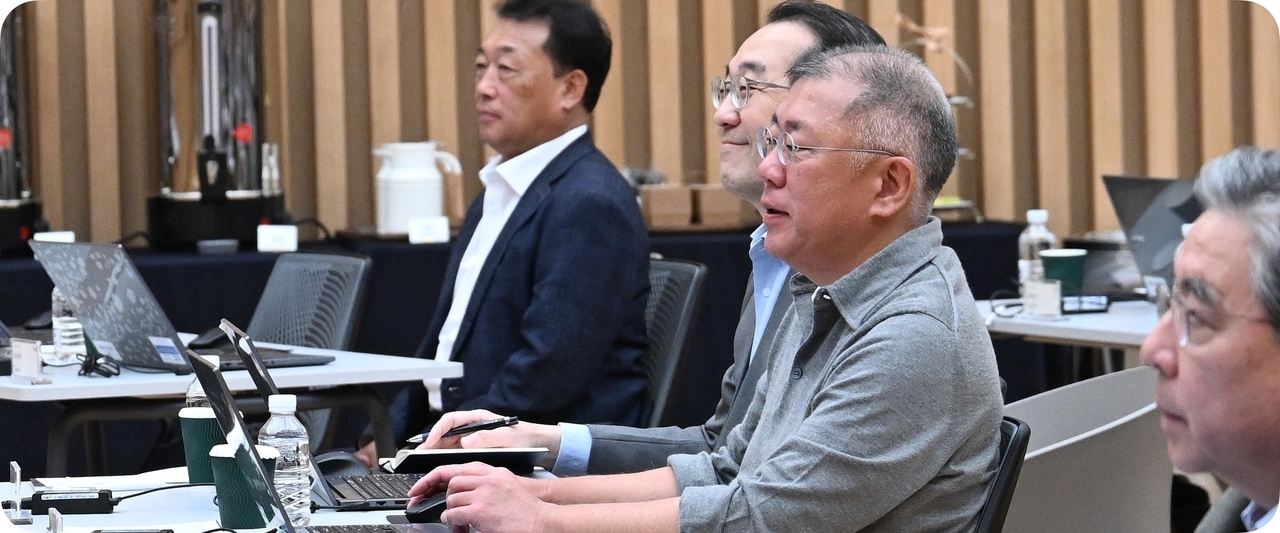
Senior executives are no exception. Hyundai Motor Group Chairman Euisun Chung, vice chairmen and affiliate CEOs took part in a hands-on session using vibe coding to produce global affairs briefing reports. Even when given identical prompts, participants found that results varied from person to person — a lesson, Jin said, that the group shared as a reminder not to over-rely on AI.
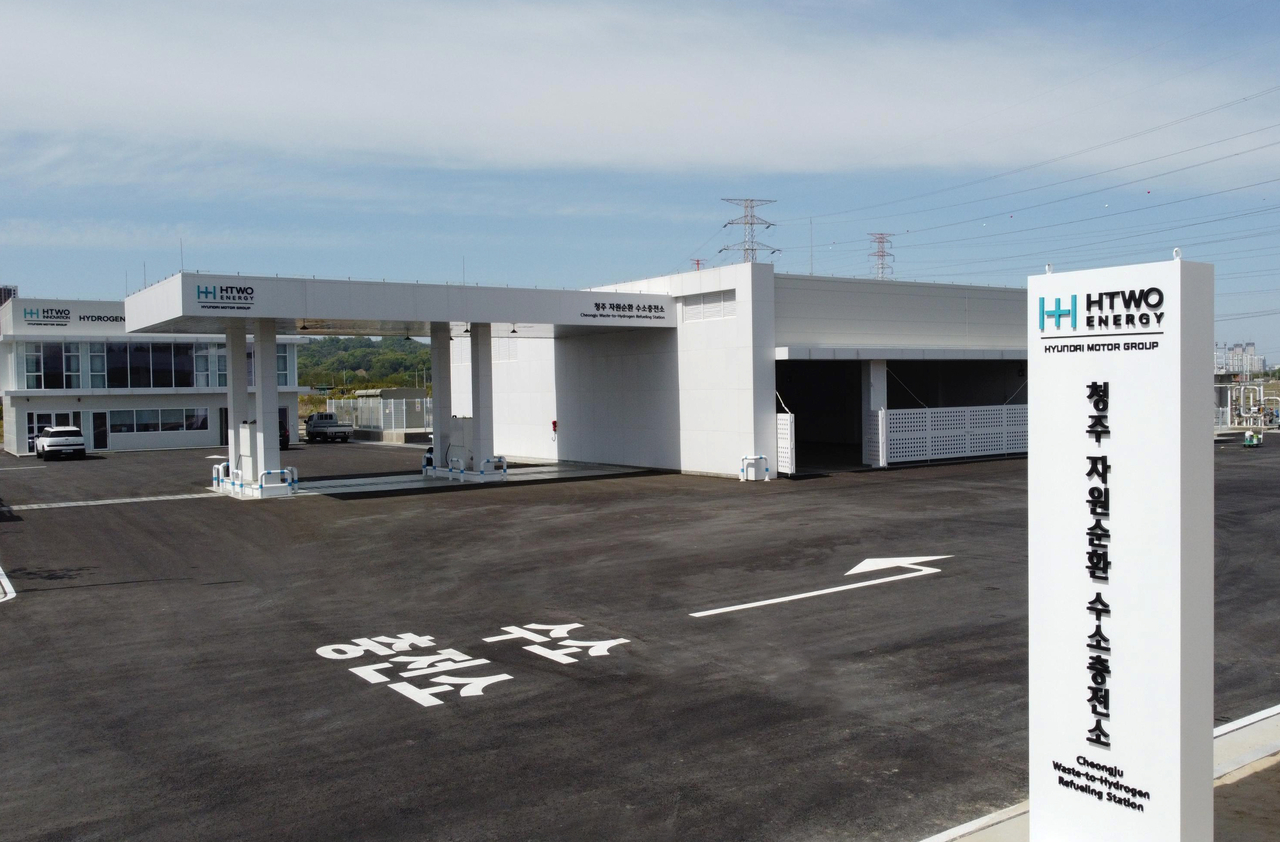
More than 70 percent of the group's employees currently use H Chat for work. Since July, the platform's scope has been extended to cover national core technology areas — including autonomous driving and hydrogen — where overseas transfer is strictly controlled. "The average age of our employees is over 40," Jin said. "It is remarkable that employees like ours are using vibe coding."
'70% of staff to use AI weekly' — data secured from about 12 million connected cars
As AI adoption spreads across the entire organization, the group is also building a framework to manage it safely. This month, Hyundai Motor Group will launch H-Launch, an in-house platform that allows AI-built work tools created by non-developer employees to be distributed as internal services for colleagues to use, rather than remaining confined to individual PCs.
The group is also preparing for scenarios in which AI agents interact directly with business systems. It plans to assign each agent a unique ID — similar to an employee number — and build a management system that logs all agent activity. Actions that are difficult to reverse, such as data deletion, will require human approval before execution.
The organization driving the group's AX effort is also operating on a fixed timeline. Hyundai Motor Group established an AI governance task force in April under Vice Chairman Jang Jae-hoon, with Jin serving as its head. The criteria for dissolving the TF include at least 80 percent of software developers using AI tools, more than 70 percent of all employees using AI tools at least once a week, and more than 40 percent of organizational units automating work through AI agents.
The target date for dissolution is June 2027. "If the TF still exists two years from now, I would consider the group's AX to have failed," Jin said.
Through its group-wide AX push, Hyundai Motor Group has gathered real-time data from about 12 million connected vehicles worldwide, amassing approximately 140 petabytes of vehicle sensor data. It is also managing customer, quality, sales and other operational data from dozens of affiliates through more than 7,000 data pipelines.
The group is also accelerating infrastructure expansion to support physical AI development in areas such as autonomous driving and robotics, and is building out the capability to provide GPU resources as a service. From the second half of 2029, it plans to operate services using more than 10,000 GPUs at its Saemangeum AI data center.
The group is also evaluating alternatives to reduce its dependence on Nvidia. Hyundai Motor Group is conducting a proof-of-concept with Google using the seventh-generation tensor processing unit "Ironwood," testing whether its in-house on-premises LLM can run on TPUs. AMD GPUs, Amazon Web Services' AI chips and inference chips from domestic startups are also under consideration.
Hyundai Motor Group said it will evaluate options directly against four criteria — model compatibility, performance, total cost of ownership and supply stability — and select the best combination without being locked into any single manufacturer.
"The most important thing is an organizational culture that can quickly adopt whatever technology emerges and turn it into business results," Jin said. "We will build an organization that learns fast, unlearns fast and relearns, so we can stay ahead of the next wave of technological innovation."
eyre@heraldcorp.com