Background to the Monetary Policy Board's rate hold
Assessing the effects of preemptive hikes
Inflation concerns persist as growth momentum builds
Shin Hyun-song: next year's inflation to exceed forecast
Tightening bias maintained; November hike expected
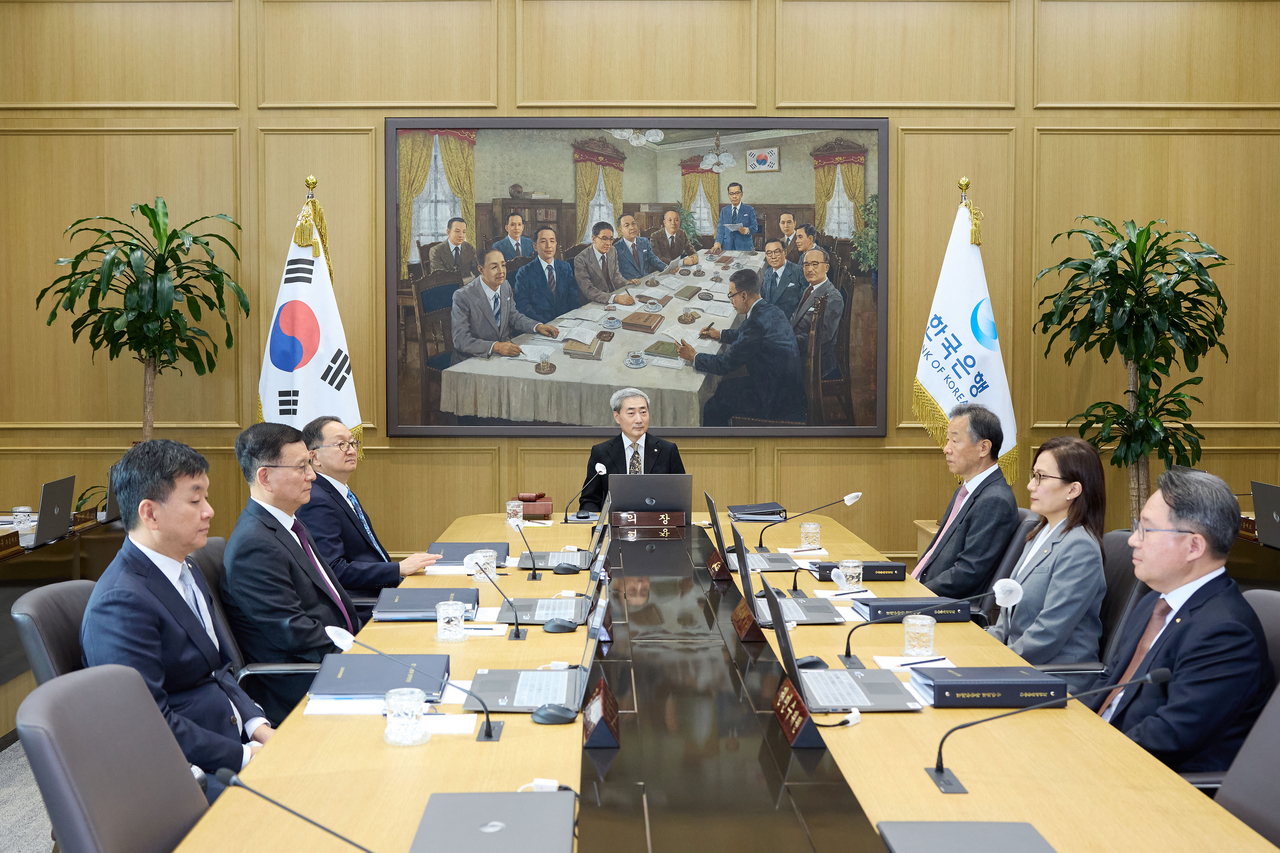
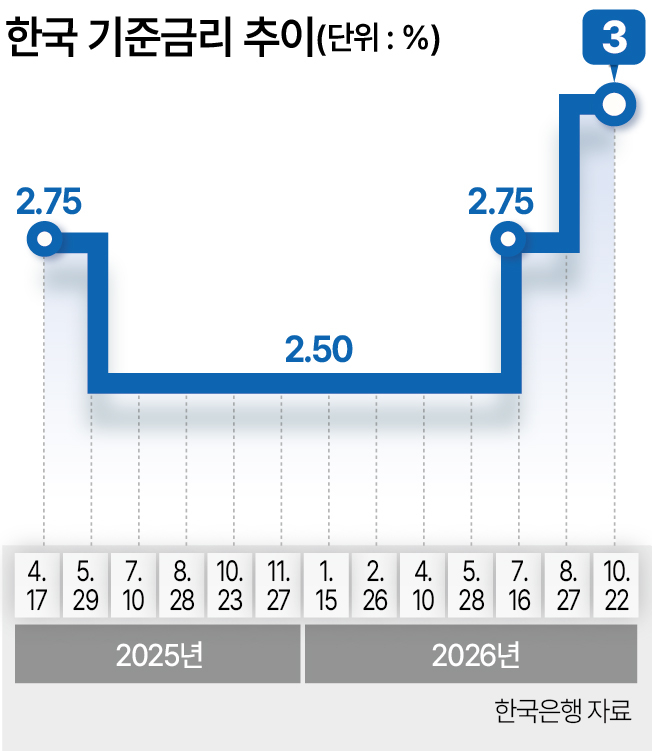
The Bank of Korea paused its rate-hiking cycle after two consecutive increases, but it has not loosened its grip on monetary tightening.
Markets are reading the decision as a "hawkish hold," as the BOK kept language about "the timing and pace of further hikes" in its policy statement. With major indicators — from inflation to growth — still pointing toward tightening, expectations are building for another rate increase next month.
A breather to assess preemptive hikes, but key indicators still signal tightening
The BOK's Monetary Policy Board held the benchmark interest rate at 3 percent annually Thursday, with the primary rationale being a need to assess the policy effects of recent consecutive hikes. Having broken with convention by delivering a preemptive increase at the previous meeting, the board said it wanted to confirm how the rate rises were feeding through to lending rates, household loans and the housing market.
A recent decline in the won-dollar exchange rate also bolstered the case for a hold. The monthly average won-dollar rate fell sharply from 1,488.9 won in July and 1,404.4 won in August to 1,339.2 won so far this month through Wednesday. The weekly closing rate on Wednesday stood at 1,325.2 won per dollar, down 2.9 won from the previous session, marking a fourth consecutive session at a new yearly low — the weakest level since Oct. 2, 2024, when it hit 1,319.3 won. Dollar sales by semiconductor exporters have overwhelmed upward pressure from factors such as net foreign selling of domestic stocks, rising global oil prices and broad dollar strength.
"The won-dollar exchange rate has fallen considerably, supported by improved foreign-exchange supply and demand conditions stemming from a large current-account surplus, despite the strength of the US dollar," Governor Shin said.
Key macroeconomic indicators covering inflation, growth and financial stability, however, continue to point toward further rate increases.
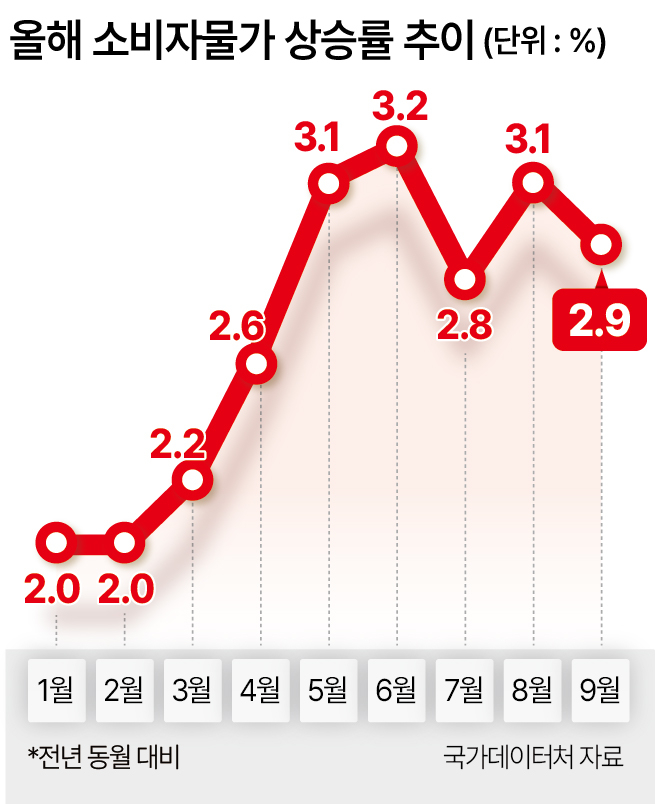
Consumer price inflation eased to 2.9 percent in September, but underlying price pressures remain elevated once the base effect from last year's telecommunications fee discounts is stripped out. BOK Deputy Governor Lee Ji-ho said at a price-monitoring meeting that October consumer price inflation would likely remain high, "at around 3 percent, as the upward trend in core items continues."
Global oil prices — a critical driver of inflation — are also surging. Dubai crude averaged $113.7 per barrel in September, a jump of 28.1 percent, as Middle East tensions reignited. Import prices turned positive in September for the first time in four months, and producer prices rose for a second consecutive month. Both are expected to feed through to consumer prices with a lag. The BOK also projects that rising incomes, led by the semiconductor sector, will increasingly push prices higher.
"Going forward, inflation will remain above the target level for a considerable period as the pass-through of higher cost pressures continues and demand-side pressures gradually build," Shin said. "Consumer price and core inflation this year will broadly align with the August forecast, but next year they will exceed the previous projection."
Improving growth conditions are also reducing the perceived cost of further hikes. The BOK's August revised economic outlook projected growth of 3.3 percent this year and 2.9 percent next year. The IMF recently raised its growth forecast for South Korea this year to 3.3 percent as well. Some analysts suggest growth could surpass those projections on the back of strong semiconductor exports driven by expanding AI investment.
"Going forward, the domestic economy will sustain high growth in exports and investment on the strength of the semiconductor boom, and consumer spending will gradually recover as income conditions improve," Shin said. "Growth this year and next year will significantly exceed the August forecast."
Financial imbalances continue to accumulate. The Financial Vulnerability Index, which gauges South Korea's medium- to long-term financial imbalances, has risen for nine consecutive quarters — from 37.6 in the first quarter of 2024 to 46.5 in the second quarter of this year — reaching its long-term average. Household credit growth has outpaced the economy's underlying fundamentals by a widening margin.
Although the pace of growth in financial-sector household loan balances slowed for the first time this year in September, total household credit — which includes both loans and sales credit — surpassed 2,000 trillion won ($1.51 trillion) for the first time in history as of the end of the first half, remaining at an elevated level. According to the Seoul Metropolitan Government, the actual transaction price of Seoul apartments rose 15.5 percent year-on-year as of August, the highest rate since November 2021, when it stood at 17.9 percent.
"Household loans shifted to a net decrease as other loans were repaid, but housing-related loans continued to grow," Shin said. "The pace of home price increases in the Greater Seoul area has widened again."
Will rates rise next month? October inflation and third-quarter GDP in focus
Market attention is now turning to November's meeting, the last Monetary Policy Board session of the year. The median of the dot plot released in August pointed to one additional hike by February next year, to 3.25 percent. Although no dot plot was released at Thursday's meeting, markets broadly expect the rate to reach 3.25 percent before year-end. Morgan Stanley forecast a hike to 3.25 percent in November and a terminal rate of 3.5 percent in the first quarter of next year, while Citibank Korea projected quarter-point increases in both November and February next year, also arriving at a terminal rate of 3.5 percent.
How strong inflation and economic growth prove to be before the next meeting will likely determine the rate path. Key variables include whether October consumer price and core inflation rebound to elevated levels, and how robust growth appears in the advance estimate of third-quarter real GDP. The BOK is also expected to raise its growth forecast further in the revised economic outlook due next month, which would strengthen the case for another hike.
On the other side, financial market jitters over the profitability of AI investment and the declining exchange rate could temper the urgency for a hike. The outcome of the US Federal Reserve's FOMC meeting, scheduled for Monday and Tuesday (local time), is another variable. According to the CME Group's FedWatch tool, the probability of a hold at that meeting stood at 85.1 percent as of Wednesday (local time), more than double the 42.4 percent seen a month earlier.
"It is too early to feel reassured about price stability. Global oil prices continue to fluctuate around $100 per barrel, so inflationary pressure could return with a lag — that is something we need to watch carefully," said Park Sang-hyun, an economist at iM Securities. He added that annual growth this year appeared likely to come in above the BOK's forecast, and that home prices in the Greater Seoul area, particularly in Seoul, remained unstable — a view that led him to forecast a further rate hike.
Kong Dong-rak, a researcher at Daishin Securities, said semiconductors could lead inflation higher if buyers feel pressure to purchase quickly given that pricing power lies with suppliers. "From the perspective of demand-side inflationary pressure, semiconductors deserve close attention," he said.
kimstar@heraldcorp.com
forest@heraldcorp.com