Foreign investors have been moving in opposite directions on South Korea's two dominant chipmakers, Samsung Electronics and SK hynix. Buying has flowed into Samsung Electronics in recent sessions, while selling pressure on SK hynix has persisted. On Wednesday, however, foreigners turned net buyers of both stocks. Securities analysts said investor sentiment is recovering on the back of strong earnings from US AI companies, but whether the foreign buying will continue remains uncertain.
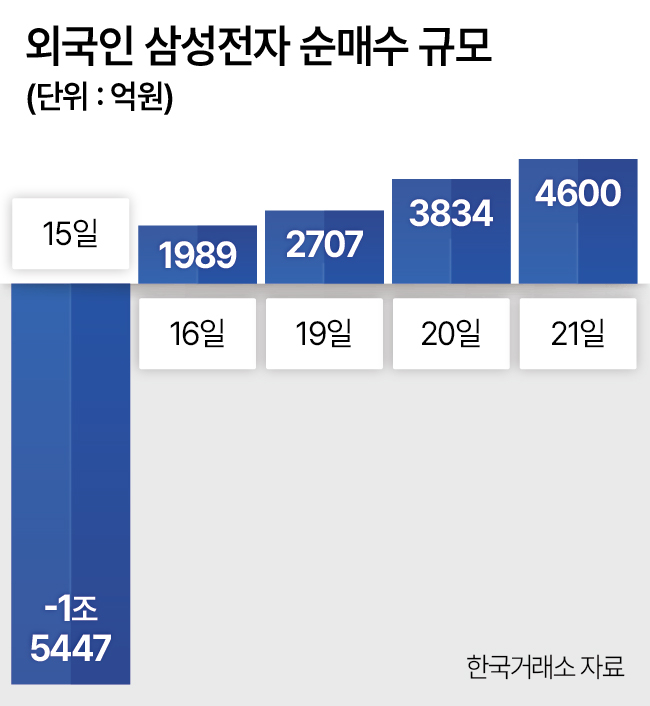
According to Korea Exchange data released Thursday, foreign investors net bought Samsung Electronics for four consecutive trading days from Friday through Wednesday. Their cumulative net purchases reached 1.31 trillion won ($991 million). Over the same period, they net sold SK hynix shares worth 414 billion won.
Foreign investors had sold SK hynix for 18 consecutive trading days from Sept. 21 through Tuesday, accumulating net sales of 16.17 trillion won. On Wednesday, however, they turned net buyers of both Samsung Electronics and SK hynix simultaneously, signaling a possible shift in foreign flows into large-cap semiconductor stocks — the first time that had happened since Sept. 9.
SK hynix also suffered a steeper share price decline over the period. From Sept. 21 through Wednesday, Samsung Electronics fell 14.37 percent while SK hynix dropped 30.32 percent. During the same stretch, foreign investors net sold 15.97 trillion won worth of SK hynix shares and 3.94 trillion won worth of Samsung Electronics shares. The concentrated foreign selling in SK hynix is widely seen as a key driver of its sharper price decline.
Among the factors cited for the divergence in foreign flows is the controversy surrounding the planned NASDAQ listing of Solidigm, an SK hynix subsidiary. "Since last year, expectations for the domestic stock market have rested on the structural earnings growth of Korean companies driven by expanded AI capital investment, and on governance improvements following amendments to the Commercial Act," said Heo Jae-hwan, a researcher at Eugene Investment & Securities. "However, governance improvements and shareholder returns have fallen short of expectations." The concern is that a Solidigm NASDAQ listing could deepen the so-called Korea discount.
Recent strong earnings from US AI-related companies have helped lift sentiment toward semiconductor stocks. SpaceX announced Wednesday (local time) that it turned a profit for the first time in the third quarter. On a conference call, CEO Elon Musk said demand from hyperscalers to lease AI computing capacity is outpacing supply and that the shortage is expected to persist for an extended period, fueling expectations for further AI infrastructure investment and rising semiconductor demand.
Super Micro Computer also issued a preliminary sales forecast of $18.5 billion to $19.5 billion for the first quarter of fiscal year 2027, well above the market consensus of $15.2 billion. Its gross margin guidance of 12.0 to 12.5 percent also exceeded the market estimate of 10.15 percent, raising hopes for a profitability recovery.
"A direct catalyst that would ease the funding concerns weighing on AI-sector sentiment has yet to materialize," said Hwang Su-uk, a researcher at Meritz Securities. "That said, a succession of earnings surprises is increasing the likelihood that market attention will shift back from flows and sentiment to earnings and fundamentals."
Analysts said uncertainty surrounding AI remains elevated, making it unclear whether the rally in semiconductor stocks can be sustained. They particularly advised watching whether foreign buying continues.
"For the first time since Sept. 9, we have seen foreigners simultaneously net buy both Samsung Electronics and SK hynix, suggesting that risk perception toward the semiconductor sector as a whole may have eased somewhat," said Lee Jae-won, a researcher at Yuanta Securities Korea. "Given that net buying and net selling have alternated recently, however, additional confirmation is needed before concluding that foreigners have decisively shifted to sustained buying," he added.
"Foreign investors are buying in the spot market, but conviction about the market's direction is still lacking," said Lee Jun-young, a researcher at Eugene Investment & Securities. "Rather than chasing the rally, a response that accounts for volatility is warranted." On Wednesday, foreign investors net bought 655.8 billion won on the Kospi market while simultaneously net selling 816.5 billion won in KOSPI 200 futures.
"In a thin liquidity environment, tug-of-war dynamics are frequently emerging between expectations for expanding real AI demand and a sustained investment cycle on one side, and concerns over profitability and funding risks on the other," said Han Ji-young, a researcher at Kiwoom Securities. "Volatility will be unavoidable through next week as the market works through earnings from US hyperscalers and domestic chipmakers."

moon@heraldcorp.com