Stay-at-home spouses, income-free youth to gain 'payment-exemption' status
Household-based pension system to be overhauled for first time in 38 years
One in three Koreans aged 18–59 outside pension coverage
Preventing abuse by wealthy households, linking real premium support remain key challenges
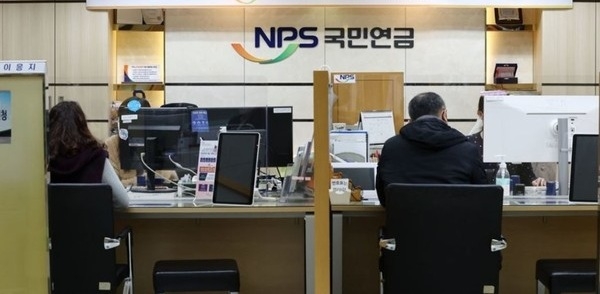
South Korea is pushing to bring income-free stay-at-home spouses and young adults between the ages of 18 and 26 into the national pension system. Under the plan, they would be classified as "payment-exemption subscribers" — a status that allows them to maintain enrollment without paying premiums immediately — giving them the opportunity to secure pension entitlements later through back payments.
The overhaul aims to shift the system from a "one household, one pension" model — the design in place since the scheme launched in 1988 — to a "one person, one pension" framework, fundamentally narrowing the gaps in retirement income protection.
According to a work-status report the National Pension Service submitted Thursday to the National Assembly's Health and Welfare Committee for its national audit, the agency has formally proposed a structural reform to bring income-free spouses and others into the subscriber base. Under current law, an unmarried person aged 27 or older with no income qualifies for payment-exemption status, but the income-free spouse of an enrolled subscriber is classified as an "excluded person" entirely barred from joining — a distinction that has long drawn criticism as discriminatory.
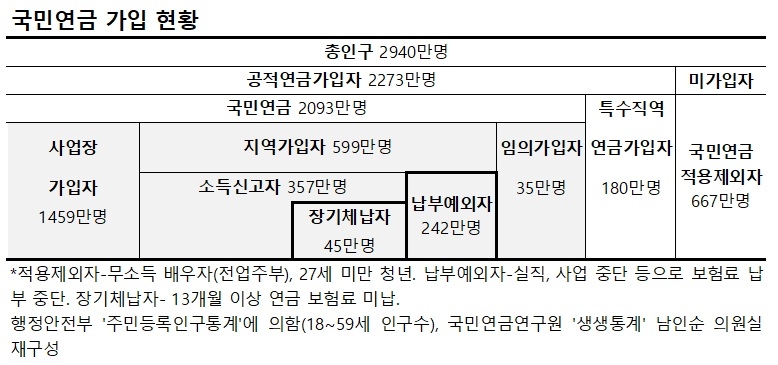
Of the approximately 29.4 million people aged 18 to 59 on the Ministry of Interior and Safety's resident registration rolls, about 22.73 million are enrolled in a public pension — roughly 20.93 million in the national pension and 1.8 million in occupational pension schemes. The remaining about 6.67 million, including stay-at-home spouses and income-free young adults, are classified as excluded persons. Adding the approximately 2.42 million payment-exemption subscribers who have stopped paying due to job loss and 450,000 long-term delinquents, the total number of people outside effective coverage reaches about 9.54 million.
The current structure poses a serious threat to the retirement security of married women. Consider two 55-year-old women — a stay-at-home spouse, referred to here as Person A, and an unmarried woman, Person B. Neither has ever paid premiums or earned income, yet when they sought advice, the outcomes were starkly different. Person B, being unmarried, was told she could claim a pension by making back payments to cover past periods. Person A, who spent her life managing the household and raising children, was told back payments were simply not an option for her.
When the system was introduced, the income replacement rate stood at 70 percent, meaning a single pension for a male breadwinner household was enough to support a couple in retirement. As that rate was gradually reduced, one pension alone became insufficient to cover living costs. The system has remained locked in a household-based framework designed 38 years ago, effectively sidelining married spouses with no income.
Under the proposed reform, Person A would be recognized as a payment-exemption subscriber and could make back payments covering up to 119 months. She would also become eligible for premium support if she meets income requirements.
In practice, women pushed out of the formal system have long had to fend for themselves. As of the end of 2025, female regional subscribers who reported income had paid premiums for an average of only 116 months — falling short of the 120-month minimum required to receive a pension. As a result, women account for more than 80 percent — 268,113 out of 333,717 — of voluntary subscribers who pay premiums entirely on their own. Women also outnumber men by 2.2 times among those who continue voluntary enrollment past age 60 to accumulate enough qualifying months.
Financial support to close coverage gaps will also be expanded. Starting next year, the National Pension Service plans to cover one month's worth of premiums — 41,000 won ($31) — for young adults born in 2009 who turn 18, and to raise the income threshold for premium support for low-income regional subscribers from below 800,000 won to below 1 million won per month. The maximum monthly premium subsidy for farmers and fishers was also raised to 50,350 won this year.
However, the proposed reform — which would bring all 6.67 million excluded persons, including income-free spouses, into the regional subscriber system as payment-exemption enrollees and widen access to back payments — raises issues that warrant careful consideration.
Critics warn the change could reignite concerns about regressive use of the system, with stay-at-home spouses from wealthy households making large lump-sum back payments covering up to 119 months just before retirement to collect pensions with disproportionately high returns.
Such criticism has surfaced before. Back payments were previously found to be used as a pension investment strategy by affluent households, particularly in the Gangnam area, prompting authorities to cap the back-payment period at under 10 years.
Experts say the solution is to enroll all citizens as individual subscribers while tightening the formula used to calculate the standard monthly income at the time of back payment, so as to prevent the system from disproportionately benefiting high earners. They also recommend closely linking premium support with advance credits for childbirth and caregiving, so that low-income spouses with no earnings can benefit in a meaningful way. The government also plans to work on changing public perceptions, addressing the misconception that expanding eligibility amounts to forcing people with no income to join the pension system.
thlee@heraldcorp.com