12 of 14 major universities to restrict graduates from school record-based tracks
Kyung Hee University, Chung-Ang University among 9 newly added schools
First year of 5-tier grading system warrants caution on past cutoff comparisons
Applicants must weigh subject coverage, document reviews and CSAT minimums
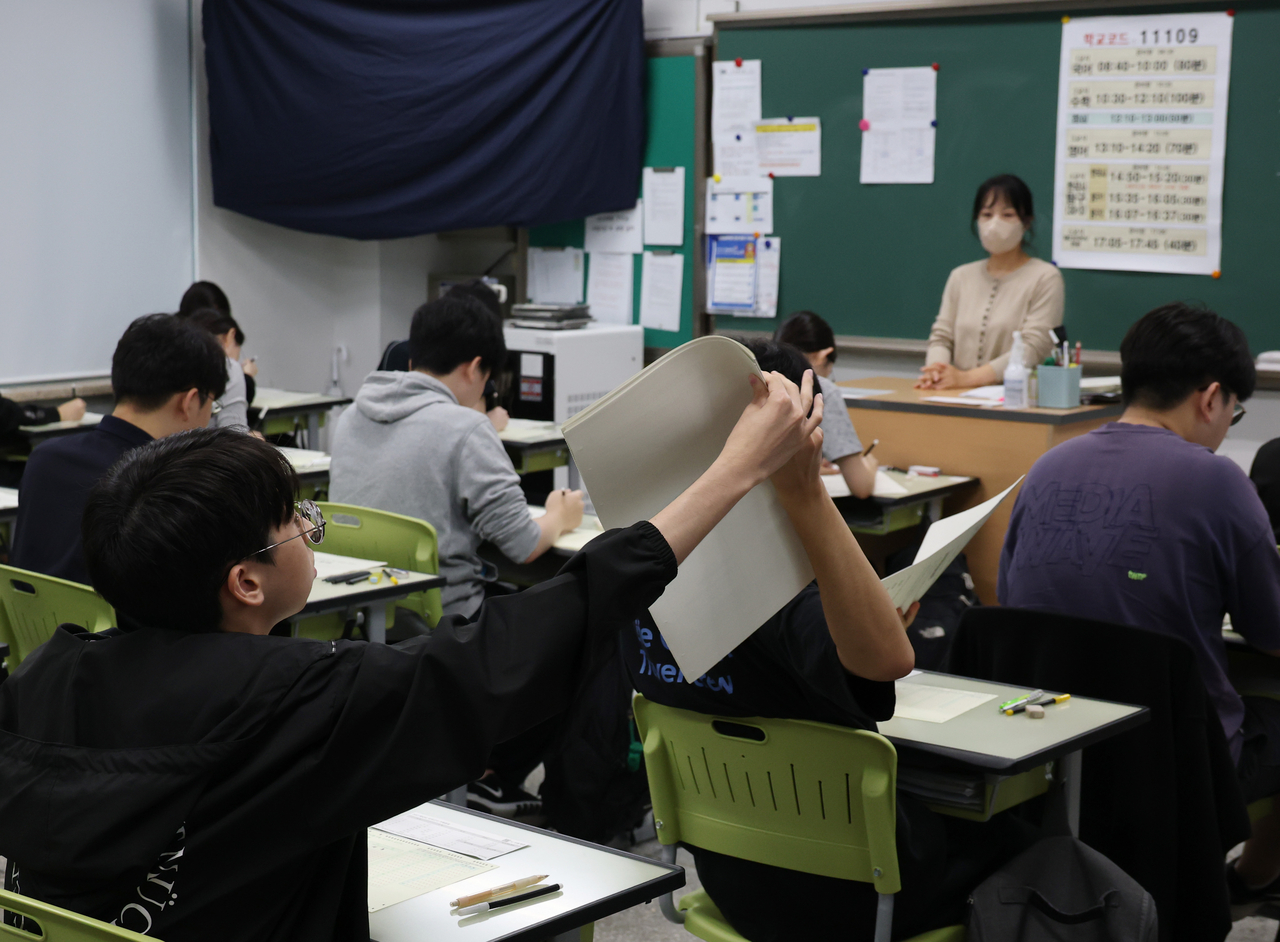
Conditions are set to favor current high school students over repeat exam-takers in the 2028 university admissions cycle, as more major universities move to bar graduates from their school record-based tracks.
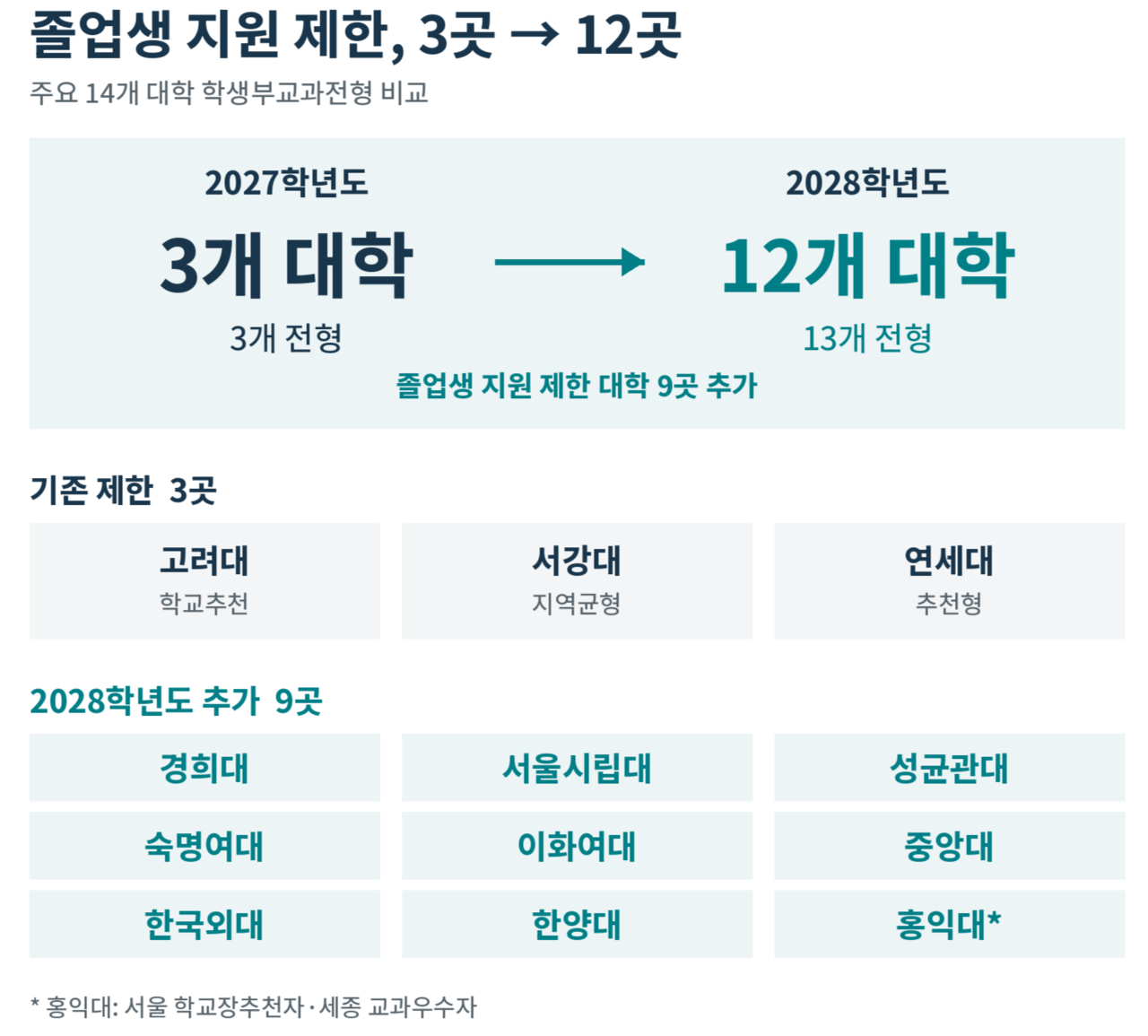
An analysis by Etoos Edu of admissions plans at 14 major universities for the 2028 cycle found that 12 schools — across 13 separate tracks — will restrict graduates from applying to their school record-based admissions programs. That is up from three universities and three tracks in the 2027 cycle.
Previously, only Korea University's school recommendation track, Sogang University's regional balance track and Yonsei University's recommendation track barred graduates from applying. Starting with the 2028 cycle, nine more universities will join them: Kyung Hee University, University of Seoul, Sungkyunkwan University, Sookmyung Women's University, Ewha Womans University, Chung-Ang University, Hankuk University of Foreign Studies, Hanyang University and Hongik University. Hongik University will apply the restriction to two tracks — the principal's recommendation track at its Seoul campus and the academic excellence track at its Sejong campus.
Current students will no longer have to compete against graduates who may carry stronger grade point averages. However, barring graduates does not necessarily lower admission cutoff scores, as each university's enrollment quota and the volume of current-student applications also play a role.
The standard for interpreting internal grades is also changing. Under the new 5-tier grading system taking effect for the 2028 admissions cycle, the top 10 percent of students will receive a first-tier grade, and the top 34 percent will fall within the first two tiers. Under the existing 9-tier system, those thresholds stood at 4 percent and 11 percent, respectively. Because more students will share the same tier, direct comparisons with past admission cutoffs will be difficult.
When selecting which universities to apply to, students should first check which subjects each school counts toward its grade calculation. Dongguk University excludes common-curriculum subjects from its scoring and instead counts the top 10 subjects — drawn from Korean, mathematics, English, social studies and science — for which both a class rank and an achievement grade are available. Students whose first-year grades were low but who improved in their second and third years may want to consider applying there.
Some universities also factor in a document review alongside internal grades. Dongguk University combines academic grades at 70 percent with a document review at 30 percent. The University of Seoul's regional balanced selection track and Hanyang University's recommendation track both select students on a 60-40 split between grades and document review. Applicants to these schools need to understand not only what grade tier is expected but also what the document review evaluates.
Even strong internal grades will not guarantee admission if an applicant fails to meet the minimum College Scholastic Ability Test score requirement. Excluding applicants who do not clear that threshold can significantly reduce the effective competition ratio. In the 2026 admissions cycle, Kyung Hee University's regional balance track posted an initial competition ratio of 8.18 to 1; once only applicants who met the CSAT minimum were counted, the effective ratio dropped to 5.22 to 1. The University of Seoul's regional balanced selection track fell similarly, from 11.27 to 1 to 7.96 to 1.
Whether a CSAT minimum applies will also vary by school in the 2028 cycle. Konkuk University will introduce a CSAT minimum requirement for its grade-based track for the first time, while Korea University will drop its CSAT minimum across all departments except its medical school. Students should assess whether their strengths lie in their internal grades or their CSAT performance before deciding where to apply.
Kim Byung-jin, director of the Etoos Education Assessment Research Institute, advised students to build their application strategy by weighing not only graduate restrictions but also how academic grades are calculated, what document reviews entail and whether a CSAT minimum applies. "Admissions plans are subject to change, so applicants should also check the final recruitment guidelines when they are released," he added.
brunch@heraldcorp.com