Seoul AI Foundation report on AI awareness and public perception
More than half say they understand AI concepts; 7.7% have heard of it but don't know what it is
Understanding rate: 64% among those in their 20s vs. 35.8% among those in their 60s — a gap of nearly 30 percentage points
By education: 69% among those with master's or doctoral degrees vs. 29.2% among high school graduates or below — a gap of about 40 percentage points
85.1% have used generative AI; 63.2% use it daily
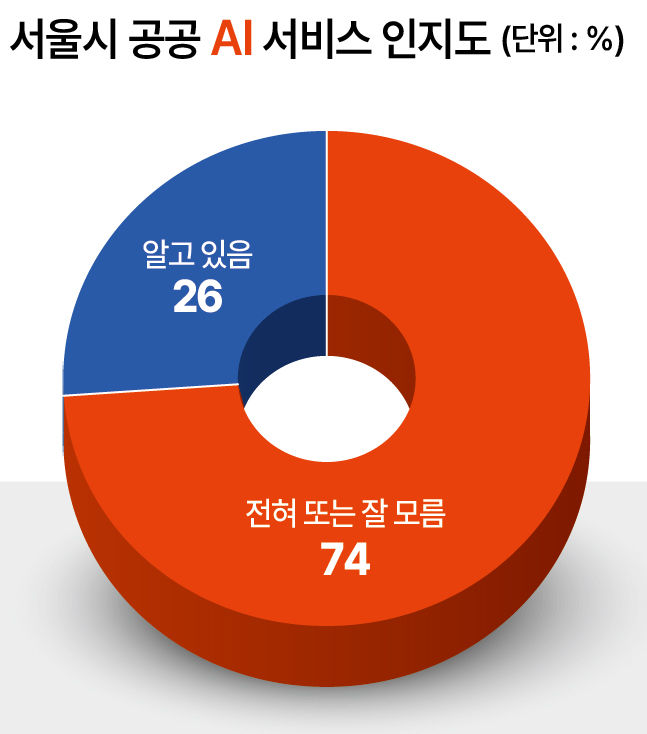
74% unaware that Seoul offers public AI services such as chatbots
More than half of Seoul residents are aware of artificial intelligence, but three in four have no idea the city offers public AI services such as its chatbot Seoul Talk and a public data chatbot, according to a new report — findings that point to an urgent need for better outreach.
The report also found that AI comprehension rates vary by as much as 30 to 40 percentage points depending on age and education level, highlighting the need to close the digital divide.
The Seoul AI Foundation recently released its "Seoul Metropolitan Government AI Status and Citizen Awareness Survey Report." The foundation conducted the survey to inform the development of the "2027–2029 Seoul Metropolitan Government AI Master Plan."
The survey was conducted online in June this year among 5,640 Seoul residents between the ages of 19 and 69. Respondents were selected in proportion to the population of each autonomous district and were broken down by gender, age, household type, occupation, income and education level.
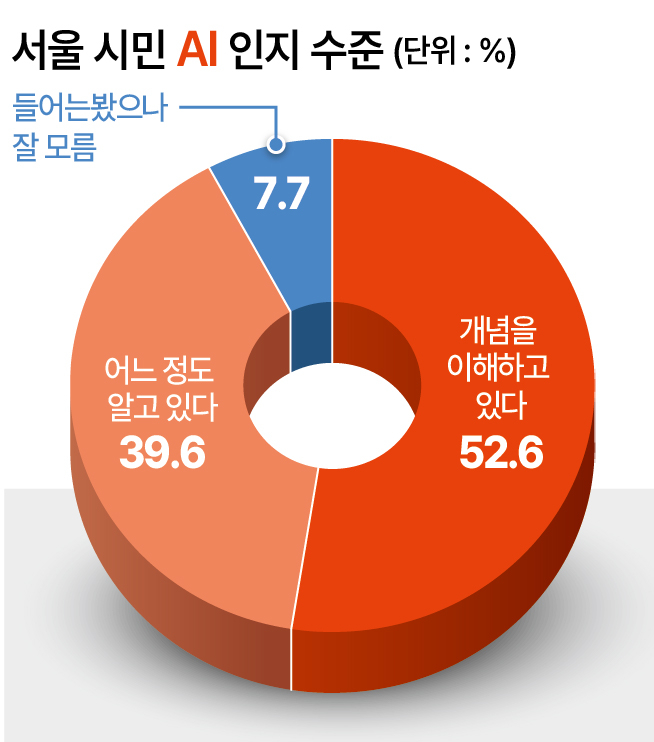
The survey found that 52.6% of Seoul residents said they understand the concept of AI, while another 39.7% said they know it to some degree. Only 7.7% said they had heard of AI but did not really know what it was.
By age group, those in their 20s had the highest comprehension rate at 64%, while those in their 60s had the lowest at 35.8% — a gap of 28.2 percentage points. By gender, the difference was negligible: 53.4% for men and 51.8% for women. By education, those with master's or doctoral degrees reported a 69% comprehension rate, compared with 29.2% for high school graduates or below — a gap of about 40 percentage points.
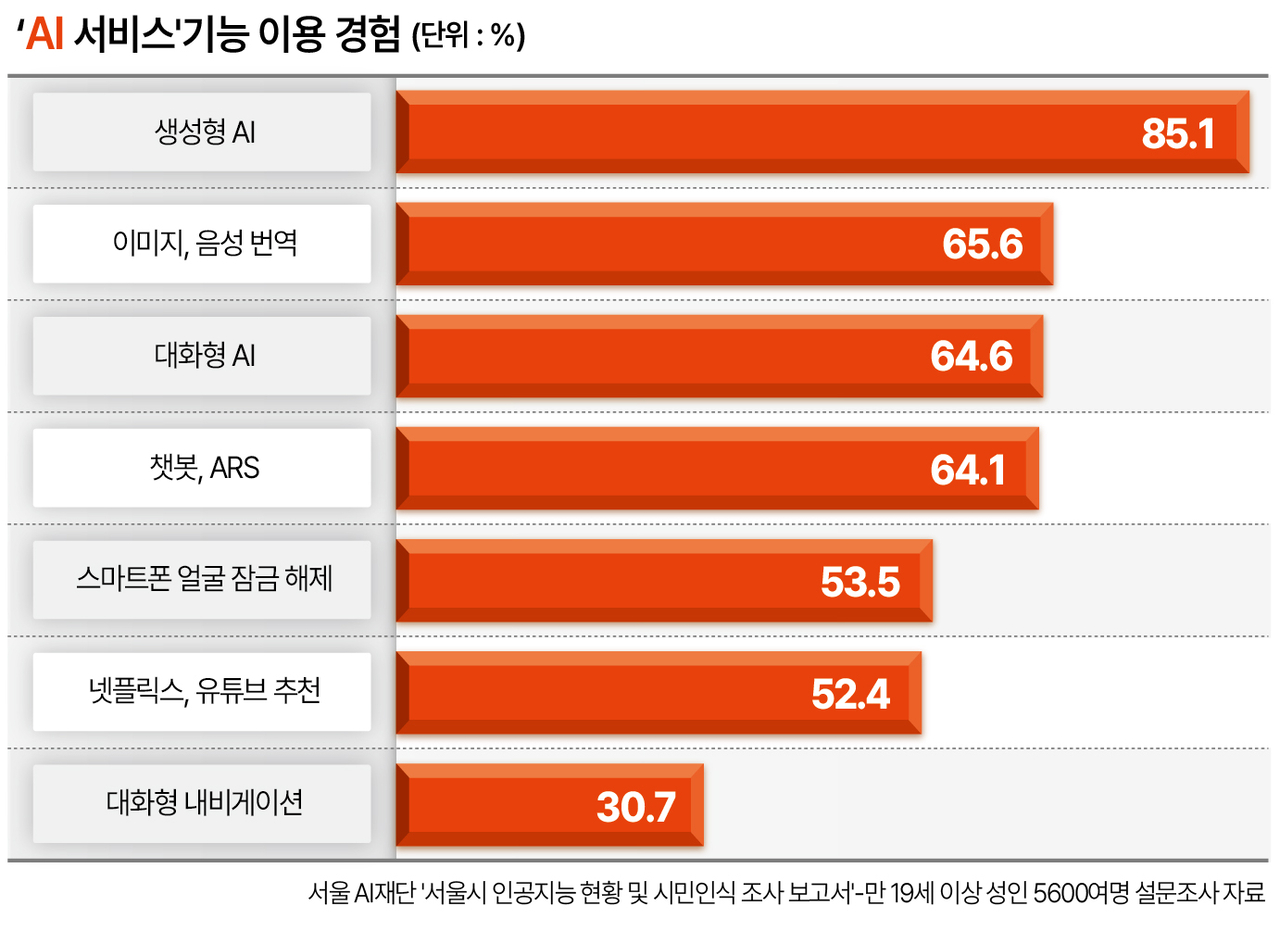
When asked about experience using AI services or features, generative AI tools such as ChatGPT and Gemini ranked highest at 85.1%, followed by image and voice translation (65.6%), conversational AI (64.6%) and chatbots and automated response systems (64.1%). Only 1.2% said they had not used any AI service. By age group, those in their 20s and 30s used generative AI at a rate of 91%, about 23 percentage points higher than those in their 60s at 68.3%.
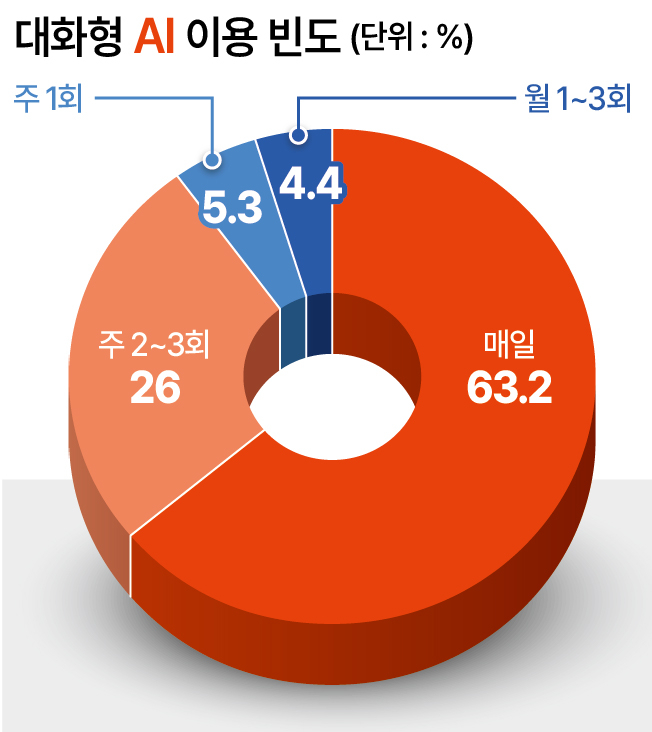
The foundation also asked how often residents use generative AI. Daily use was the most common at 63.2%, followed by two to three times a week (26.0%) and once a week (5.3%). The top purposes were information search (48.6%), improving work efficiency (32.4%) and learning and self-development (9.3%).
The survey also examined conversational AI usage. Daily use was the most common at 48.5%, followed by two to three times a week (26.3%) and once a week (9.9%). The top purposes were information search (48.3%), lifestyle convenience (30.6%) and media content playback and control (8.5%).
The foundation asked residents whether they were aware of Seoul's public AI services, including Seoul Talk. Some 74% were unaware that such services existed — 33.1% said they had no knowledge at all and 40.9% said they were largely unaware. The average awareness score on a 100-point scale was just 26.3, indicating broadly low recognition.
Residents were also asked about their experience using specific Seoul city AI services. Usage rates were highest for Seoul-type healthcare AI (45.3%), followed by AI chatbot civil complaint guidance (19.4%) and automated AI civil complaint response (18.3%). Some 32.3% said they had not used any of the services.
Despite low awareness, residents expressed support for public AI services. The services they most wanted introduced were an AI disaster and crisis forecasting system (25.4%), AI urban facility safety management (18.9%) and AI chatbot civil complaint response and guidance (18.2%). Some 80% of respondents said they support the expansion of public AI services.
When asked what goals public AI services should pursue, "strengthening citizen convenience services" ranked highest at 35.1%, followed by strengthening the social safety net (30.4%), improving administrative efficiency (12.8%) and creating economic opportunities and jobs (9.4%).
"The AI concept comprehension rate stands at 52.6%, meaning use itself has entered a stage of daily normalization, but a clear generational gap has emerged," the foundation said in the report. "Three in four Seoul residents are unaware that public AI services even exist, confirming that raising awareness and recognition is an urgent task."
The Seoul Metropolitan Government earlier unveiled a vision to become a "global AI innovation-leading city" in February last year and has since pursued talent development, expanded investment and the AI transformation of industry. The city is working to train 10,000 AI professionals a year through programs such as its Youth Employment Academy and university partnership projects, and to establish a 500 billion won ($377 million) AI fund.
In January this year, the city also announced a vision to become a "physical AI-leading city," opening urban spaces as testing grounds for technology and expanding policies to support the on-site application and spread of AI technologies developed by private companies.
ikson@heraldcorp.com