NASDAQ falls 2.60%, Philadelphia Semiconductor Index drops 6.72%
Nvidia down 4.4%, SK hynix ADR off 8%
AI profitability fears compound oil price surge
Market watches fallout from Solidigm IPO cancellation
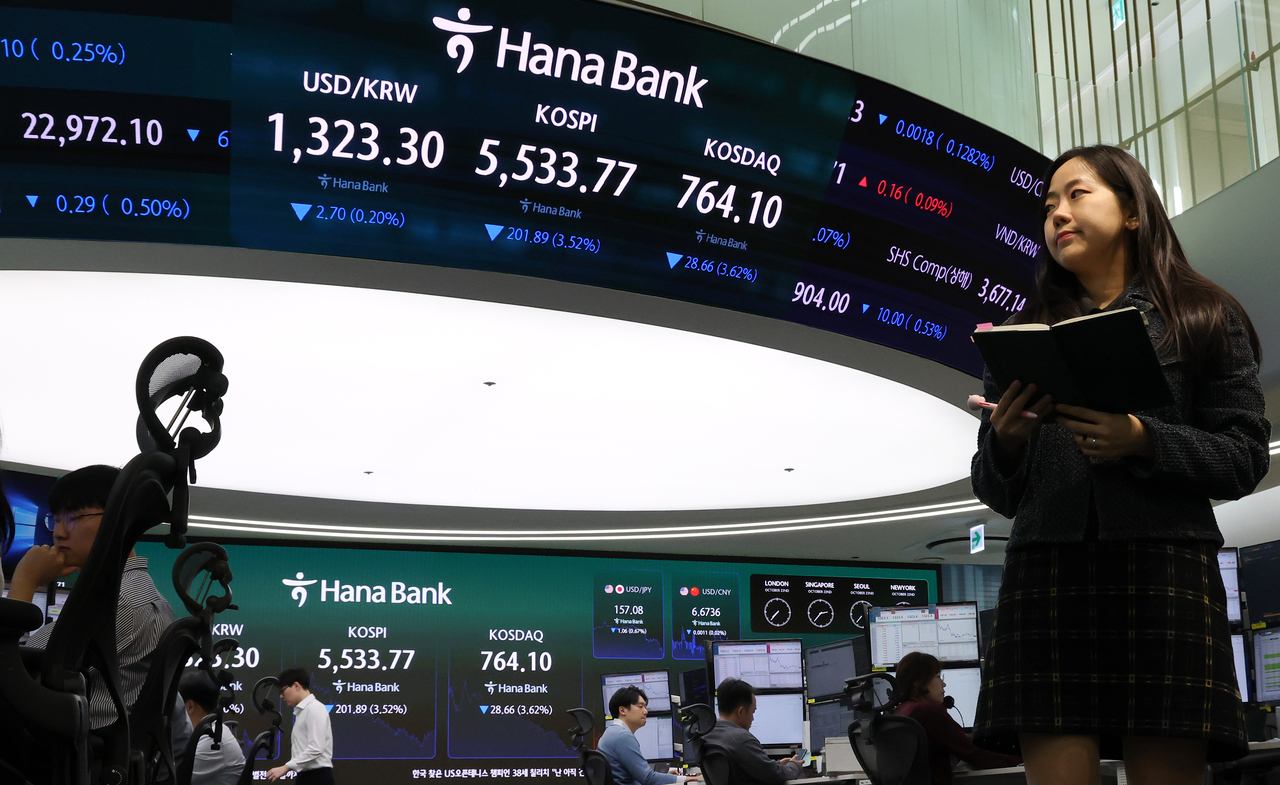
Renewed concerns over AI profitability hammered semiconductor stocks on Wall Street overnight, and analysts expect the domestic market to remain under pressure Friday.
The Kospi closed Thursday down 201.89 points, or 3.52 percent, at 5,533.77.
At the close of the regular session at 3:30 p.m., foreign investors and retail investors were net buyers of 59 billion won ($44.5 million) and 381 billion won, respectively, while institutions were net sellers of 463 billion won. Including after-market trading, foreign and retail net purchases stood at 37.1 billion won and 363.3 billion won, respectively, while institutions remained net sellers at 446.5 billion won.
Several factors converged to weigh on the market: profit-taking following Wednesday's sharp rebound, the conclusion of share buyback programs by Samsung Electronics and SK hynix, lingering doubts about AI infrastructure investment, and growing fears over a Middle East escalation.
It was also the first trading session after Samsung Electronics completed its employee stock-compensation buyback and SK hynix wrapped up its 40 trillion won share buyback and cancellation program — the former earlier this month and the latter on Wednesday — adding a supply-demand overhang to the market.
Samsung Electronics tumbled 4.03 percent and SK hynix fell 5.49 percent.
Overnight on Wall Street, conditions were equally grim. The three major indexes closed mixed amid broad weakness in AI and semiconductor stocks.
The Dow Jones Industrial Average edged up 0.02 percent, while the S&P 500 fell 1.21 percent and the NASDAQ Composite dropped 2.60 percent — the NASDAQ's steepest single-day decline since June.
Seo Sang-young, a managing director at Mirae Asset Securities, said Meta's free cash flow deficit and Tesla's downward revision to its capital expenditure outlook — both reported Thursday — reignited concerns about returns on AI investment. "Meta's five-year credit default swap premium reached an all-time high of 114.79 basis points, reflecting the financial strain now being priced into credit markets as well," he said.
The Philadelphia Semiconductor Index tumbled 6.72 percent.
Micron fell 6.26 percent, Nvidia dropped 4.40 percent and Intel lost 8.04 percent. Memory-related names also took heavy losses, with SK hynix's American depositary receipts falling 8.07 percent and SanDisk declining 8.51 percent.
A surge in crude oil prices driven by heightened Middle East tensions added further downward pressure on equities.
Brent crude futures on the London ICE exchange settled up 4.00 percent at $113.17 per barrel, the highest level since May. West Texas Intermediate for December delivery rose 2.39 percent on the New York Mercantile Exchange.
Indicators tracking Korean market sentiment fell across the board. The MSCI Korea ETF dropped 4.98 percent and the MSCI Emerging Markets ETF fell 2.91 percent. The Russell 2000 index and the Dow Jones Transportation Average bucked the trend, rising 0.11 percent and 1.87 percent, respectively. KOSPI 200 overnight futures fell 2.64 percent.
However, some market participants expressed cautious optimism that SK hynix's announcement halting its review of a NASDAQ listing for its subsidiary Solidigm could provide a positive catalyst for SK hynix shares and the broader Kospi.
SK hynix disclosed at around 7:30 a.m. Friday that "Solidigm has been reviewing various financing options to expand production capacity and strengthen competitiveness, but has decided to halt its review of a pre-IPO and initial public offering after comprehensively considering capital market conditions and other factors."
Market participants had long worried that a Solidigm IPO would amount to a de facto dual listing and, if realized, could dilute shareholder value in SK hynix.
Some analysts also noted that concerns over big tech's continued AI spending and related credit risks had already been partially priced in through Thursday's sharp domestic market selloff, suggesting the downside Friday may be more limited than feared.
Han Ji-young, a researcher at Kiwoom Securities, said the domestic market was likely to open lower on the back of the US AI stock correction triggered by Meta's credit concerns and higher oil prices. "The negative fallout from Meta has already been partially priced in by the domestic market the previous day, and the case for oversold conditions remains valid," she added.

yuni@heraldcorp.com