Vacancy rate at local investment and grant agencies stands at 13.5% — nearly three times that of local public enterprises
875 agencies excluded from legal mandate; only 8 of 17 cities and provinces apply local ordinances
Researchers call for expanding coverage and easing hiring barriers rather than raising the quota
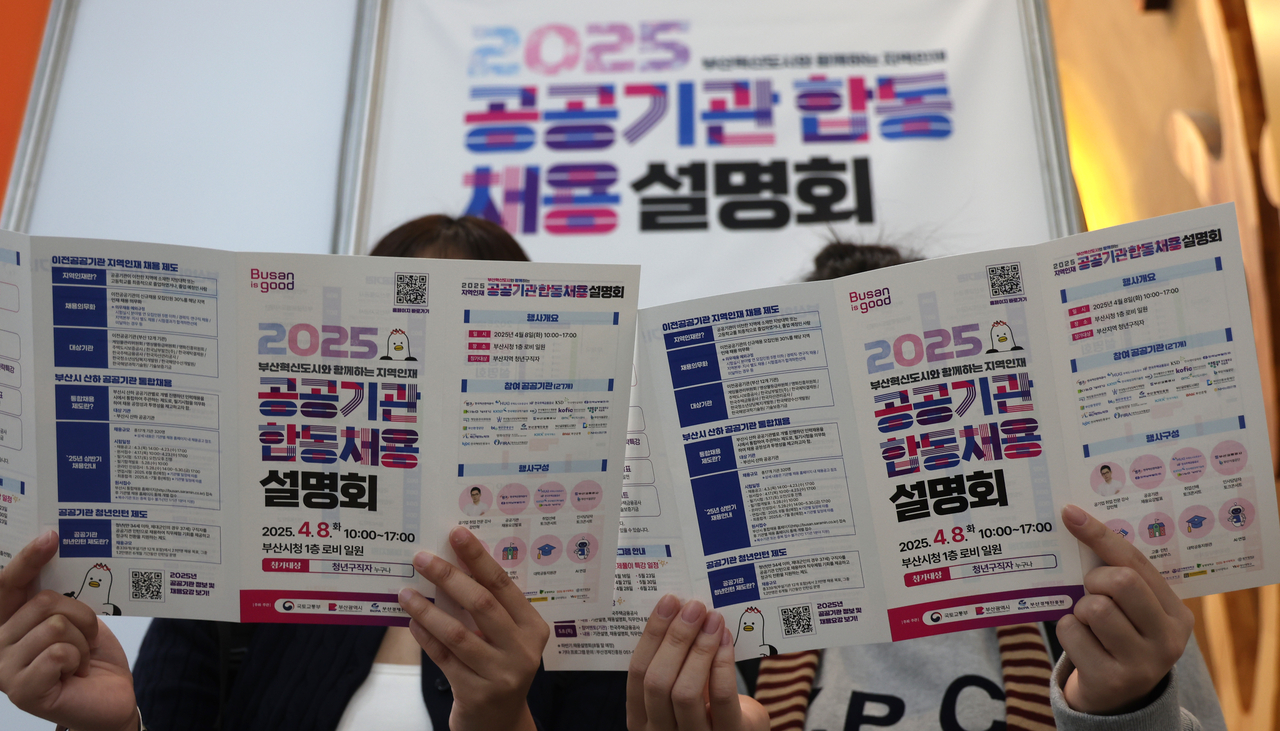
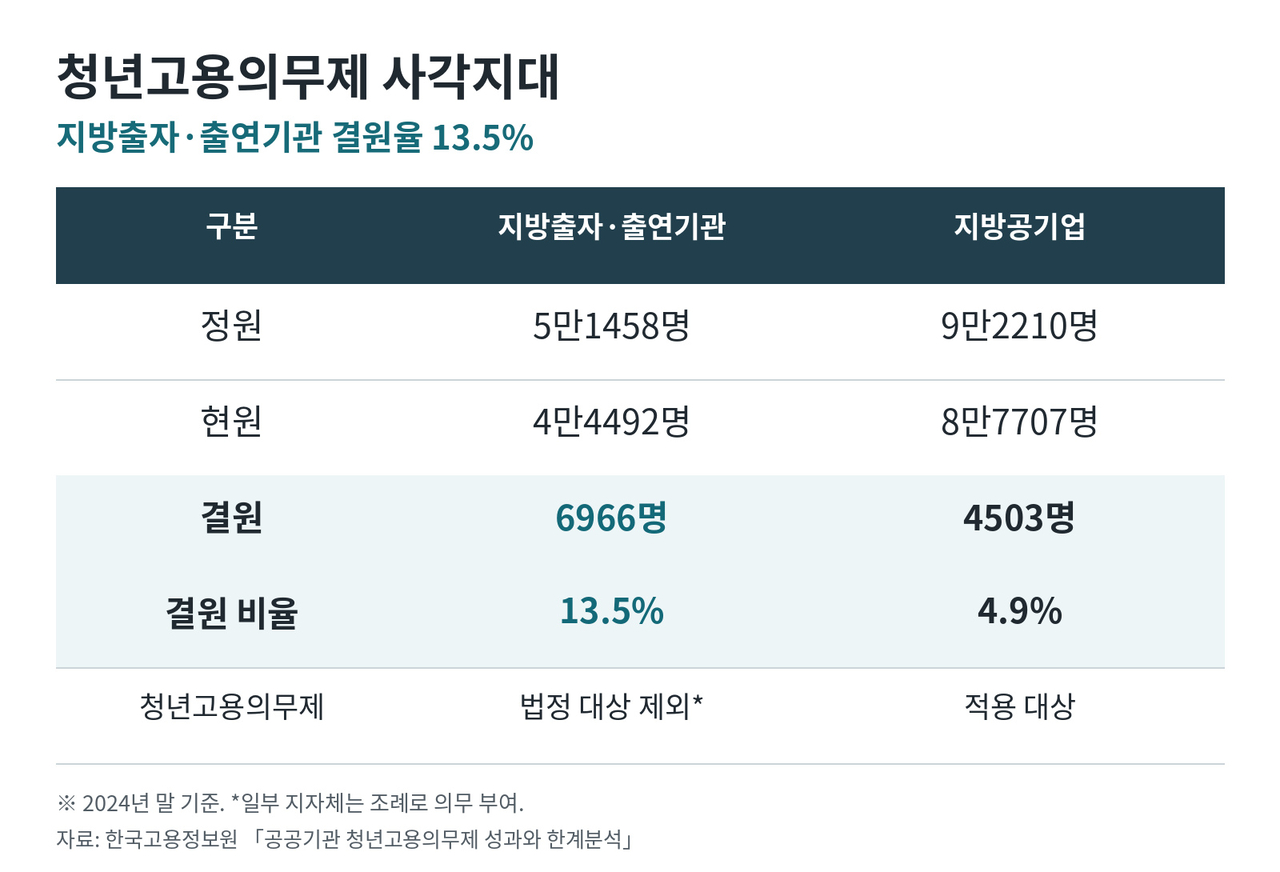
Even amid a serious youth unemployment crisis, roughly 7,000 authorized positions at local investment and grant agencies — including regional medical centers — remain unfilled. The vacancy rate stands at 13.5% of total authorized headcount, yet these agencies fall outside the legal scope of the youth employment mandate that applies to public institutions and local public enterprises. Researchers say expanding the system and removing local governments' budget barriers has become urgent.
According to a report released Friday by the Korea Employment Information Service — titled "Performance and Limitations of the Public Institution Youth Employment Mandate" — local investment and grant agencies had an authorized headcount of 51,458 and an actual workforce of 44,492 as of end-2024, leaving 6,966 positions vacant. The 13.5% vacancy rate is roughly three times that of local public enterprises, which recorded 4,503 vacancies, or 4.9%.
7,000 posts sit empty, but youth hiring obligations vary by region
Under the Special Act on Promoting Youth Employment, public institutions and local public enterprises are required to hire youth job-seekers for at least 3 percent of their authorized positions each year. Local investment and grant agencies, however, are excluded from that legal requirement.
As of September 2025, 875 such agencies exist nationwide. Some local governments have imposed the obligation through municipal ordinances, but only 8 of the country's 17 cities and provinces have done so — meaning agencies of the same type face different obligations depending on where they are located.
The mandate has shown some effect in expanding youth hiring. Among three agencies newly designated as public institutions in 2022, the share of youth in new hires rose from 55.9% in 2020 to 76.8% in 2022. However, because authorized headcount and project scale also grew over the same period, the researchers cautioned that the increase cannot be attributed entirely to the mandate. Statistical analysis suggested a positive effect, but it did not reach the conventional 5 percent significance level.
The researchers estimated that extending the mandate to local investment and grant agencies — and bringing their vacancy rate down to the level seen at local public enterprises — could create approximately 3,800 additional youth jobs. They noted, however, that this figure is an estimate based on the assumption that existing vacancies would be filled, and does not mean all 6,966 vacant posts are immediately available or that 3,800 hires would follow automatically from expanding the mandate alone.
Raising quota to 5% alone won't work — headcount caps and wage costs must be addressed
Calls have emerged from political circles to raise the mandatory youth hiring ratio from the current 3 percent to 5 percent, but the barriers on the ground are steep.
A simulation using 2024 data showed that applying a 5 percent threshold would push the number of non-compliant institutions to 251, or 51.1 percent of the total — a sharp increase from the 97 institutions, or 19.8 percent, that fell short under the 3 percent standard. The simulation did not account for exemptions such as restructuring. In practice, 76 institutions were officially recorded as non-compliant in 2024 after 21 were granted exemptions. Interviews with 18 public institutions found that all expressed concern about a rise to 5 percent, saying hiring volume is driven by retirements and headcount increases, making it difficult to expand new recruitment without growth in authorized positions.
The formula used to calculate the mandatory ratio was also flagged as a problem. The current authorized headcount includes not only the standard budgeted positions but also separate slots for wage-peak employees and flexible positions, meaning that even when an institution independently expands youth hiring, the denominator grows alongside it. Most institutions said they would welcome a calculation based on budgeted positions alone. Even so, the researchers estimated that changing the formula while raising the ratio to 5 percent would still leave 239 institutions, or 48.7 percent, in non-compliance. A separate proposal to set a 70 percent youth share among new hires also fell short, with 142 institutions failing to meet that threshold.
One alternative identified for expanding hiring capacity was filling parental leave vacancies with permanent staff. Regional medical centers have worked with local governments to hire permanent replacements when nurses go on parental leave, and the researchers found this had a positive effect on expanding permanent youth employment. Some local public enterprises, however, said their local governments had not approved the practice and were pursuing individual negotiations.
Institutions also called for stronger support from the Ministry of Employment and Labor. Many public institutions said they were not receiving ministry support, and agencies that had relocated to innovation cities pointed to a shortage of National Competency Standards-aligned education for local talent. Researchers said youth hiring consulting, job-training programs linked to regional universities, and expanded work-experience support should all be strengthened.
Ha Tae-wook, head of the Health Jobs Research Institute, which conducted the study, said the scope of the mandate should be extended to local investment and grant agencies, and that support functions for public institutions and universities should be explicitly codified in law.
fact0514@heraldcorp.com