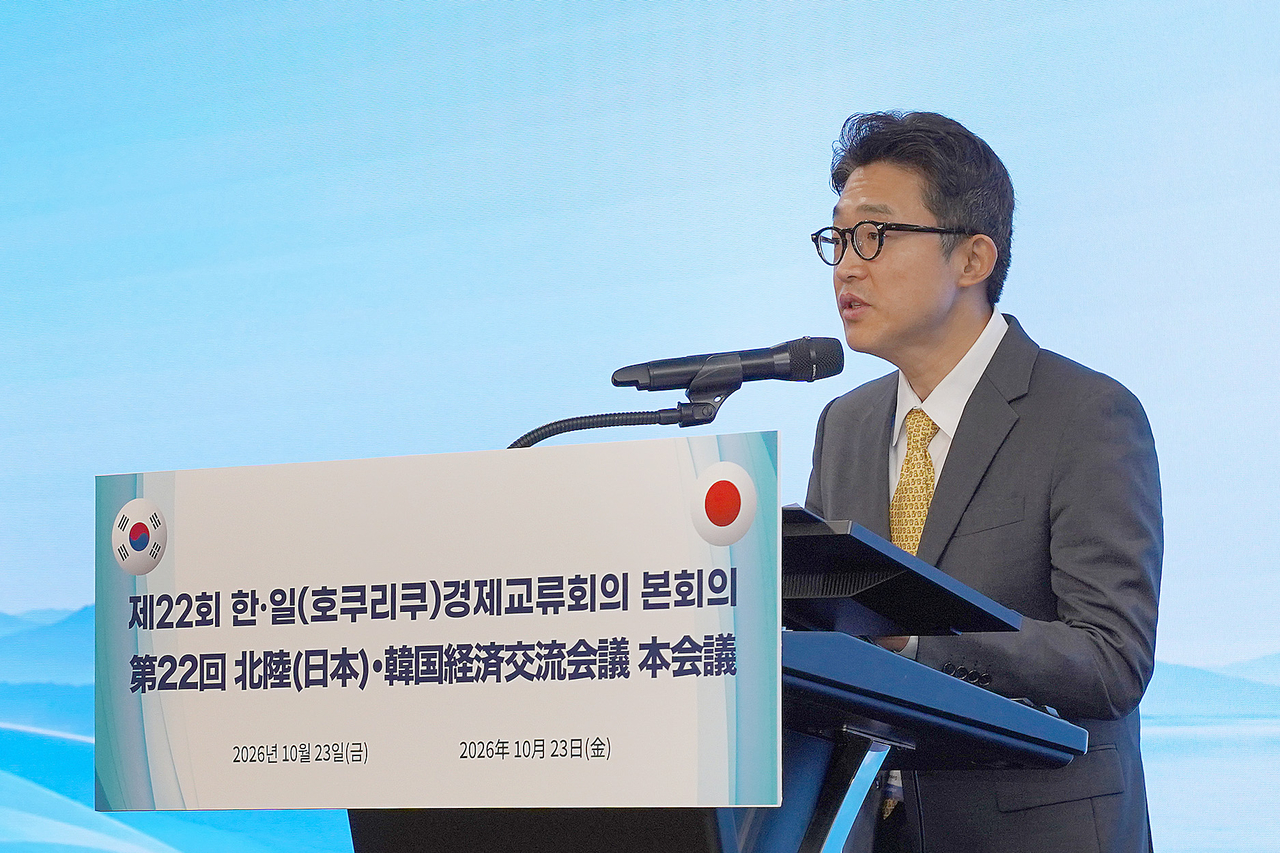
22nd Korea-Japan Hokuriku Economic Exchange Conference
South Korea and Japan are expanding cooperation in future industries — including advanced materials, AI and robotics — drawing on each region's manufacturing strengths as the two countries mark the 60th anniversary of diplomatic normalization.
The Ministry of Trade, Industry and Energy co-hosted the 22nd Korea-Japan (Hokuriku) Economic Exchange Conference with Japan's Chubu Bureau of Economy, Trade and Industry at the Daegu Marriott Hotel on Friday, discussing ways to deepen cooperation between local governments and businesses on both sides.
The Chubu Bureau is one of eight regional bureaus under Japan's Ministry of Economy, Trade and Industry, overseeing five prefectures in the central region: Aichi, Gifu, Mie, Toyama and Ishikawa.
About 150 officials and business representatives from both countries attended the conference, which was jointly organized by the Korea-Japan Economic Association, the Hokuriku Economic Federation and the Hokuriku Association for the Japan Sea Economic Area (AJEC). The Hokuriku Economic Federation is an umbrella body for the three Hokuriku prefectures of Toyama, Ishikawa and Fukui, while Hokuriku AJEC is an industry-government-academia consultative body focused on international trade and investment.
The Korea-Japan (Hokuriku) Economic Exchange Conference has served as a longstanding regional economic cooperation channel since 2000 — with a pause during the COVID-19 pandemic — bringing together local governments and businesses from South Korea's Daegu, Ulsan, Gangwon Province and North Gyeongsang Province with their counterparts in the three Hokuriku prefectures of Toyama, Ishikawa and Fukui across trade, investment and industrial technology.
This year's conference centered on the theme "Beyond the 60th Anniversary of Diplomatic Normalization — Into Action," with a focus on pursuing concrete cooperation in future industries.
In advanced materials, North Gyeongsang Province's Technopark and Japan's Tsudakoma Industries, among others, discussed plans for joint research and technology exchange in carbon fiber composites.
In AI and robotics, cloud software company Tilon and robot automation solutions firm IM Robotics each presented case studies — one on AI-driven workplace transformation and the other on smart factory applications using autonomous mobile robots.
The two sides also exchanged views on building industrial clusters and addressing regional depopulation as part of broader efforts to sustain local economic vitality.
"Cooperation between local governments and regional businesses on both sides is essential for Korea-Japan economic ties to advance further," said Bae Jun-hyung, director general for trade cooperation at the Ministry of Trade, Industry and Energy. "We will actively support efforts to connect the strengths of each region's industries and create new growth opportunities."
oskymoon@heraldcorp.com