Defense Committee holds national audit of Army, Navy and Air Force academies
Hwang Myeong-seon: 'Commander education must change as the battlefield changes'
Han Ki-ho: 'Academies already provide joint and advanced-technology education'
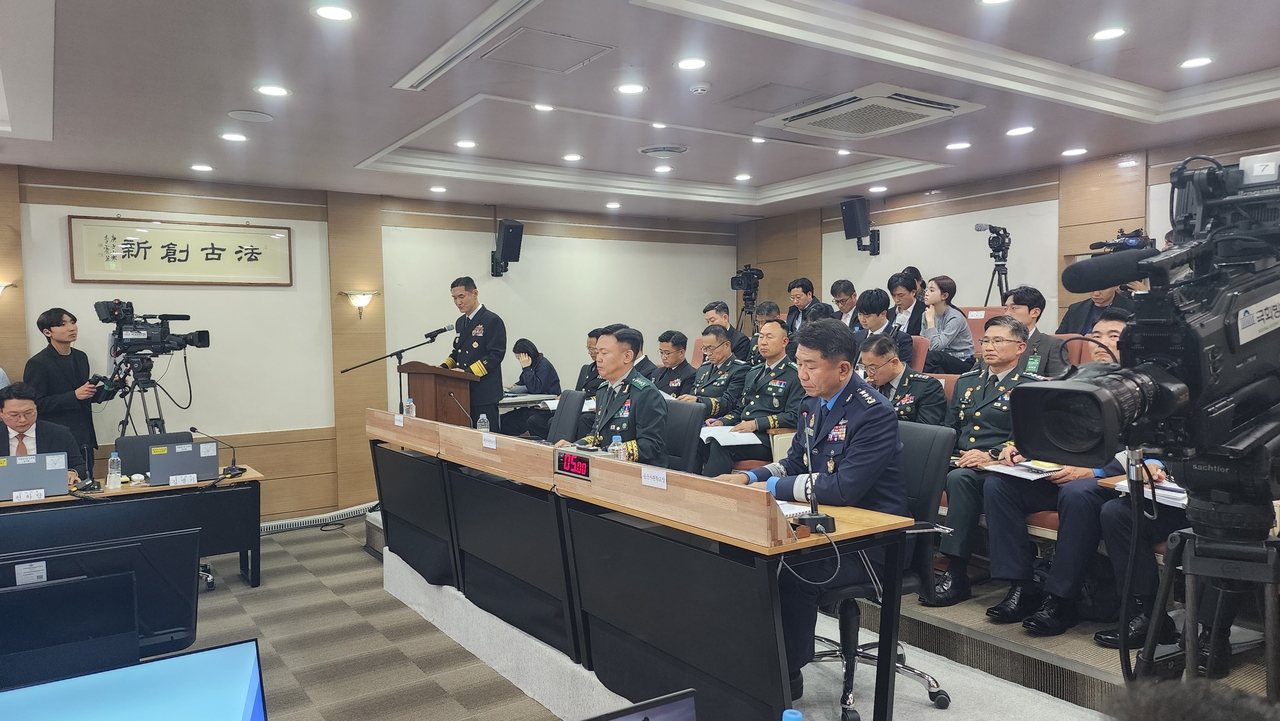
A proposal to merge the Army, Navy and Air Force academies came under scrutiny Thursday at a National Assembly Defense Committee national audit. The ruling party, which says officer training must be overhauled to prepare for future warfare, clashed with the opposition, which argues there is no need to merge academies that already provide joint and advanced-technology training.
The Defense Committee convened the audit at the Korea Military Academy in Seoul, with Korea Military Academy Superintendent Park Hu-seong, Korea Naval Academy Superintendent Park Gyu-baek and Korea Air Force Academy Superintendent Park Heung-jae in attendance. Lawmakers examined the feasibility of the government's academy merger plan and how branch-specific expertise would be maintained under any consolidated structure.
Democratic Party of Korea lawmaker Hwang Myeong-seon said drones, unmanned systems, electronic warfare and AI are transforming the nature of war and argued the merger is necessary. "Commanders who can connect information across the Army, Navy and Air Force and understand both the potential and the limits of technology will determine the outcome of battles," Hwang said. "That is precisely why we are pursuing the integration of the three academies."
Hwang said shared and similar curriculum areas account for 52 percent of the total across the three academies, rising to as much as 76 percent when general major coursework is included. "The similarity in liberal arts courses reaches 95.4 percent," he said, adding that cadets from all three branches "are in effect already being educated on the same humanistic and scientific foundation."
Korea Military Academy Superintendent Park acknowledged the overlap in liberal arts courses but said differences emerge at the level of detailed content and major coursework. "Each branch and each academy teaches with its own distinct characteristics in mind," Park said.
Hwang said the merger should not weaken branch-specific expertise but rather strengthen both common and specialized education simultaneously. "As the battlefield changes, commander education must change too," he said. "Sharing faculty and facilities would broaden cadets' choices and deepen the quality of their education."
All three superintendents expressed agreement with the broader goal of expanding joint education and deepening understanding of other branches' information and operational environments. Park said he agreed that "educational innovation and reform at the academies to prepare for the future is necessary."
People Power Party lawmaker Han Ki-ho pushed back, saying the briefings from the three academies had in fact reinforced his view that a merger is unnecessary. "After hearing the reports from all three academies, I am more convinced than ever that integration is not needed," Han said. "They are already providing in-depth joint education and quite rigorous training in advanced technologies, including AI."
Han also raised cadet opposition to the plan, noting that 91.3 percent of cadets are against the merger. "Why are the superintendents staying silent?" he demanded. He added that while military personnel must remain politically neutral, "that neutrality does not mean bowing your head without a soul when the roots of the military and the foundations of national security are being shaken in the wrong direction."
Meanwhile, each academy outlined plans to strengthen future-warfare education in AI and drones. The Korea Military Academy reported initiatives to enhance AI education and drone operation capabilities; the Naval Academy said it would pursue drone certification for all cadets and expand training in unmanned surface vessels and unmanned submarines; and the Air Force Academy presented plans for AI education reform and aerospace specialization.
rimsclub@heraldcorp.com