Ministry of Land, Infrastructure and Transport comprehensive national audit
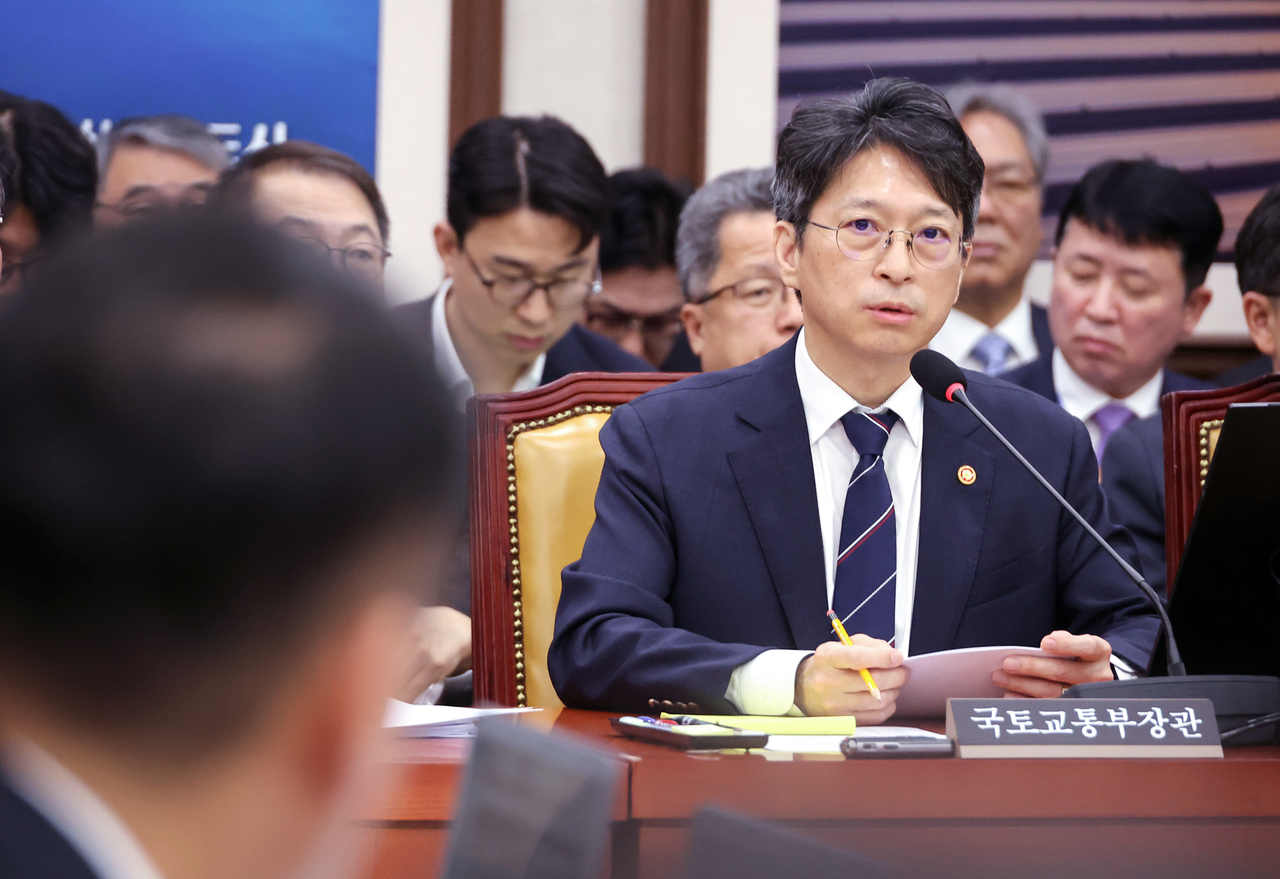
Land Minister Hong Ji-seon said the government is preparing measures to address a range of market conditions — including sharp price drops or surges — amid growing concerns over rising apartment prices in the Greater Seoul area and a tightening jeonse market.
Hong made the remarks Friday morning at the National Assembly's Land, Infrastructure and Transport Committee comprehensive national audit, responding to People Power Party lawmaker Kang Dae-sik, who asked whether the ministry was working on measures to address rising apartment prices in the metropolitan area. "We are working on them now," Hong said.
According to the Korea Real Estate Board's weekly apartment price survey for the third week of this month (as of Monday), Seoul apartment prices rose 0.13 percent, extending a streak of consecutive weekly gains to 89 weeks.
When Democratic Party of Korea lawmaker Jeong Il-young attributed the decline in jeonse supply to tighter regulations on private rental businesses and stricter owner-occupancy requirements, Hong said the picture was more complex. "Regulated zones and land transaction permit zones are limited to Seoul and parts of Gyeonggi Province, but the problem is that jeonse and monthly rent listings are also declining and monthly rents are worsening in regional areas where no such regulations exist," she said.
The remarks were widely interpreted as a signal that the drop in jeonse listings cannot be attributed solely to government measures such as land transaction permit zones or other real estate regulations.
Hong had taken a similar position at an earlier national audit on Oct. 7, saying she believed there was demand for the land transaction permit zone system and that the government would review whether to extend it after monitoring market conditions.
When People Power Party lawmaker Jeong Hee-yong said the government's housing supply plan for this year was falling short of its target by 12 to 19 percentage points and that public trust in real estate policy overall was eroding, Hong acknowledged that private-sector supply was lagging. "It seems the public-sector volume will be achievable to a reasonable degree, but the private-sector volume is not being met properly," she said. "We have a five-year plan in place. We will do our best to make up for it next year."
At its first regular housing supply briefing, held jointly with the Office for Government Policy Coordination on Thursday, the Ministry of Land, Infrastructure and Transport projected it would break ground on between 218,000 and 235,000 units by year-end — representing 81 to 88 percent of its annual target — through remaining groundbreaking of public housing, newly built purchase units and private redevelopment projects. As of the second week of this month, however, only about 99,000 units had broken ground, roughly 37 percent of the target, leaving the ministry well short of its goal.
hss@heraldcorp.com