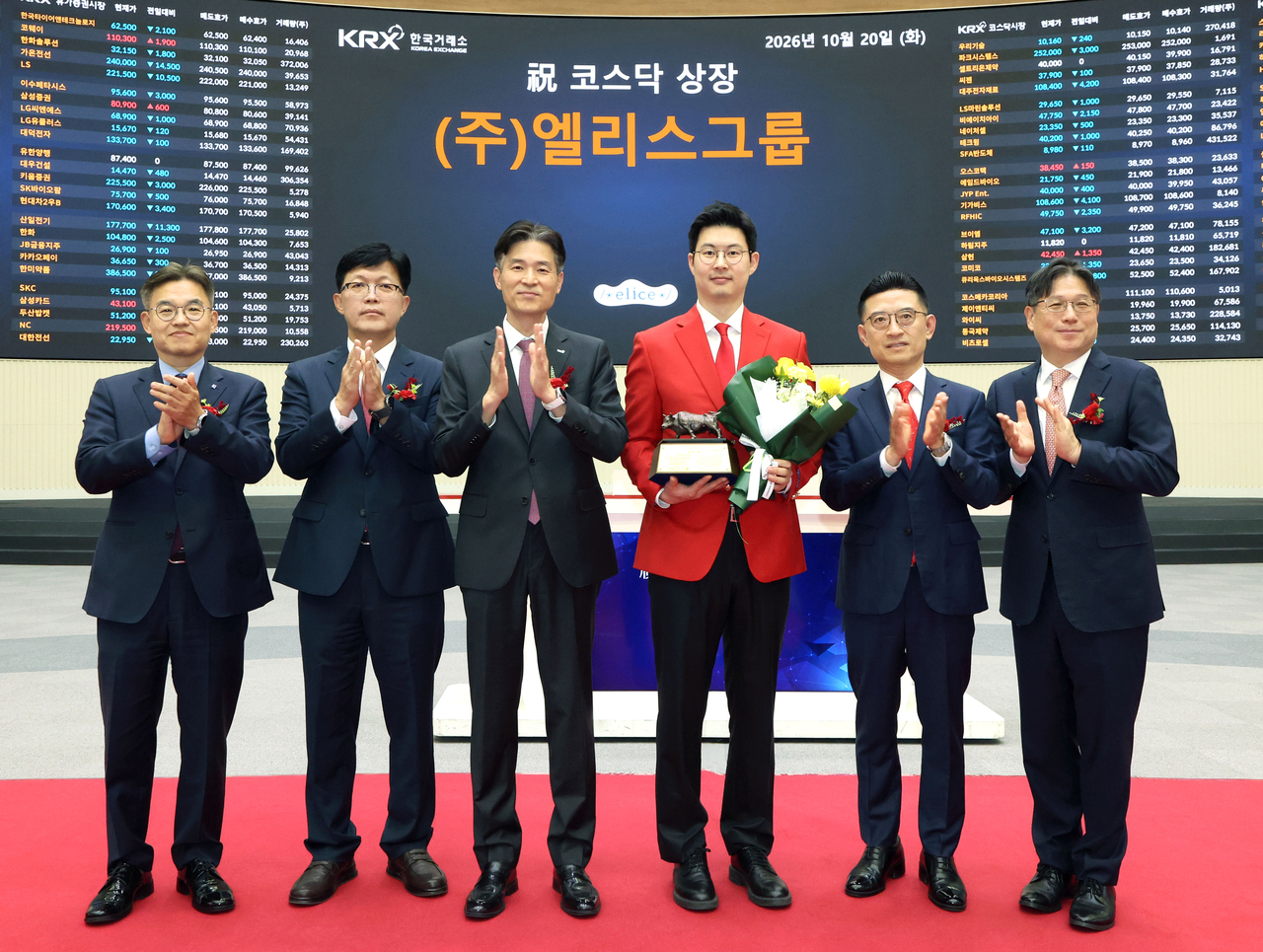
AI infrastructure firm Eliss, whose shares plunged 32 percent on its first day of trading on the Kosdaq, has recovered a market capitalization of 1 trillion won ($755 million) within two days of its listing. Sales more than tripled in the first half of this year, fueling growth expectations, but the company's heavy dependence on public-sector clients and the financing burden of its large capital expenditure plans have emerged as key concerns.
According to the Korea Exchange, Eliss shares were trading at 96,000 won as of 9:22 a.m. Friday, up 2,400 won, or 2.56 percent, from the previous session. The stock dipped as low as 90,100 won in early trading before turning higher and briefly touching 97,000 won. On Thursday, the shares closed up 17.15 percent at 93,600 won, pushing the market capitalization to 1.04 trillion won. The stock had plunged 32.04 percent from its offering price of 90,500 won on Tuesday, its first day of trading, but has since posted gains in two consecutive sessions after hitting the daily upper limit the following day.
The sharp debut-day drop drew attention from international media as well. Bloomberg reported Tuesday (local time) that the sell-off illustrated weakening investor confidence in so-called neo-cloud companies — operators of data centers purpose-built for AI computing. Reuters also reported that investor concerns about AI capital spending are growing. Barron's, the American financial magazine, noted that rapid revenue growth alone may not be enough to dispel worries about high valuations and future financing pressures at AI companies.
Financing pressures from heavy capital investment are already weighing on sentiment across the global AI infrastructure sector. US AI cloud firm CoreWeave faces mounting concerns over its debt load, while some data center companies in Australia — including Parmeus Grid and AirTrunk — have withdrawn or delayed their initial public offerings. Although AI infrastructure firms are growing rapidly, the ability to secure stable funding for capital expenditure has become a key variable for investors.
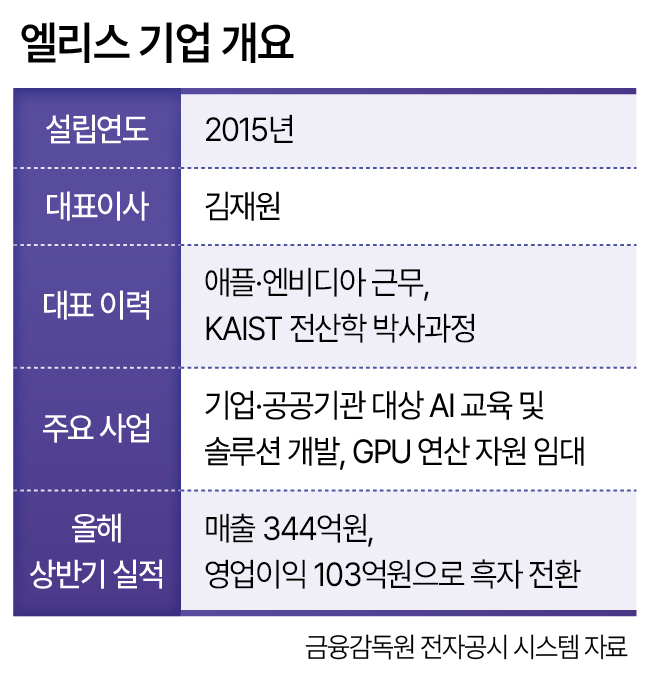
Eliss was founded in 2015 by Kim Jae-won, who previously worked at Apple and Nvidia and completed a doctoral program in computer science at KAIST. The company started as an AI education platform before expanding into GPU-based cloud services. According to Kiwoom Securities, while conventional data centers take 24 to 36 months to build, Eliss's proprietary modular data centers can be deployed in three to six months.
Its financial performance has improved sharply. Sales in the first half of this year reached 34.4 billion won, up 202.2 percent from 11.4 billion won in the same period last year. Operating profit swung from a loss of 3.6 billion won to a profit of 10.3 billion won over the same period. The share of cloud revenue in total sales rose from about 7 percent in 2023 to 76 percent in the first half of this year. The cloud business rents GPU computing resources to customers and charges fees based on usage and contract duration.
Securities industry watchers have taken note of Eliss's scarcity value as a listed domestic AI infrastructure play and its earnings trajectory. "Given how rare it is to invest in a neo-cloud company in Korea, a market capitalization of more than 1 trillion won seems justifiable when you factor in the company's growth potential," said an official at a brokerage firm's proprietary investment desk.
However, the concentration of revenue among a small number of clients is a concern. According to Eliss's investment prospectus, sales to the National IT Industry Promotion Agency in the first half of this year came to about 22.5 billion won, accounting for 65.6 percent of total revenue. Last year, the same client accounted for 13.5 billion won, or 34.3 percent of annual sales. A single top customer also generated 85.9 percent of cloud revenue. Whether the company can convert its government-driven revenue base into private-sector contracts is seen as the key determinant of its long-term growth.
Eliss has not disclosed specific figures for its private-sector revenue share or the scale of its long-term contracts. A company official said it would be inappropriate to provide information beyond what was disclosed in the securities registration statement, adding that details of ongoing contract negotiations with customers could not be shared due to non-disclosure agreements.
Beyond the challenge of expanding its private-sector customer base, the company also faces a significant financing burden from large-scale capital investment. In the first half of this year, Eliss generated 6.7 billion won in operating cash flow while spending 41.3 billion won on property and equipment — more than six times what it earned from operations. The company plans to deploy the approximately 200.9 billion won raised through its IPO into AI infrastructure and cover additional funding needs through cash on hand and borrowings from financial institutions.
The company has also committed to a new facilities investment that exceeds its own equity. On Thursday, Eliss disclosed plans to invest 330 billion won in AI modular data centers and related infrastructure to meet customer demand — equivalent to 114.0 percent of its equity of 289.4 billion won. The investment period runs from Nov. 2 through June 30 next year.
An overhang from early lock-up expirations also looms. According to the prospectus, the expiration of a lock-up period on Nov. 20 — one month after listing — will add 1,328,151 shares, or about 11.9 percent of total shares outstanding, to the freely tradable float. That would raise the proportion of tradable shares from 20.8 percent at the time of listing to 32.7 percent. While not all of those shares are expected to be sold, whether early investors choose to exit is seen as a key variable for the stock's near-term direction.
"There needs to be a process of confirming customer expansion as government contracts — which currently make up the bulk of cloud revenue — transition to private-sector AI cloud deals," said Kim Hak-jun, a researcher at Kiwoom Securities. "Demand for additional financing to fund further infrastructure investment is likely to persist, so investors should be mindful of heightened volatility."

hajun825@heraldcorp.com