City climbs three spots from last year on strengths including clean carriages and affordable fares; CNN also highlights Seoul subway in its own global ranking
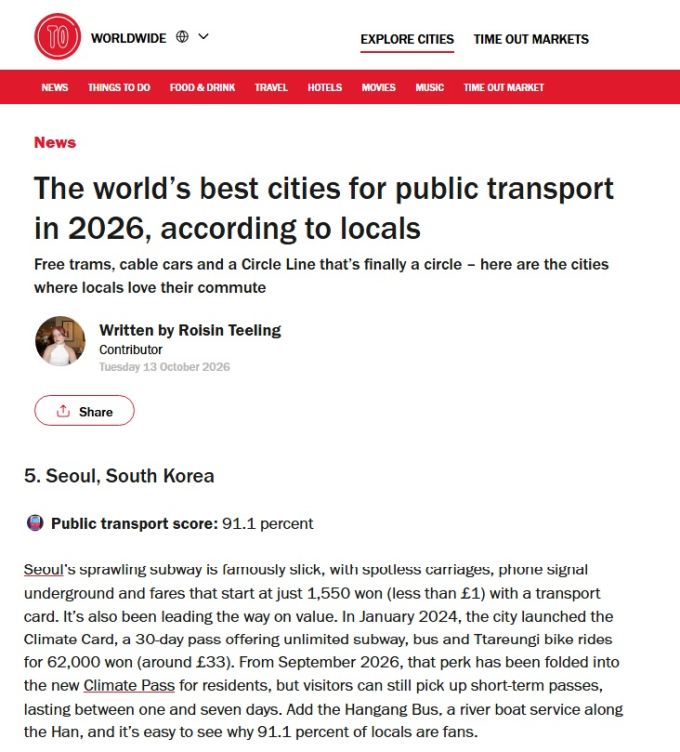
Seoul has been ranked fifth among the world's best cities for public transportation by a British travel media outlet, climbing three spots from eighth place last year. US broadcaster CNN also named the Seoul subway one of the world's top metro systems.
The Seoul Metropolitan Government announced Friday that Seoul placed fifth in Time Out's "Best Cities for Public Transport 2026," published Monday (local time).
In a survey of more than 24,000 people worldwide, 91.1 percent of respondents rated Seoul's public transportation positively, lifting the city three places from eighth last year.
Seoul trailed Taipei (95.0 percent), Singapore (93.5 percent), Hong Kong (92.8 percent) and Edinburgh (92.4 percent) to finish fifth, while outpacing Zurich (sixth, 90.7 percent) and Vienna (seventh, 90.3 percent).
Time Out cited Seoul's dense subway network, clean carriages, reliable mobile connectivity even underground and affordable fares as key strengths. The outlet also highlighted various transit services, including the Climate Card and short-term passes for foreign visitors.
CNN separately spotlighted the Seoul subway. In its "18 Best Subway Systems in the World," published Saturday (local time), the network praised Seoul's cleanliness, safety and efficiency, and drew attention to onboard amenities including air conditioning and heating systems, heated seats and internet access.
The Seoul Metropolitan Government said the recognition reflects years of effort to improve public transit safety and convenience. The city completed installation of platform screen doors at all 262 stations on subway lines 1 through 9 in 2009.
As a result, the annual average number of subway accident fatalities fell from 37.1 between 2001 and 2009 to 0.4 between 2010 and 2024. Last year, there were no such deaths at all.
In addition, the city has been expanding elevator access at subway stations since 2007, and as of the end of last year had secured a "one station, one route" system at all 338 stations under its management — allowing wheelchair users to travel by elevator from street level to the platform without interruption.
More recently, the city introduced automatic safety footboards to prevent passengers from falling into the gap between the platform and train, along with a "tagless" service that processes transit card payments automatically without requiring riders to tap a terminal.
"The global acclaim for Seoul's subway is the result of sustained investment in citizen safety and mobility," said Yeo Jang-gwon, head of the Seoul Metropolitan Government's transportation bureau.
ken@heraldcorp.com