27 central government agencies, 2,995 civil servants set to relocate next year
Only 24 move-in units this year; Sejong tops nation in jeonse price gains
Next year's supply backloaded to second half; government weighing expansion
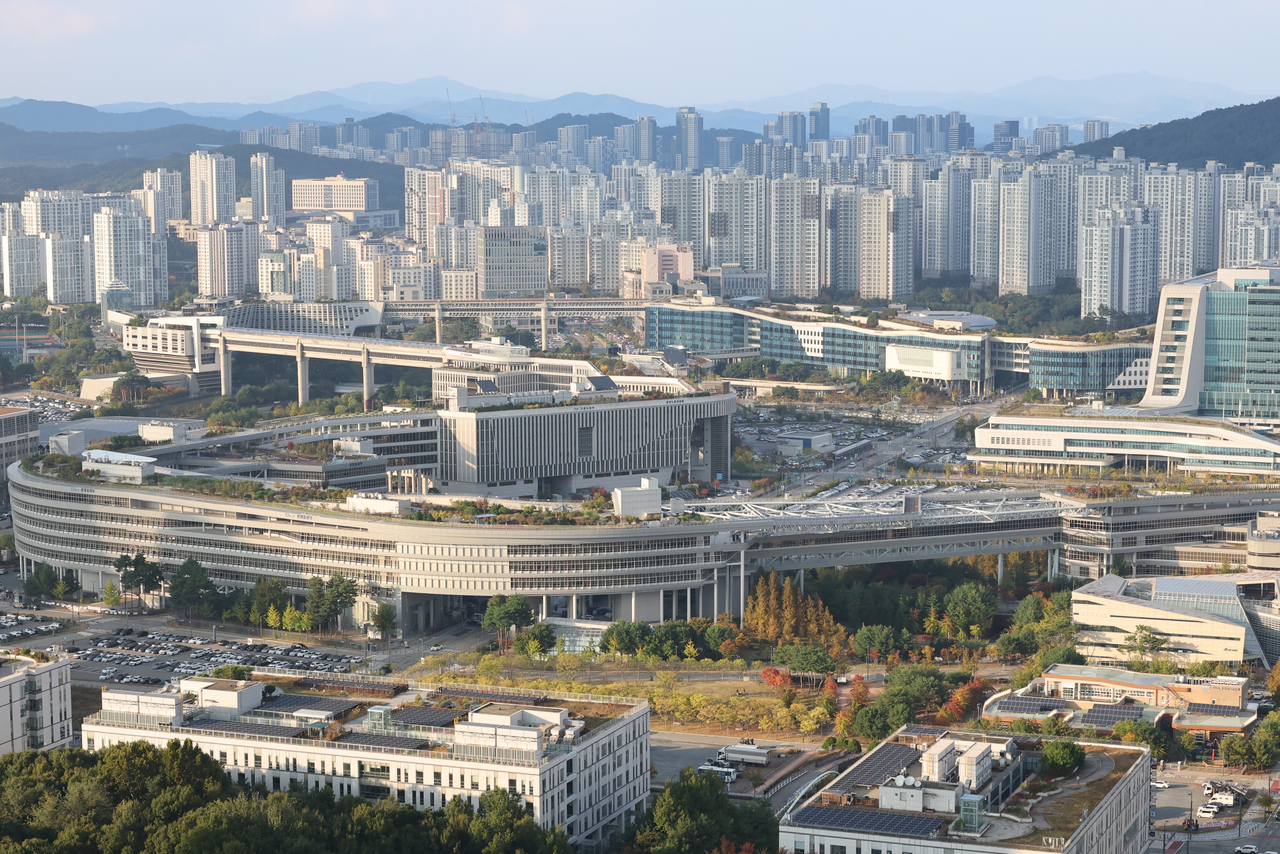
As the government pushes ahead with plans to relocate 27 central government agencies and 2,995 civil servants to Sejong in 2027, a deepening jeonse drought in the city's apartment market is stoking fears of a housing crunch. Across Sejong, large complexes of 2,000 units or more are listing zero jeonse properties or only a handful, with the shortage spreading throughout the city. The government has pledged to secure the maximum annual supply to prevent any gap, but critics say the roughly 2,000 units scheduled for move-in next year are concentrated in the second half — far too late to absorb the wave of incoming residents.
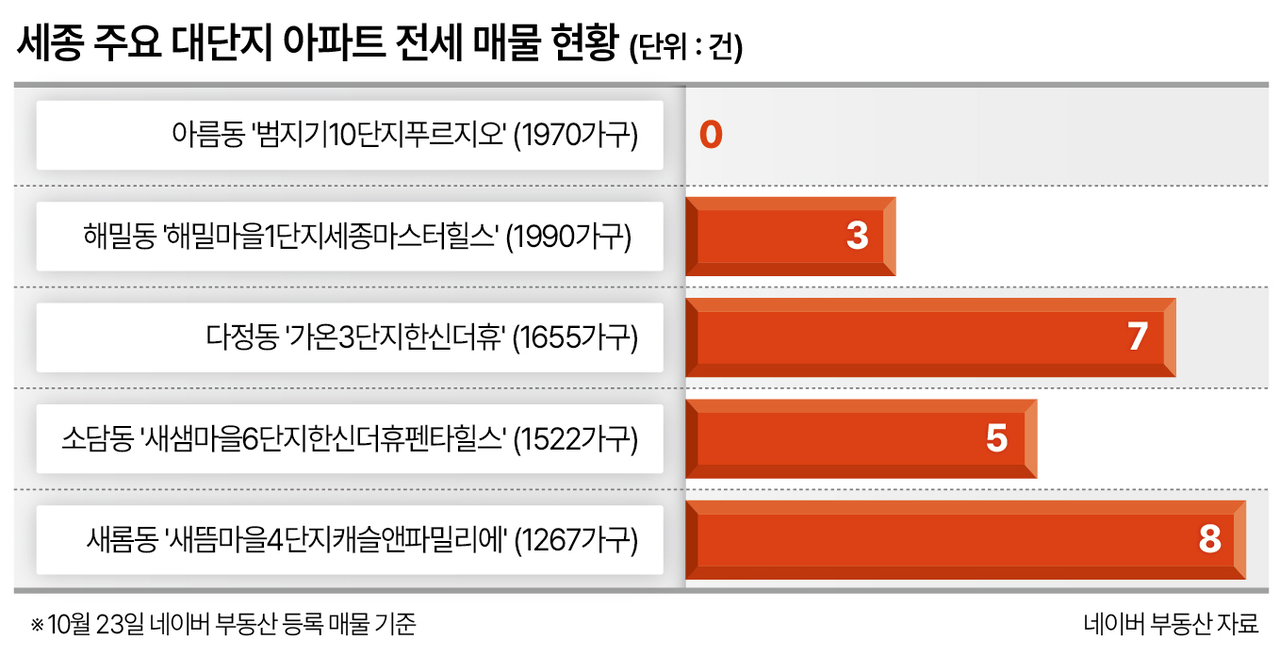
According to real estate industry sources, the supply-demand imbalance in Sejong's jeonse market has worsened sharply. Beomjigi 10 Danji Prugio in Areum-dong — a complex of 1,970 units — currently has zero jeonse listings on the market. Haemil Maeul 1 Danji Sejong Master Hills in Haemil-dong (1,990 units) has just three listings, and Saesaem Maeul 6 Danji Hansin The Hu Pentahills in Sodam-dong (1,522 units) has only five.
The picture is no better at smaller flagship complexes that are among the most sought-after addresses in Sejong. Sejong Leaders Fore 2 Danji in Naseong-dong (845 units) has three jeonse listings, as does the nearby Naritjae Maeul 6 Danji Hansin The Hu Reserve (370 units). Another flagship complex, Hanteul Maeul 6 Danji Jungheung S-Class Centum View in Eojin-dong, also has just three listings available.
The jeonse shortage in Sejong is largely attributed to a sharp drop in new move-in supply over the past one to two years. According to figures from the Multifunctional Administrative City Construction Agency, annual move-in volume — which had held at around 3,000 units in 2023 and 2024 — fell to 1,689 units last year and plunged to just 24 units this year. As a result, the total number of jeonse listings for apartments across Sejong fell roughly 20 percent over the past year, from 707 in October last year to 565 as of Friday, deepening the rental squeeze.
The shortage has also pushed jeonse prices to new highs. According to the Ministry of Land, Infrastructure and Transport's actual transaction price disclosure system, a 59-square-meter unit at Gaon 6 Danji Jungheung S-Class Centum City in Dajeong-dong set a new high when a new tenant moved in Oct. 5 with a deposit of 300 million won ($226,000). That is more than 100 million won above the 191 million won paid in a renewal contract on Oct. 7. A 112-square-meter unit at Naritjae 1 Danji Leaders Fore in Naseong-dong also set a new record, with a fresh jeonse contract signed Oct. 1 at a deposit of 580 million won.
Against this backdrop, Sejong posted the highest weekly jeonse price increase in the country this week. The Korea Real Estate Board's weekly apartment price trend survey showed Sejong jeonse prices rising 0.27 percent — outpacing Seoul at 0.16 percent and Gyeonggi Province at 0.18 percent.
The concern is that the relocation pressure will only intensify: a total of 44 agencies and 9,929 civil servants are set to move to Sejong in stages from next year through 2031. In the first half of next year, six agencies will relocate first — the Korea Communications Commission, the Personal Information Protection Commission, the Nuclear Safety and Security Commission, the National Human Rights Commission of Korea, the National Education Commission and the Overseas Koreans Agency. In the second half, the Financial Services Commission and 19 other government ministry affiliates and advisory bodies will follow.
With nearly 3,000 people relocating to Sejong next year alone, the planned move-in supply stands at just 2,367 units. Those units are slated to serve as an athletes' village for the Chungcheong Universiade in August before being converted into rental housing — meaning the immediately available private supply is effectively zero.
To head off a housing gap, the Multifunctional Administrative City Construction Agency plans to finalize short- and medium-to-long-term housing supply plans as soon as the results of a housing and transportation demand survey — currently being conducted among civil servants at relocating agencies through the end of this month — are available. The agency is reviewing whether to roughly double the current average annual supply of 4,000 to 5,000 units to match the pace of relocations and rental demand year by year.
"We are not planning to increase supply to 8,000 units all at once — because the relocations are phased, we plan to scale up in line with the number of people moving each year," an agency official said. "To meet next year's demand, there are about 1,100 publicly supported private rental units scheduled for move-in in early 2028, and we are also looking at working with the private developer to bring that move-in date forward."
hwshin@heraldcorp.com