Supreme Court overturns lower court rulings that had sentenced repeat offender to suspended prison term
Mouth-rinse procedure carries legal force after being codified in Road Traffic Act enforcement rules
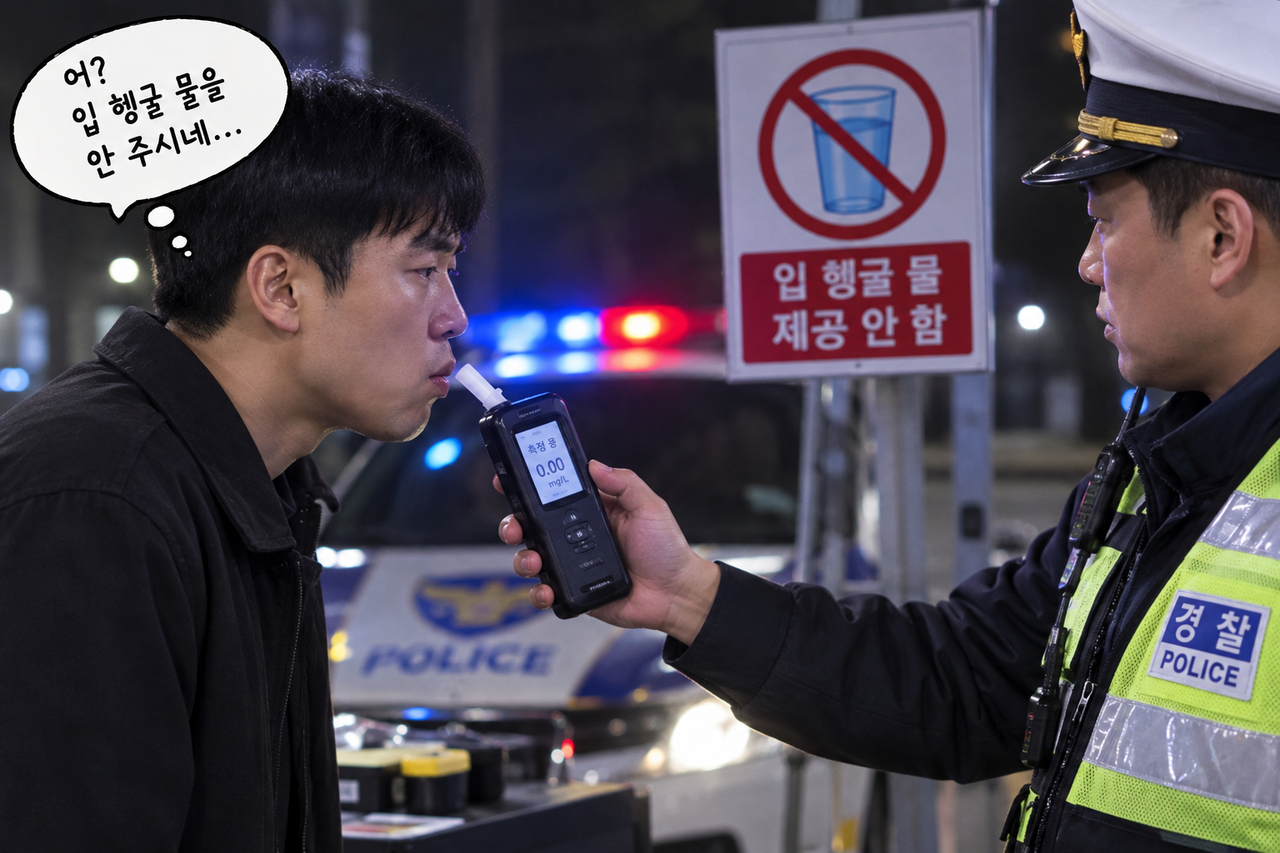
A drunk driver stands a strong chance of escaping conviction after a legal battle turned on a single procedural lapse: police never offered him water to rinse his mouth before administering a breathalyzer test.
The Supreme Court's First Division, presided over by Justice Cheon Dae-yeop, recently overturned a lower court ruling that had sentenced the defendant, identified only as A, to one year in prison suspended for two years on charges of violating the Road Traffic Act, and remanded the case to Daejeon District Court.
A was indicted on charges of driving a cargo truck while intoxicated on a road in Sejong in December 2023.
Police responded to a report of a person asleep at the wheel of a vehicle with its engine running in the middle of the road and administered a breathalyzer test on A. The process, however, contained a critical gap.
A's blood alcohol concentration measured 0.081 percent. Police had not provided him with water to rinse his mouth before the test, and for roughly an hour until his release they neither offered water nor requested a retest.
Prosecutors applied a repeat-offense charge, noting that A had previously received a summary order imposing a fine of 1 million won ($755) for drunk driving in 2019.
A argued that the failure to provide mouth-rinse water caused his blood alcohol reading to come in higher than his actual level, and that the test result therefore constituted illegally obtained evidence.
The first-instance court rejected that argument, ruling that the mouth-rinse procedure was merely an internal Korean National Police Agency guideline and that non-compliance did not render the breathalyzer test unlawful. It sentenced A to one year in prison suspended for two years.
The court also found it difficult to conclude that a mouth rinse had been necessary, given that the test was conducted more than 20 minutes after A had stopped drinking.
The appellate court upheld the first-instance ruling and dismissed A's appeal.
The appellate court said A had suddenly risen and blown into the breathalyzer on his own, making it impossible to provide drinking water, and placed the responsibility on A. It also found the breathalyzer reading to be largely accurate.
The Supreme Court, however, reversed the lower courts, ruling that the breathalyzer result constituted illegally obtained evidence.
The court found that in July 2023 — before the test in this case was conducted — the mouth-rinse procedure had been written into the enforcement rules of the Road Traffic Act, giving it binding legal force.
Accordingly, the court held that a breathalyzer result obtained without following that procedure is in principle inadmissible and cannot be used as evidence of guilt.
The court further found that the result did not fall under any of the exceptional circumstances that would allow it to be admitted as evidence of guilt.
"Research showing that the effect of residual alcohol in the mouth disappears 20 minutes after drinking is premised on experiments that exclude factors such as burping and hiccupping," the court said. "In actual drunk-driving enforcement situations, the risk that residual alcohol causes a blood alcohol reading higher than the true level cannot be considered to have disappeared."
sun@heraldcorp.com