BOK digital currency chief Yoon Seong-gwan speaks at Financial Settlement Institute seminar
International CBDC project Agora targets 2028 launch
Initiative linked to won internationalization and Korean bond market access
Central bank money should serve as settlement asset in tokenized financial infrastructure
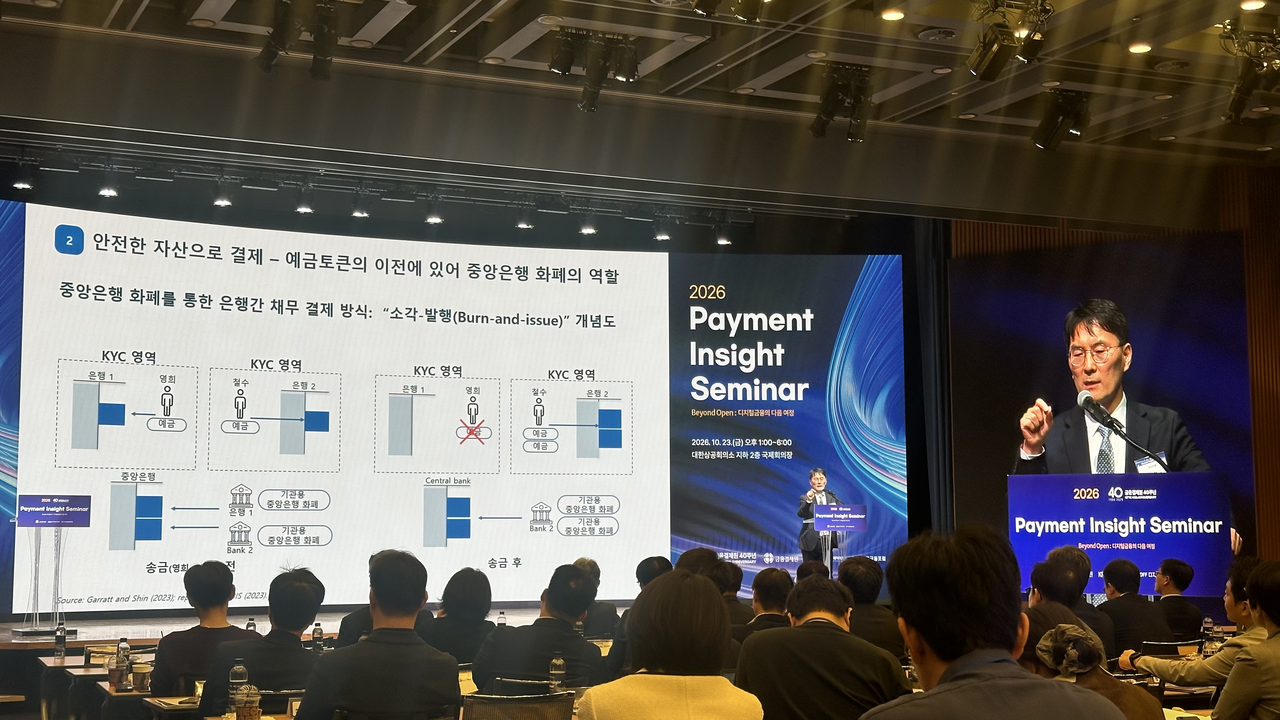
Project Agora, an international CBDC initiative in which the Bank of Korea participates, is being developed with a target launch date of 2028. The Bank of Korea said it expects to link tokenized government bonds to the project's cross-border remittance infrastructure, improving foreign investors' access to the domestic bond market and contributing to the internationalization of the won.
Yoon Seong-gwan, head of the Bank of Korea's CBDC division, said the project had completed real-transaction testing, speaking Friday at the 2026 Payment Insight Seminar hosted by the Financial Settlement Institute at the Korea Chamber of Commerce and Industry in Seoul. "Next year we plan to establish the operating entity, governance structure and supervisory framework, with the goal of launching in 2028," he said.
Project Agora is a platform development initiative led by the Bank for International Settlements (BIS) to improve cross-border payment and settlement systems. Eight central banks, including the Bank of Korea, and more than 40 financial institutions are participating to develop an international remittance system using tokenized central bank money and commercial bank deposits.
Yoon identified correspondent banking and anti-money laundering (AML) procedures as the main pain points in existing international remittances. When funds pass through multiple banks, any problem with recipient verification or AML screening can halt a transfer and make recovery a lengthy process. "Once funds get stuck, the return procedure becomes extremely complicated," he said. "There are cases where resolving it takes more than a month."
Agora addresses these problems by requiring all participating financial institutions to complete AML screening in advance. Funds are transferred only after every institution has finished recipient verification and AML checks without issue. The system uses an atomic settlement structure, meaning that if any single participant flags a problem, the entire transaction is not executed.
Yoon also outlined a plan to link tokenized government bonds to Agora's domestic payment infrastructure. The concept involves tokenizing government bonds onto a domestic-jurisdiction ledger that the Bank of Korea will build, combining payment-versus-payment (PvP) and delivery-versus-payment (DvP) settlement.
"This connects to the internationalization of the won, and could also make it more convenient for foreign investors to access the Korean government bond market," Yoon said. The Bank of Korea plans to review the specific design of the domestic-jurisdiction ledger to be connected to Agora next year.
Domestically, the Bank of Korea is also expanding Project Han River, a CBDC pilot program using deposit tokens. The bank increased the number of participants from about 100,000 in the first real-transaction phase to up to 500,000 in the second, and expanded the number of participating banks from seven to nine.
Yoon said deposit tokens would bring structural changes to the domestic payments market. "Korea's payments market is centered on credit cards," he said. "Deposit tokens could help shift the balance toward a relatively lower-cost, debit-type payment instrument."
The government has set a target of processing 25 percent of national treasury disbursements through CBDC-based systems by 2030. The Bank of Korea is also in discussions with relevant ministries on expanding the use of deposit tokens to cover government subsidies and fiscal spending by local governments.
"The purpose of Project Han River is to support banks from behind, enabling them to use deposits in token form to create more innovative financial services," Yoon said. "Ultimately, I hope bank deposits can transform into a form that contributes more to the national economy."
Yoon also said central bank money should serve as the settlement asset in tokenized financial market infrastructure. "Central banks can flexibly supply liquidity to market participants such as banks and securities firms, and because they carry no credit risk by nature, they can also ensure the legal finality of settlement," he said. "The settlement asset in financial market infrastructure must be central bank money."

kyoung@heraldcorp.com