Oxygen defects slow electron recombination by 2.5 times, opening path to more efficient solar hydrogen production
South Korean researchers have identified a new principle that could boost the efficiency of photocatalysts used to produce hydrogen from sunlight. The finding is expected to open a new path toward developing high-performance photocatalysts for solar hydrogen production, carbon dioxide conversion and pollutant decomposition.
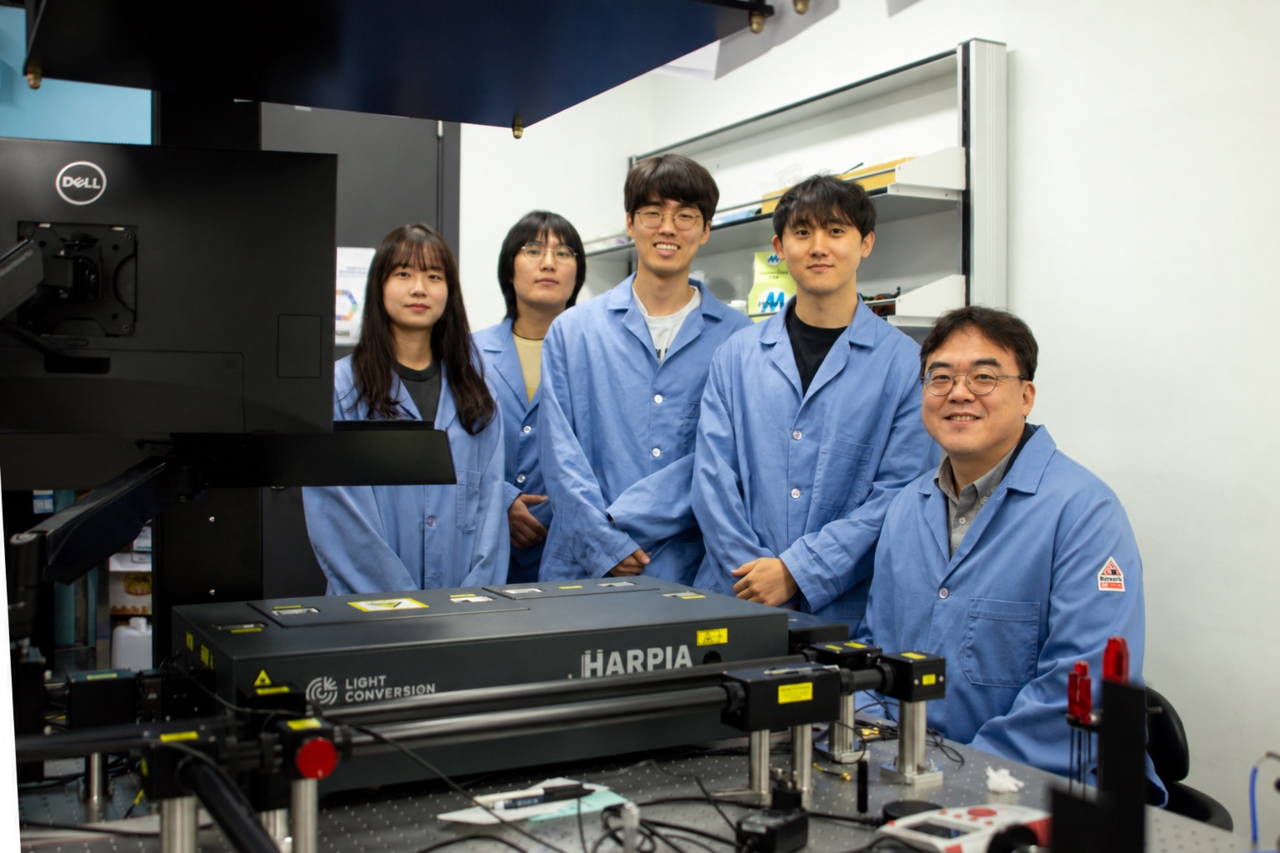
KAIST announced Sunday that a research team led by Kim Tae-gyu, a chemistry professor at the institute, working jointly with Kyung Hee University, Catholic University of Korea and the Pohang Accelerator Laboratory, had identified the mechanism by which "oxygen defects" inside titanium dioxide stably trap electrons.
Titanium dioxide is a widely used photocatalytic material that accelerates chemical reactions when exposed to light. It is applied in eco-friendly technologies such as solar-powered hydrogen production and the conversion of carbon dioxide into useful substances.
A key limitation, however, is that electrons energized by light quickly recombine with holes, dissipating the energy before it can drive chemical reactions. How long electrons can be kept from recombining with holes is therefore a critical factor determining photocatalyst performance.
The research team focused on "blue titanium dioxide" — a bluish variant in which some oxygen atoms are missing. The team reasoned that the vacancies left by missing oxygen atoms could act as a kind of "waiting room," temporarily trapping electrons.
To test this, the researchers used the X-ray free-electron laser at the Pohang Accelerator Laboratory's fourth-generation synchrotron light source, tracking changes in electron states and surrounding atomic structures at femtosecond resolution — intervals of one quadrillionth of a second.
The analysis found that in both ordinary titanium dioxide and blue titanium dioxide, electrons were temporarily trapped immediately after light exposure. In blue titanium dioxide, however, the influence of oxygen defects created a "deep trapping state" from which electrons could not easily escape.
The electrons moved into an increasingly stable state over roughly 1.5 nanoseconds — billionths of a second. The subsequent rate of electron-hole recombination was about 2.5 times slower than in ordinary titanium dioxide.
The result suggests that light-generated electrons could remain available for chemical reactions for longer.

The team also confirmed that the arrangement of surrounding atoms shifts as electrons settle into a stable trapped state, meaning that structural changes in the atomic environment — not just the oxygen defects themselves — also affect electron stability.
The study is significant for mapping the full chain of mechanisms by which microscopic defects inside a material trap electrons, trigger structural changes in surrounding atoms and delay energy loss.
Precisely controlling the quantity and distribution of oxygen defects could enable the design of photocatalysts that use solar energy more effectively, the researchers said. However, they noted that further verification is needed to determine whether the findings translate into actual gains in hydrogen production efficiency.
"We have shown that oxygen vacancies in a material are not simply defects but play an important role in keeping electrons trapped for longer," Kim said. "This will help in designing photocatalysts that make more effective use of light energy by fine-tuning the microscopic structure of materials."
The findings were published online in the Journal of the American Chemical Society on Sept. 17.
nbgkoo@heraldcorp.com