More dropouts expected as regional physician program expands medical school quotas
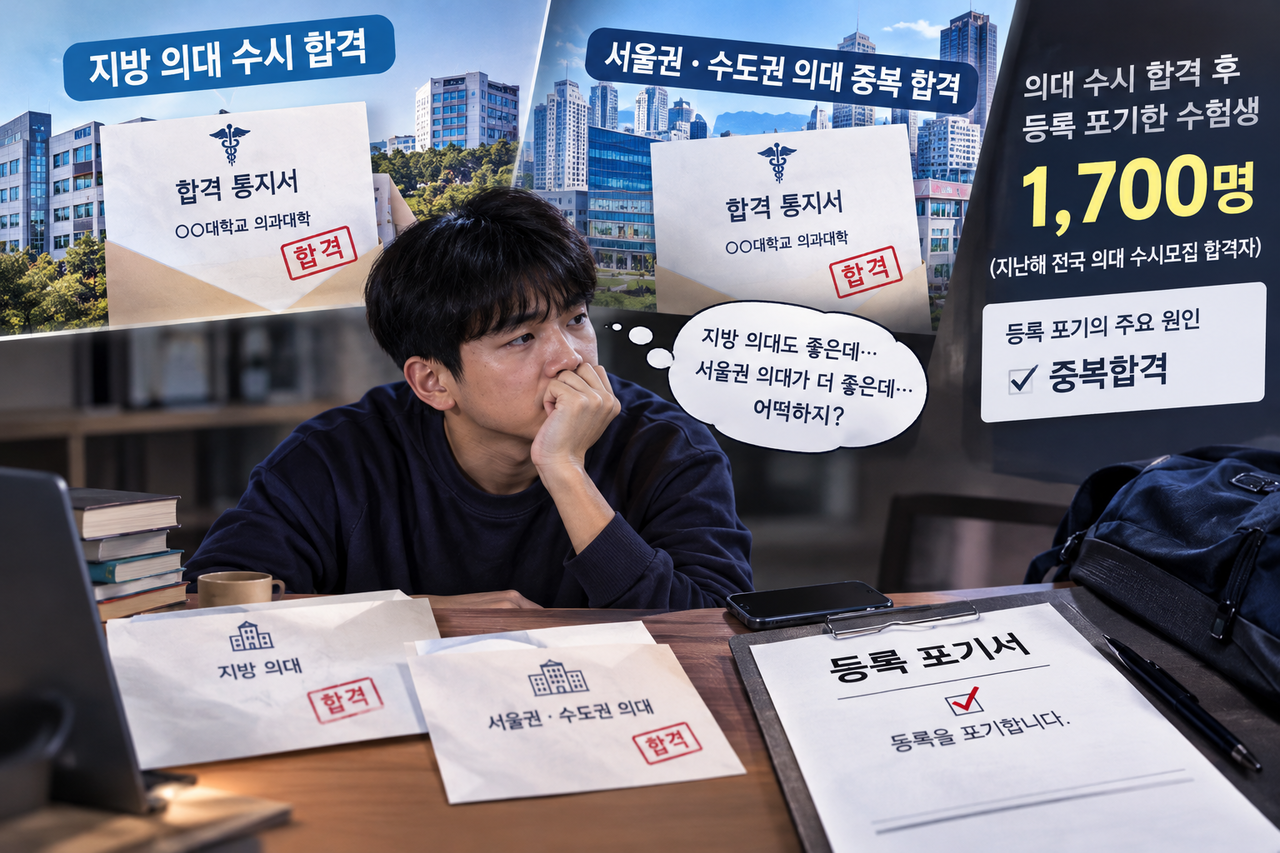
Nearly 1,700 students were accepted to medical schools last year — and then never enrolled. A new analysis of last year's early admissions cycle at medical schools nationwide shows that multiple acceptances drove the mass withdrawals. The trend is expected to worsen this year as medical school quotas expand under the new regional physician program.
According to Jongno Hagwon and Yonhap, 1,728 of the students admitted through early admissions at 39 medical schools nationwide for the 2026 academic year declined to enroll — equivalent to 95.4 percent of the 1,812 seats offered in that round.
In the academic-record track, 1,039 students — or 112.9 percent of the 920 seats available — declined to enroll. In the comprehensive evaluation track, 689 students, or 77.2 percent of the 892 seats, did the same.
Looking at supplementary admission rates — the ratio of additional acceptances issued relative to the original quota — by region, the academic-record track saw a rate of 101.7 percent in the Seoul area and 300.0 percent in the Gyeonggi-Incheon area.
Among non-metropolitan schools in the national-selection category, the average supplementary rate was 146.4 percent. By region: Chungcheong at 183.3 percent, Daegu-North Gyeongsang at 181.8 percent, Honam at 177.8 percent, Jeju at 150.0 percent, Busan-Ulsan-South Gyeongsang at 112.2 percent, and Gangwon Province at 100.0 percent.
For non-metropolitan schools in the local-talent selection category, the average was 97.3 percent — with Gangwon Province at 115.8 percent, Daegu-North Gyeongsang at 114.0 percent, Chungcheong at 104.1 percent, Jeju at 100.0 percent, Busan-Ulsan-South Gyeongsang at 97.9 percent, and Honam at 84.5 percent.
Students admitted to schools in the Gyeonggi-Incheon area were relatively more likely to withdraw.
In the comprehensive evaluation track, the supplementary rate was 86.9 percent in the Seoul area and 94.2 percent in the Gyeonggi-Incheon area. For non-metropolitan schools, the national-selection rate stood at 79.1 percent and the local-talent selection rate at 61.4 percent.
Breaking down the non-metropolitan comprehensive track further, national-selection rates were: Gangwon Province at 110.0 percent, Chungcheong at 75.9 percent, Honam at 67.6 percent, Daegu-North Gyeongsang at 58.3 percent, and Busan-Ulsan-South Gyeongsang at 42.9 percent. Local-talent selection rates were: Honam at 108.7 percent, Daegu-North Gyeongsang at 86.4 percent, Jeju at 66.7 percent, Chungcheong at 44.9 percent, Busan-Ulsan-South Gyeongsang at 33.9 percent, and Gangwon Province at 29.8 percent.
Analysts say the withdrawals were driven almost entirely by students holding simultaneous acceptances at other medical schools.
"Students admitted through national selection at regional schools are believed to have left for medical schools in the Seoul metropolitan area, while those admitted to schools in the Gyeonggi-Incheon area are thought to have moved to Seoul-area schools," said Im Seong-ho, head of Jongno Hagwon.
The school with the highest supplementary admission rate in the 2026 early admissions cycle — identified only as University A — recorded 355.6 percent in the academic-record track.
Seoul National University's medical school, by contrast, saw zero withdrawals in both its general and regional-balance tracks.
Fifty students across 11 universities could not be placed through early admissions and were rolled over to the regular admissions round.
Im warned that the expansion of medical school quotas under the 2027 regional physician program could push withdrawal rates even higher. "The number of students leaving early admissions due to multiple acceptances may increase, and more seats may end up being carried over to regular admissions as well," he said.
sun@heraldcorp.com