Three labs at Pangyo R&D center receive new designation
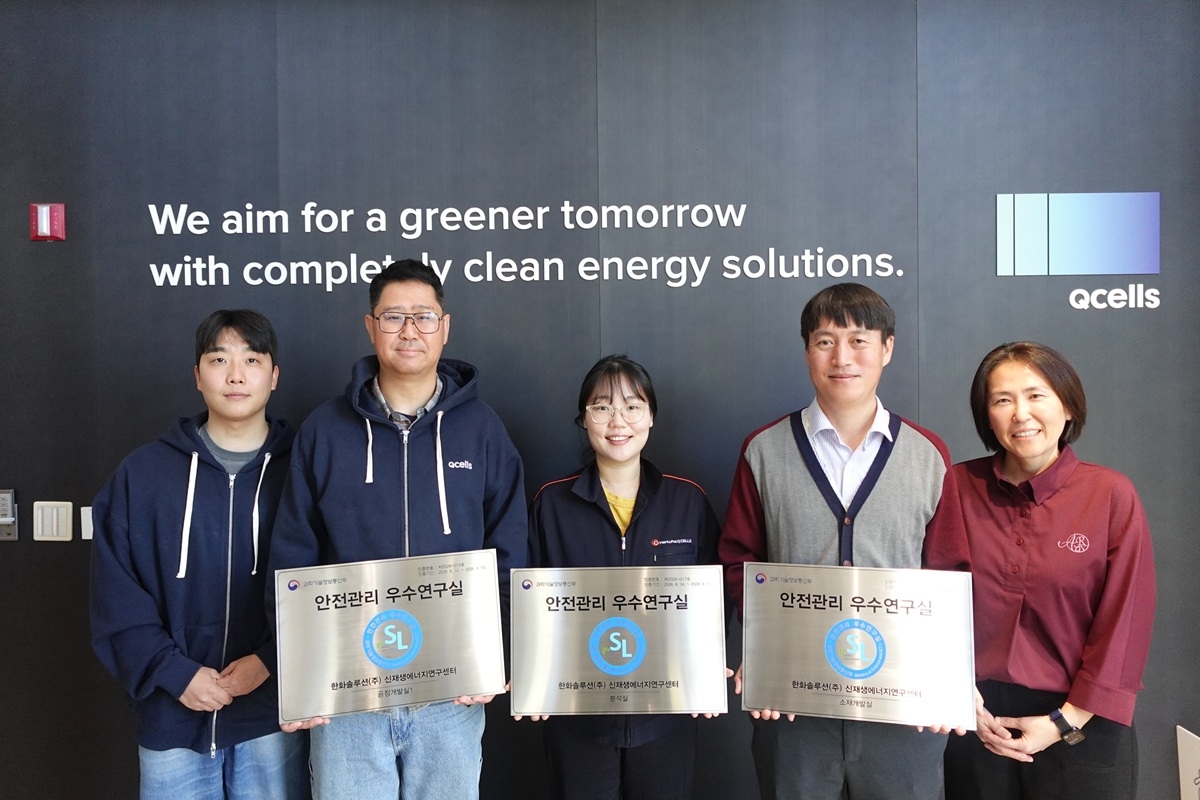
Hanwha Solutions' Qcells division announced Monday that three laboratories at its Renewable Energy Research Center in Pangyo have received new Excellence in Laboratory Safety Management certification.
The certification program, administered by the Ministry of Science and ICT, evaluates laboratories that demonstrate outstanding safety management practices. Assessors review safety management systems, activity levels and researchers' safety awareness in a comprehensive examination.
Hanwha Qcells prepared systematically across every stage — from auditing its safety and environmental management framework and building out its systems to on-site implementation and raising safety awareness among staff. The company particularly strengthened communication channels among safety managers, laboratory supervisors and research personnel to ensure the safety management system operates in close coordination with day-to-day lab activities. As a result, all three laboratories that entered the certification program this year earned the designation.
The Renewable Energy Research Center is South Korea's largest next-generation solar cell research and development hub, where scientists are developing core perovskite tandem solar cell technology. The three labs newly certified — the Process Development Lab, the Materials Development Lab and the Analysis Lab — all conduct key research aimed at bringing tandem solar cells to mass production.
The Process Development Lab verifies the efficiency and reliability of tandem solar cells, while the Materials Development Lab researches materials suitable for mass production. The Analysis Lab uses advanced analytical equipment to precisely characterize materials and devices, identify the root causes of process issues and support product development improvements.
Moon Su-jin, head of the Pangyo R&D Center, said the company would build on the certification to operate its safety and environmental management framework reliably and spread best practices across the broader research institute. "We will continue to strengthen a culture of laboratory safety and accelerate tandem solar cell research and development to bring it to mass production as quickly as possible," Moon said.
Meanwhile, Hanwha Qcells has set 2029 as its target year for commercializing tandem technology, which is widely regarded as a potential game changer in the global solar market.
yeongdai@heraldcorp.com