Opposition seizes on mayor's acquittal to sharpen attacks on ruling party
Party leadership race, general election and presidential contest all heat up
'Unity needed, but internal rifts must first be resolved'
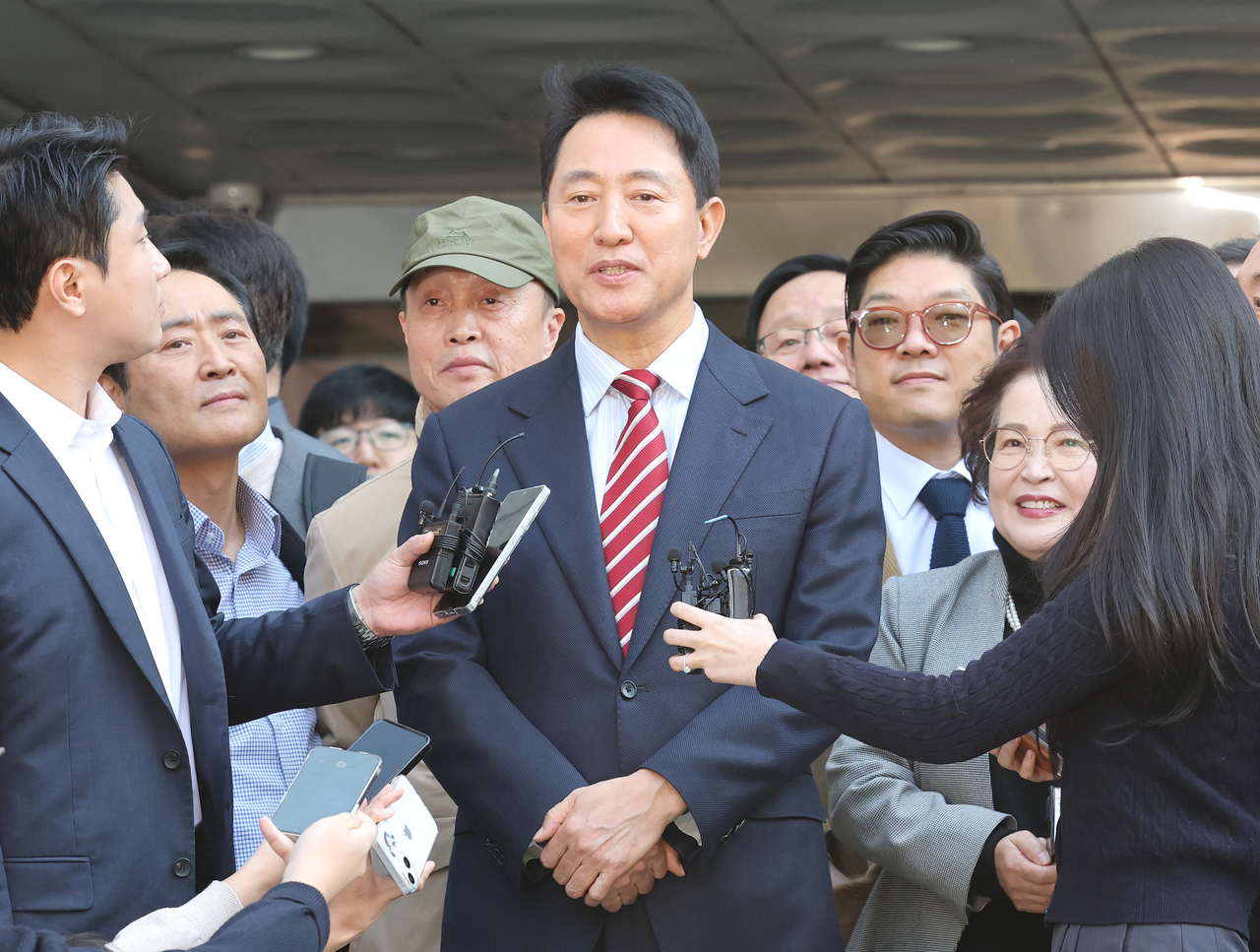
Seoul Mayor Oh Se-hoon's acquittal at the appellate level has lifted what observers had called his "legal risk burden," and analysts say the conservative camp's race for its next generation of leadership is now in full swing. At the same time, voices — particularly from the broader opposition bloc — warn that the field needs more than a crowded multicandidate contest: it needs a unifying center of gravity.
Conservative politicians rallied around Oh's acquittal Monday, using it as a springboard to sharpen their attacks on the ruling party.
People Power Party leader Jang Dong-hyeok, speaking at a supreme council meeting at the National Assembly, said the special prosecutor had been "acting as an indictment vending machine for the administration, only to be struck down by the courts." He demanded that the special prosecutor apologize to the public and immediately drop any plans to appeal to the Supreme Court.
Jang had already gone on the offensive Friday, right after the appellate ruling, posting on Facebook: "Seoul Mayor Oh Se-hoon — fully acquitted. Justice has prevailed. The one who should be on trial is not Mayor Oh. It is President Lee Jae Myung."
PPP lawmakers mentioned as contenders for the next party leadership also welcomed the verdict while keeping up their criticism of the ruling camp. Rep. Na Kyung-won wrote on Facebook that "it is time for us to regroup for a bigger fight," adding that "the lawless rampage of Lee Jae Myung's Democratic Party administration has gone too far."
Rep. Ahn Cheol-soo said he hoped the ruling would mark "a turning point that ends the practice of weaponizing the law to destabilize politics and slash away at citizens' lives." Rep. Ju Jin-woo criticized what he called the "Minjunggi special prosecutor," created unilaterally by the Democratic Party and aimed solely at the PPP as the opposition party.
Criticism of the ruling party came from outside the PPP as well. Independent Rep. Han Dong-hoon joined the offensive, saying he was relieved that the appellate court "corrected the first-instance ruling without yielding to the blatant and crude pressure from Democratic Party politicians such as Democratic Party of Korea leader Kim Min-seok and Legislation and Judiciary Committee Chairwoman Seo Young-gyo."
Reform Party Rep. Lee Jun-seok attended the sentencing hearing in person Friday. Immediately afterward, he posted on Facebook that "there were those who tried to exploit the so-called Myung Tae-kyun gate, borrowing the Democratic Party's blade to carry out a political assassination."
Within the PPP, some see Oh's sudden emergence as a leading presidential contender as a development that could raise the stakes of the party convention and presidential primary, while drawing together a broader coalition of supporters.
Others, however, caution that "more candidates entering the race and a leadership capable of uniting them are two entirely different things." Each figure commands a distinct political base and constituency, and their interests diverge sharply when it comes to the party leadership and the presidency.
The internal rifts blocking conservative unity remain unresolved. Jang has drawn criticism over his reliance on a hard-line support base and his handling of intraparty disciplinary matters. Tensions between the so-called pro-Han faction — supporters of Rep. Han — and the party leadership continue to simmer. Han's potential return to the PPP and Lee Jun-seok's independent path are also cited as issues that will need to be worked out as the conservative camp attempts to build a broader coalition.
Against that backdrop, analysts say the next party convention will be a pivotal moment that determines the conservative power structure. How the contest unfolds — whether Jang wins reelection, how non-leadership factions consolidate, and what role Oh and other key figures play — will shape the party's internal dynamics going forward. Political observers also note that the rifts forged during the leadership race must not be allowed to carry over into the general election and presidential campaigns.
Leading figures broadly agree that unity is necessary. Former Rep. Yoo Seung-min, appearing on YTN Radio on Monday, acknowledged that "bringing everyone together — from Rep. Jang to Lee Jun-seok and Han Dong-hoon — is an enormously difficult task," but stressed that "it has to be done, and reform is also needed."
Oh said at an event Saturday that "the People Power Party will offer greater comfort to the public when it presents a united and cohesive image rather than a divided one." Han, appearing on KBS on Sunday, said he believed that "the vision for the country that Mayor Oh and many other reasonable politicians are working toward is not so different from my own."
Lee Jun-seok, however, drew a line Monday during a CBS Radio interview, pushing back on Yoo's repeated calls for a grand conservative merger among Oh, Han, Lee and others. "I cannot agree with that," he said, adding that "former Rep. Yoo prefers unity around shared values rather than unity around personalities — so the conversation he and I had was somewhat different in that context."
mp1256@heraldcorp.com
raining@heraldcorp.com