Average price of top 20% Seoul apartments: 3.48 billion won
30.2 times the national bottom 20%
High-end Seoul apartments up 4.1% in a year
Cheapest apartments nationwide barely moved
The average price of the top 20 percent of Seoul apartments is now more than 30 times that of the bottom 20 percent nationwide, reaching the widest gap on record — meaning it would take roughly 30 provincial apartments to buy a single high-end unit in Seoul.
National bottom 20% averages 115 million won; Seoul top 20% hits 3.48 billion won
According to KB Kookmin Bank's monthly real estate data for October, based on figures as of the 12th of this month, the average sale price of apartments in Seoul's top quintile (upper 20 percent) stood at 3.48 billion won ($2.63 million), an all-time high.
Prices for the top 20 percent of Seoul apartments first crossed the 3.4 billion won threshold in December last year, then climbed to 3.47 billion won in February. They subsequently retreated — falling to 3.46 billion won in March, 3.45 billion won in April and 3.34 billion won in May — as pressure mounted on multi-home owners to list their properties ahead of a potential reinstatement of the heavy capital gains tax surcharge on multiple-home sellers.
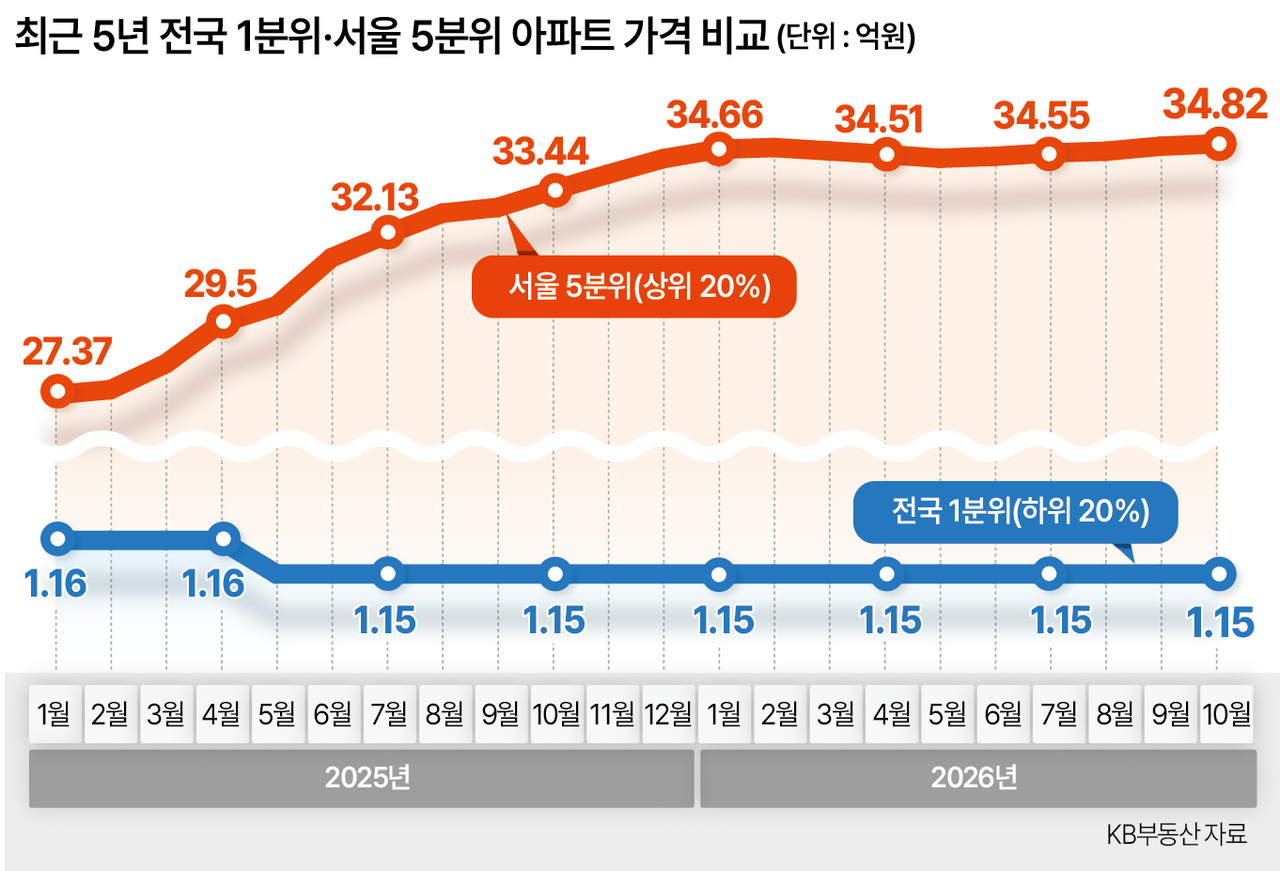
Prices rebounded from July, however, and this month crossed back into the 3.48 billion won range to set a new record. While some apartments in the Gangnam area have shown signs of price correction, the overall average for high-end Seoul apartments has continued to rise.
By contrast, the average price of apartments in the bottom quintile (lower 20 percent) nationwide came to 115.12 million won. That means a single top-tier Seoul apartment costs the equivalent of about 30.24 of the cheapest apartments in the country — a price multiple that has also reached its highest level since records began.
The widening national gap stands in contrast to a narrowing within Seoul itself. The city's own fifth-to-first quintile price ratio — measuring the gap between the top and bottom 20 percent of Seoul apartments — eased to 6.2 from 6.9 in February, as rising prices in Seoul's outer districts have closed the gap between Gangnam and non-Gangnam areas.
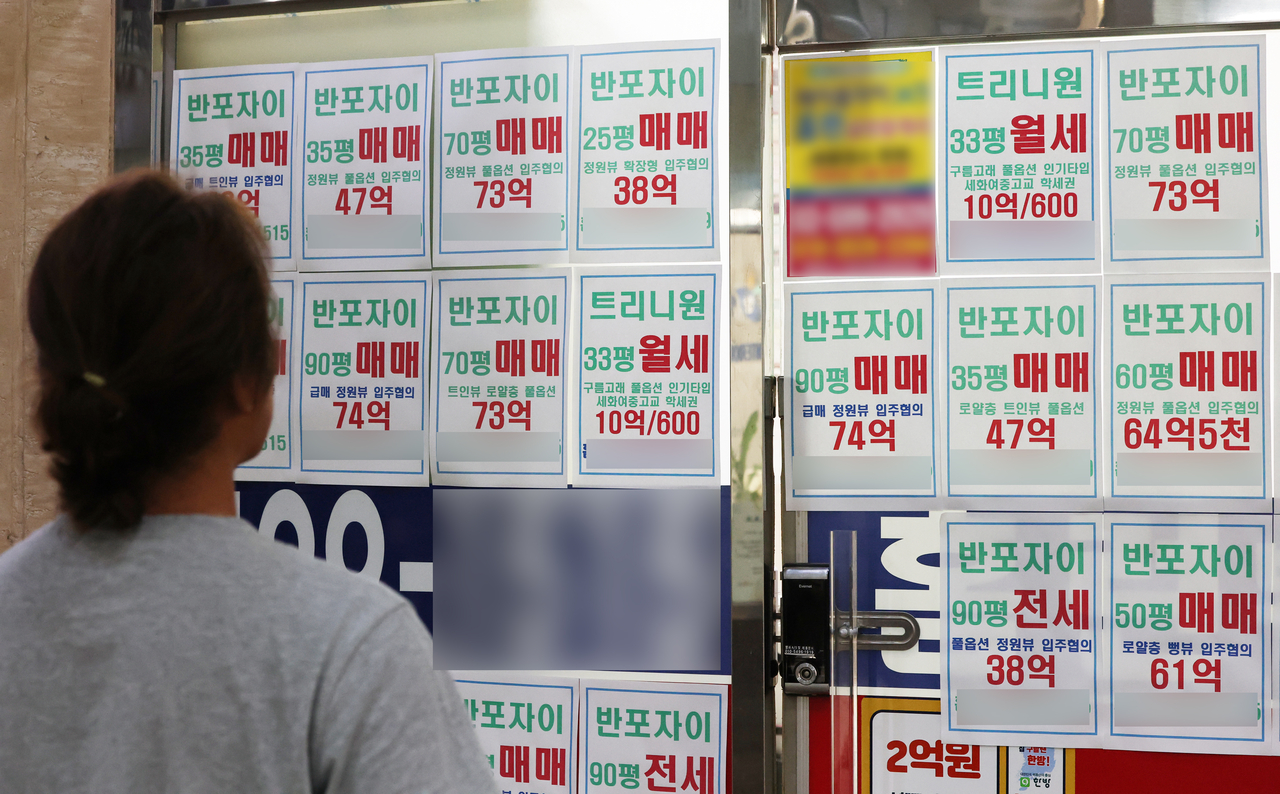
Suncheon and Cheongju apartments sell near 100 million won; Banpo Xi in Seoul fetches 4.2 billion won
The divergence reflects opposite price trends at the top and bottom of the market. The average price of Seoul's top-quintile apartments rose 137.66 million won, or 4.1 percent, from 3.34 billion won in October last year to 3.48 billion won this October. Over the same period, the average price of bottom-quintile apartments nationwide barely moved, slipping just 10,000 won — from 115.13 million won to 115.12 million won. While high-end apartment prices have continued to climb, the low-end housing market, concentrated in the provinces, has struggled to shake off the real estate downturn.
Recent transaction data also illustrates the regional divide. According to the Ministry of Land, Infrastructure and Transport's actual transaction price disclosure system, the highest sale price recorded over the past month for apartments with an exclusive use area of 84 square meters was 4.2 billion won, paid for a unit at Banpo Xi in Banpo-dong, Seocho-gu.
At the other end of the spectrum, among the lowest-priced transactions were units at Dong-A Apartments in Yongdang-dong, Suncheon, South Jeolla Province, and Pyeonghwa Apartments in Uam-dong, Cheongwon-gu, Cheongju, North Chungcheong Province — each changing hands at around 100 million won.
Even within the greater Seoul metropolitan area, price gaps between localities remain stark, with some areas still well below their 2021 peaks. An 84-square-meter apartment in Baegot-dong, Siheung, Gyeonggi Province, sold Tuesday for 500 million won — 350 million won below its October 2021 peak of 850 million won. In Godeok-dong, Pyeongtaek, a unit of the same size sold Tuesday for 580 million won, also 320 million won below its 2021 record high of 900 million won.
Experts call for sweeping tax relief, including acquisition and capital gains tax exemptions, for provincial housing
Industry experts say more aggressive tax support is needed to ease the slump in housing markets outside the greater Seoul area. Measures already in place — such as excluding homes in population-declining regions from the housing count for capital gains and comprehensive real estate tax purposes, and exempting them from the heavy capital gains tax surcharge — have not been enough, they say.
Nam Hyeok-woo, a real estate researcher at Woori Bank, said that even when a home is excluded from the housing count, sellers still owe capital gains tax. "For those with high sale prices who end up with a large tax bill even after the long-term holding deduction, the burden remains significant," he said. "An outright exemption is worth considering."
Experts also stressed the importance of relocating public institutions as part of the government's second round of such moves, and of building quality jobs, industrial infrastructure and everyday amenities in regional areas.
Kim Hyo-seon, a real estate specialist at KB Kookmin Bank, said population, jobs, and education and medical infrastructure are concentrating in the greater Seoul area, while many provincial regions are caught in a cycle of population decline, weakening housing demand and unsold-unit burdens that make price recovery difficult. "More active tax support to stimulate transactions in provincial real estate markets is worth reviewing," she said, "but tax incentives alone cannot restore genuine demand for provincial housing. Ultimately, what is needed is to give people a reason to live in those regions and to strengthen their economic self-sufficiency."
hss@heraldcorp.com