Foreign investors are expected to return to the Korean stock market from late November, once the US midterm elections conclude and AI company Anthropic completes its initial public offering, potentially triggering a rebound in Korean equities, according to an analyst.
Even if the Democratic Party sweeps both chambers of Congress in a so-called "blue wave," the impact on South Korea's semiconductor sector would be minimal, the analyst said. Solar energy and energy storage system stocks — long seen as casualties of Donald Trump's policies — could see a short-term rebound opportunity.
Kim Jae-seung, a researcher at Hyundai Motor Securities, made the remarks Tuesday at a press briefing held at the Korea Exchange in Yeouido, Seoul, where he presented on macroeconomic outlook and investment strategy.
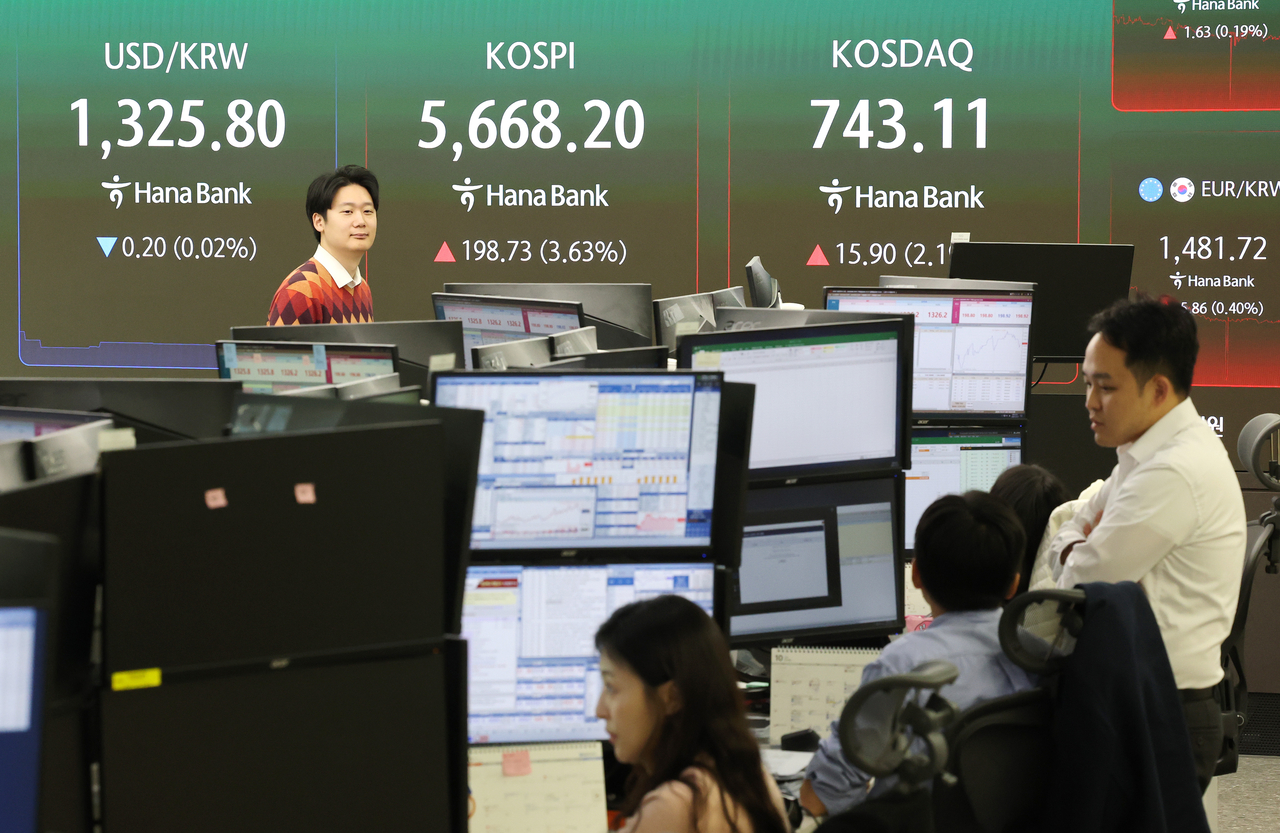
Kim identified foreign investor flows as the key to a domestic market recovery. Foreign investors have recorded net selling of about 210 trillion won ($159 billion) in the Kospi market so far this year, marking a historically aggressive selling streak.
While stock markets have typically rebounded in October ahead of midterm elections, this year's recovery has been delayed by two unusual variables: the rising possibility of a blue wave and the pending Anthropic listing, Kim said.
"A blue wave outcome decided by a single Senate seat is itself a source of uncertainty for the market," he said. "Investor sentiment will not recover until the election results are confirmed in early November."
He also said Anthropic's planned mid-November listing — at a valuation of between $1.5 trillion and $2 trillion — is weighing on near-term market flows. Anthropic filed a registration statement with the US Securities and Exchange Commission on Monday (local time), formally beginning the IPO process.
"Tech funds have no choice but to sell high-flying technology and semiconductor stocks to raise cash for Anthropic," Kim said. "Foreign investors have little incentive to buy Korean stocks before digesting this event."
However, he added that Anthropic's filing had confirmed solid profitability, and that once the listing is complete, the supply-demand distortion should ease — allowing Korean semiconductor stocks to rise in tandem with Anthropic's share price.
After the market absorbs the major events in mid-November and a US-China-Russia summit in December, foreign investors will return and drive a year-end rally and a broader recovery next year, Kim said.
Kim also projected that if a blue wave materializes, AI regulation would focus not on AI models themselves but on AI data centers, given their direct link to everyday cost-of-living concerns such as rising electricity and water bills. "Concerns about delays in data center ground-breaking in the United States have recently weighed on domestic power equipment stocks," he said, "but there will be no damage to semiconductors."
He explained that major technology companies, having confirmed their profitability, are likely to accelerate overseas data center investment to sidestep domestic US regulation, and that semiconductor demand — essential to data centers — remains robust.
By sector, Kim said investor sentiment toward solar energy, secondary batteries and ESS stocks — all seen as Trump policy victims — would improve. However, he cautioned that legislative constraints mean any rally in these stocks is unlikely to last more than a month, and recommended a short-term trading approach.
Kim also projected that if a blue wave gives Congress control over legislation and the budget, Trump would likely push harder on areas Congress cannot easily touch — diplomacy, security and tariffs.
"Trump will strongly pressure South Korea to increase investment in the United States over his remaining two years in office," Kim said. "For Korean companies directly participating in US-facing projects such as nuclear power plants or LNG, this could become a catalyst for improved investor sentiment."
A separate analyst, Choi Je-min, argued that a blue wave would reduce the risk of additional US fiscal expansion and rising inflation and interest rates. "If Congress acts as a check, Trump will also revise his policies to ease the cost-of-living burden — a major voter grievance — ahead of the next presidential election," Choi said. He added that even if military pressure on Iran intensifies after the midterms, it would amount to an exit strategy rather than a continuation of conflict.
However, Choi cautioned that a divided government could trigger impeachment proceedings against key officials or Senate delays in confirming Federal Reserve appointments. He also warned that after the debt ceiling is reached in the first half of next year, even with extraordinary measures, uncertainty over the national debt would rise toward the end of next year as debt ceiling negotiations loom.
jiyun@heraldcorp.com