Korea Astronomy and Space Science Institute analyzes latest observational data, offering explanation without complex changes to dark energy
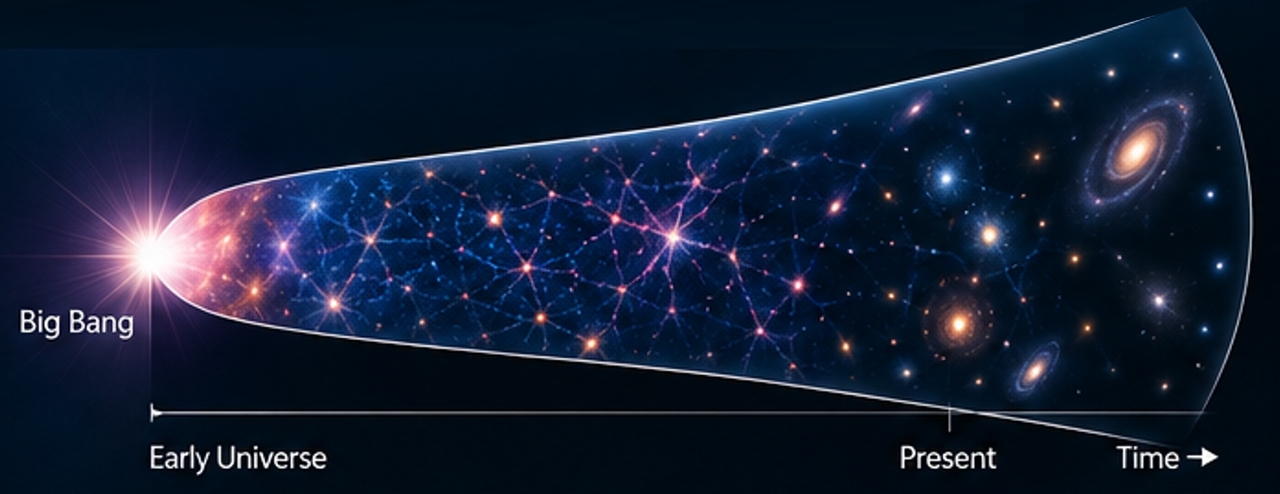
Why is the universe expanding at an ever-faster rate? Scientists have long focused on changes in "dark energy" — the force thought to be driving that acceleration. Now, a South Korean research team has proposed a new possibility: that modifying the properties of "dark matter," rather than dark energy, can account for the latest cosmic observations.
The Korea Astronomy and Space Science Institute announced Wednesday that Senior Researcher Shapellu Alman of its Center for Galaxy Evolution Research and a team led by Dr. Jang Jun-chen have proposed a new cosmological model. The model is based on the assumption that dark matter possesses a minute amount of pressure, and the institute said it can explain recent observations of cosmic expansion.
About 95 percent of the universe consists of dark matter and dark energy, neither of which has been directly identified. Dark matter does not emit light and cannot be observed directly, but it influences the movement of galaxies and the formation of large-scale structures through gravity. Dark energy is thought to be the cause of the universe's accelerating expansion.
A fresh debate has recently reignited in the astronomy community over cosmic expansion. Observational data from the US Dark Energy Spectroscopic Instrument, or DESI, raised the possibility that dark energy may be weakening over time.
The standard cosmological model assumes dark energy is constant. However, explaining the latest observational results has led some researchers to argue that dark energy's properties must change in complex ways — particularly that some models require crossing what is known as the "phantom divide," where the ratio of dark energy's pressure to its energy density equals -1. That threshold is theoretically difficult to account for.
The research team turned its attention to the properties of dark matter as a way to resolve this problem.
Conventional cosmology assumes dark matter behaves like ordinary pressureless matter, meaning its density decreases in the same way as regular matter as the universe expands.
The team departed from that assumption and examined the possibility that dark matter carries a very small amount of pressure.
To do so, the researchers combined galaxy and quasar observational data from DESI, five years of supernova data from the Dark Energy Survey, and cosmic microwave background data encoding information about the early universe.
They found that assuming dark matter has a minute pressure — causing its density to decrease slightly faster than that of ordinary matter during cosmic expansion — is sufficient to explain the recent observational results.
The team was able to construct a model consistent with observational data without requiring dark energy to cross the theoretically problematic phantom divide. The model also showed the potential to explain a subtle discrepancy between estimates of the amount of dark matter in the early universe and in the present universe.
The new model described the observational data somewhat better than existing models that assume complex changes in dark energy. However, the difference was not statistically significant, meaning further verification is needed to determine which model more accurately reflects the actual universe.
The study is significant in that it moves beyond the conventional approach of attributing cosmic acceleration solely to changes in dark energy, pointing instead to the need to also examine the physical properties of dark matter.
Kim Jin-ho, director of the institute's Center for Galaxy Evolution Research, said the study "traced the properties of dark matter in reverse through the history of cosmic expansion," adding that "particle detection experiments and cosmological observations will together contribute to uncovering the true nature of dark matter."
The research team plans to continue follow-up work next year through a dark matter research project called K-COSMOS, which will combine observations, simulations and theoretical modeling.
The findings were published in The Astrophysical Journal Letters.
nbgkoo@heraldcorp.com