SK hynix unveiled a shareholder return plan worth about 100 trillion won ($75.5 billion) for this year, sending its shares up more than 6 percent in early trading Wednesday. Securities analysts say the stock is deeply undervalued and expect the plan to serve as a catalyst for a rebound.
The chipmaker disclosed Wednesday that its projected shareholder return for fiscal year 2026 totals about 100 trillion won, consisting of more than 30 trillion won in cash dividends and more than 60 trillion won in share buybacks and cancellations. The buyback and cancellation figure includes the 40 trillion won program announced in August.
Third-quarter share buybacks amount to 20 trillion won. Of that, 10 trillion won earmarked for shareholder returns will be fully cancelled, while the remaining roughly 10 trillion won will go toward employee compensation. Buybacks allocated for employee compensation are excluded from the shareholder return total.
The third-quarter cash dividend stands at 14 trillion won, or 20,000 won per share — a regular dividend of 10,000 won reflecting improved earnings, plus a special dividend of 10,000 won funded by gains from the sale of its stake in Japanese chipmaker Kioxia. SK hynix said it would return most of the profit realized from its Kioxia investment this year to shareholders. The dividend record date is Nov. 30, with payment scheduled within one month of that date.
On its earnings conference call, SK hynix said it would continue quarterly share buybacks, reaffirming its commitment to expanding shareholder returns.
Investor attention at this earnings release centered on the shareholder return plan. With record-high earnings already priced in, the scale of additional returns was seen as the key variable driving sentiment. The roughly 100 trillion won plan was viewed as meeting market expectations; analysts had anticipated 50 trillion to 60 trillion won in additional returns on top of the existing 40 trillion won buyback program.
Securities analysts expect the expanded shareholder return program to drive the stock higher, with continued buybacks also seen easing concerns about a supply vacuum once the existing program ends. "If valuations near historical lows combine with a strengthened shareholder return policy, it will drive a genuine share price rebound," said Kim Seon-woo, an analyst at Meritz Securities.
Analysts also expect SK hynix's earnings growth to continue, driven by rising memory chip prices amid a supply shortage. Meritz Securities forecast mobile memory chip prices to surge from the first quarter of next year and raised its operating profit estimate for SK hynix in 2027 to 454 trillion won.
According to FnGuide, the consensus operating profit estimates for SK hynix stand at 262.69 trillion won for 2026 and 403.84 trillion won for 2027, suggesting the company's growth momentum will extend into next year after posting record earnings in the third quarter of this year.
A supply-side-favorable market environment is also expected to persist. Daishin Securities projected the global memory chip market would grow from $219.7 billion last year to $949.6 billion this year and $1.52 trillion next year. "The massive cash inflow creates conditions where the company can simultaneously strengthen its financial health and expand shareholder returns," said Ryu Hyeong-geun, an analyst at Daishin Securities.
On the conference call Wednesday, SK hynix forecast that the memory chip supply shortage would continue through 2030, pushing back against concerns that the industry cycle had peaked. The company said all of its DRAM and HBM supply through 2029 — including volumes under long-term supply agreements — had been sold out.
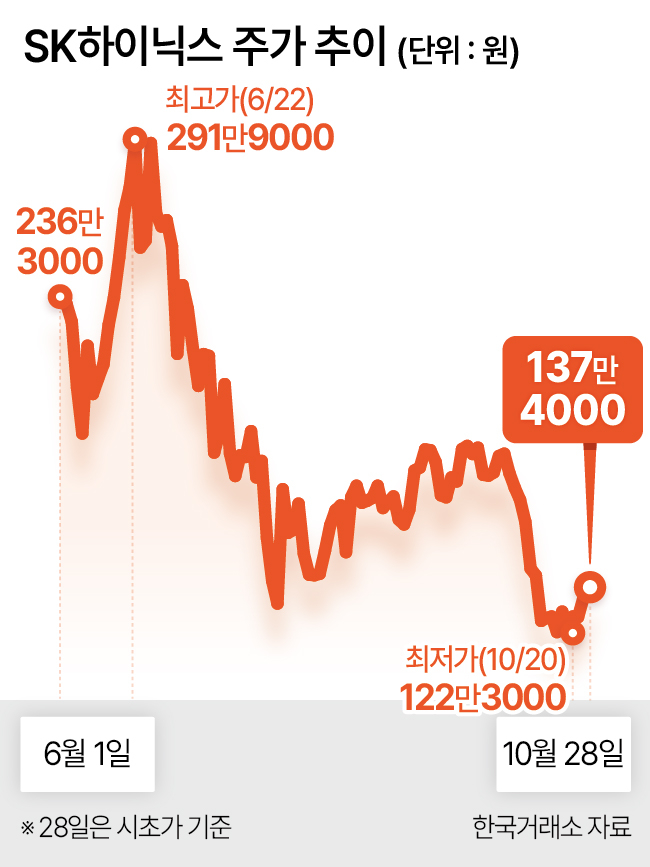
Despite the memory supercycle outlook, SK hynix shares remain roughly half their peak. Tuesday's closing price of 1.341 million won was 55.33 percent below the intraday all-time high of 3.002 million won recorded on June 23.
"The current share price does not reflect the strength of the industry cycle," Ryu said. "The stock has quietly fallen below three times its 12-month forward price-to-earnings ratio, suggesting the share price is not reflecting earnings value at all."
Analyst price targets also far exceed the current share price. The average target price set by brokerages over the past three months, as compiled by FnGuide, stands at 3.24 million won — implying upside of about 141.6 percent from Tuesday's close of 1.341 million won.
Kim Dong-won, head of research at KB Securities, said SK hynix's price-to-earnings ratio had fallen to around three times, creating an extreme divergence between earnings and share price that placed the stock in undervaluation territory comparable to past financial crises. "This is the time to focus on future earnings growth and the potential for valuation normalization, rather than the pessimism already priced into the stock," Kim said.
A remaining challenge is closing the price gap between SK hynix's American depositary receipts and its domestic shares. The ADR premium currently approaches 50 percent. Easing restrictions on conversion between the two could draw buying into the domestic shares and push the price higher.
"The realistic approach is to gradually raise the conversion limit and have the company pre-approve conversions in bulk to simplify the process," said Kim Su-hyeon, head of research at DS Investment Securities. "Market demand will grow for procedural simplification — such as allowing a single filing to cover all conversions within a set limit, rather than requiring a separate report each time."
moon@heraldcorp.com