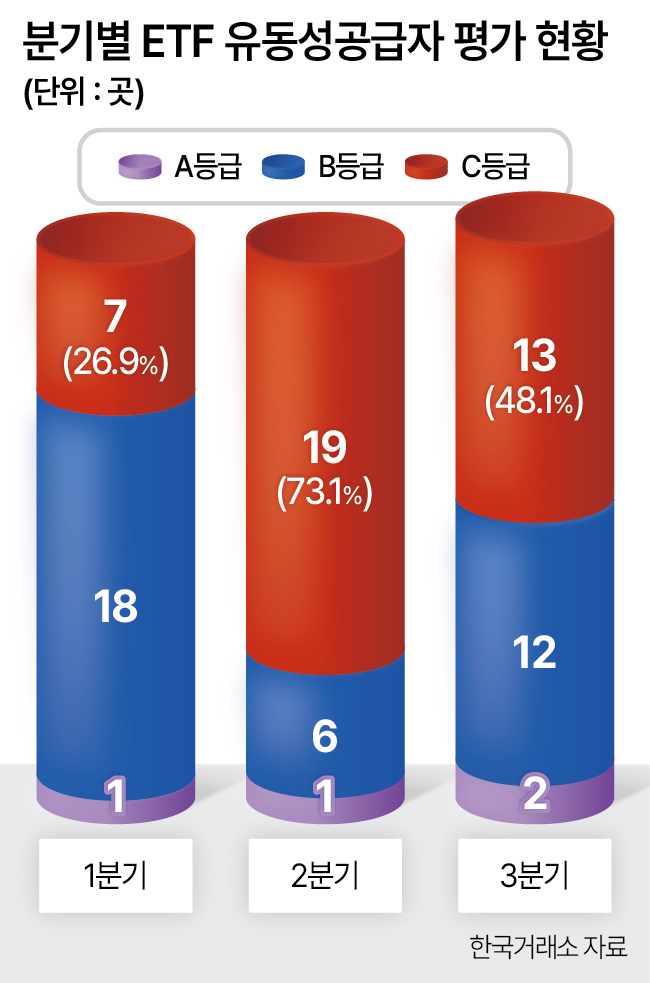
Liquidity provider ratings for ETFs have begun to recover following the tightening of regulations on single-stock leveraged ETFs in late July. In the second quarter, more than seven out of every 10 assessed securities firms received a C rating, but that share fell to below half in the third quarter. Korea Exchange said it also sees improvement in the quality of quotes — the prices and volumes that liquidity providers, or LPs, post to allow ETF investors to buy and sell.
According to Korea Exchange on Wednesday, the number of securities firms receiving a C rating in this year's ETF LP assessments jumped from seven in the first quarter to 19 in the second quarter, before falling to 13 in the third quarter. The share of C-rated firms dropped 25.0 percentage points, from 73.1 percent in the second quarter to 48.1 percent in the third. Over the same period, the number of A-rated firms rose from one to two, and B-rated firms increased from six to 12.
The LP assessment measures how favorable a trading environment each securities firm provides for ETF investors. Under Korea Exchange's KOSPI market operational rules, firms are evaluated on whether they fulfill their quote-submission obligations, the spread between bid and ask prices, the volume of quotes submitted, and compliance with relevant regulations. A narrower bid-ask spread reduces transaction costs for investors, while larger quoted volumes make it easier to trade the desired quantity.
The deterioration in second-quarter LP ratings coincided with the introduction of single-stock leveraged ETFs. Launched in late May, these products are designed to deliver twice the daily price movement of individual stocks. The faster a stock moves, the more frequently an LP must adjust its bid and ask prices and execute hedging trades to limit losses — making quote management far more demanding than for ordinary ETFs.
Regulators announced a package of tighter rules for single-stock leveraged ETFs in July. New listings were suspended indefinitely, and the minimum deposit required of investors was raised from 10 million won ($7,550) to 30 million won in cash. The allowable premium or discount between an ETF's market price and its net asset value was tightened from 3 percent to 2 percent, and authorities said they would consider restricting new ETF listings by asset managers that breach the threshold. Korea Exchange said the third-quarter recovery reflected a combination of lower market volatility easing LP quote-management burdens, the stricter single-stock leveraged ETF rules, and brokerages' own efforts to improve quote supply.
Jang Geun-hyeok, a senior research fellow at the Korea Capital Market Institute, said leveraged ETFs place a heavier burden on LP operations than ordinary ETFs. "When volatility is high, managing quotes and executing hedging trades becomes more difficult," he said. "As volatility has come down, LP activity should have become easier than it was in the second quarter."
Better LP quote supply reduces the risk that ETF investors are forced to buy at prices above fair value or sell below it. For example, if an ETF's fair value is 10,000 won but the only sell order available is at 10,100 won, an investor must either pay the extra 100 won or wait for a better price. If an LP posts a sell order close to 10,000 won, it brings down the price the investor pays. LPs similarly support investors looking to sell by posting buy orders.
"When LP activity is healthy, it has a positive effect on reducing transaction costs and the premium-discount gap for ETF investors," Jang said. "When market volatility rises, the risks LPs face in hedging also increase."
Even as LP ratings recover, the education tax burden on securities firms remains an unresolved issue. LPs buy and sell equities to hedge against losses from ETF price movements, but under the current education tax rules, securities trading losses incurred in that process cannot be deducted from taxable income. Starting this year, the education tax rate applied to taxable income exceeding 1 trillion won was also doubled from 0.5 percent to 1 percent. The heavier the tax burden, the less incentive LPs have to actively post bid and ask quotes.
"The more LP trading increases, the greater the tax burden becomes, so the education tax load on large brokerages is substantial," said one securities industry official. "The industry has repeatedly raised concerns about a tax structure that does not recognize losses, but our calls for reform have gone unheard, which is deeply frustrating."

hajun825@heraldcorp.com