Cooperative holds estimated-contribution briefing last week
Owners of 128-sq-m units choosing 117-sq-m face 613.13 million won bill
Reconstruction excess profit recapture levy estimated separately at average 131 million won per household
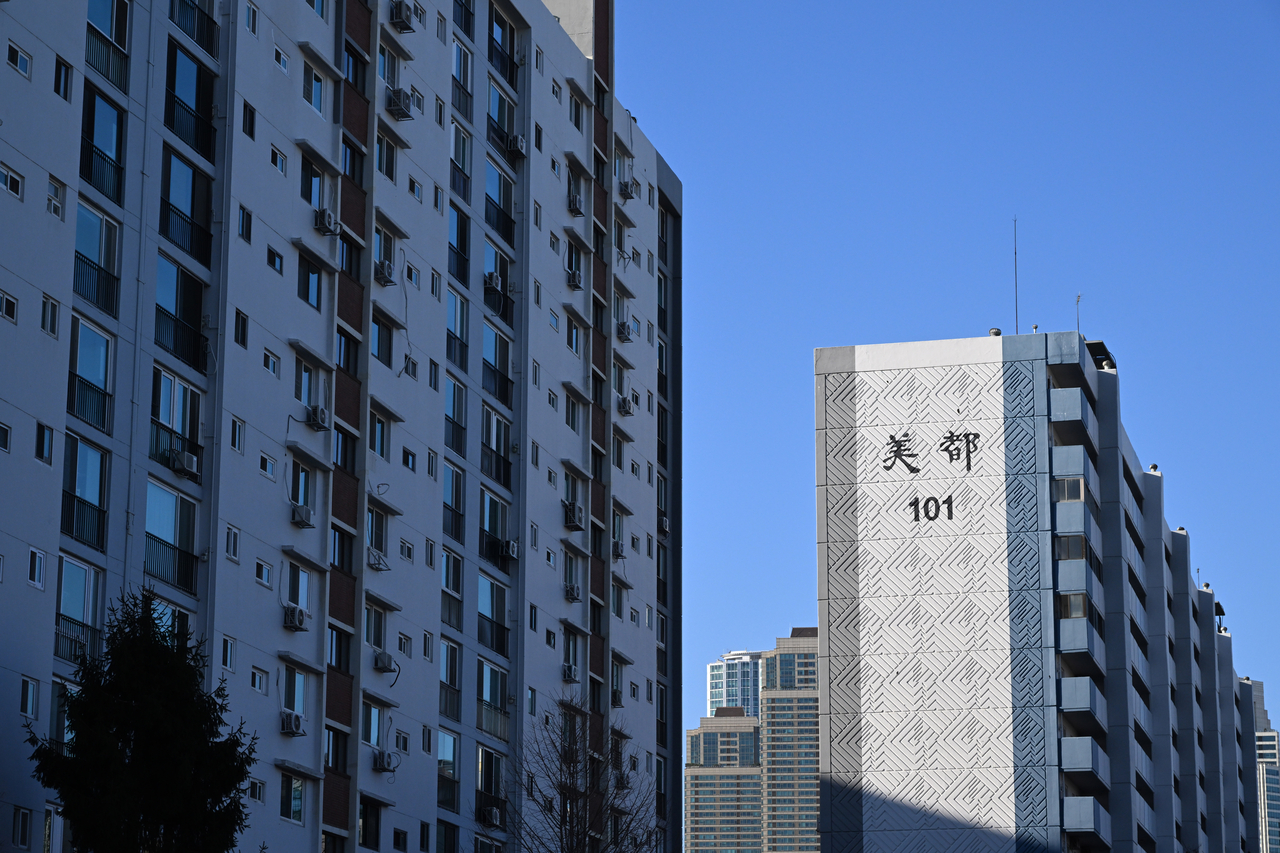
Members of the Daechi Mido apartment cooperative in Gangnam-gu, Seoul — one of the district's flagship reconstruction projects alongside Eunma — will face nine-figure contribution fees even if they downsize their units, new figures show. The outcome reflects a decision to increase the share of mid-to-large units allocated to cooperative members while cutting the number of units available for general pre-sale, pushing the proportionality ratio down from around 100 percent to the mid-70 percent range.
According to the redevelopment industry, the Daechi Mido apartment reconstruction cooperative held an estimated-contribution briefing Thursday to inform members of the details. The session, convened to share specifics following a revised maintenance plan announcement on Sept. 11, presented worked examples of estimated contribution calculations and an analysis of how project viability had changed.
Looking at estimated contributions by unit type, owners of an 84-square-meter unit who choose a 97-square-meter unit — priced at 3.72 billion won ($2.81 million) for cooperative members — must pay 792.96 million won. Estimated contributions for that same owner rise with the size chosen: 1.27 billion won for 117 square meters, 1.68 billion won for 130 square meters, 2.58 billion won for 162 square meters, and 3.37 billion won for 191 square meters.
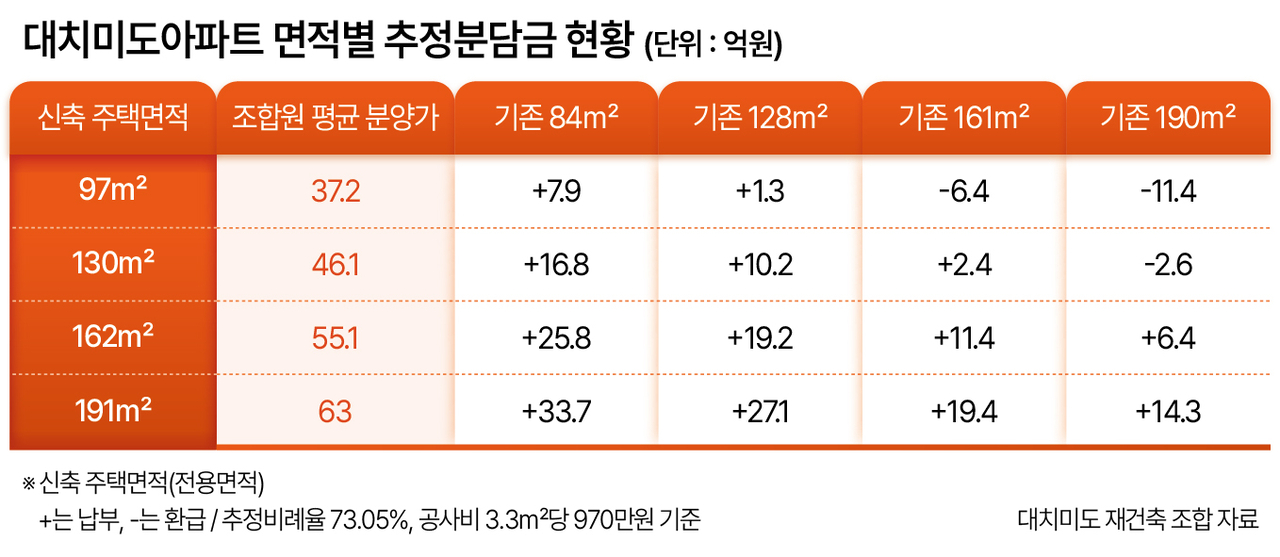
Cooperative members who currently own a mid-to-large 128-square-meter unit must still pay 131.13 million won in contributions even if they downsize by more than 30 square meters to a 97-square-meter unit. Choosing a 117-square-meter unit brings the contribution to 613.13 million won, while opting for a similarly sized 130-square-meter unit pushes it to 1.02 billion won.
Owners of the complex's largest unit type — 190 square meters — receive refunds for smaller selections: 1.14 billion won back for 97 square meters, 661.59 million won back for 117 square meters, and 259.59 million won back for 130 square meters. For larger choices, however, the burden reverses sharply, with contributions of 642.41 million won for 162 square meters and 1.43 billion won for 191 square meters.
These figures are based on an estimated proportionality ratio of 73.05 percent and a construction cost of 9.7 million won per 3.3 square meters. The proportionality ratio — a key indicator of project viability, calculated as total revenue minus total expenditure divided by total prior asset value, multiplied by 100 — stood at 100.52 percent before the maintenance plan revision but fell to 73.05 percent following design changes. The near-30-percentage-point drop stems primarily from a sharp increase in total prior asset value caused by a change in the assessment method: the revised plan now incorporates KB market prices, Korea Real Estate Board prices and official assessed values together, pushing total prior asset value up 59 percent compared with the earlier plan.
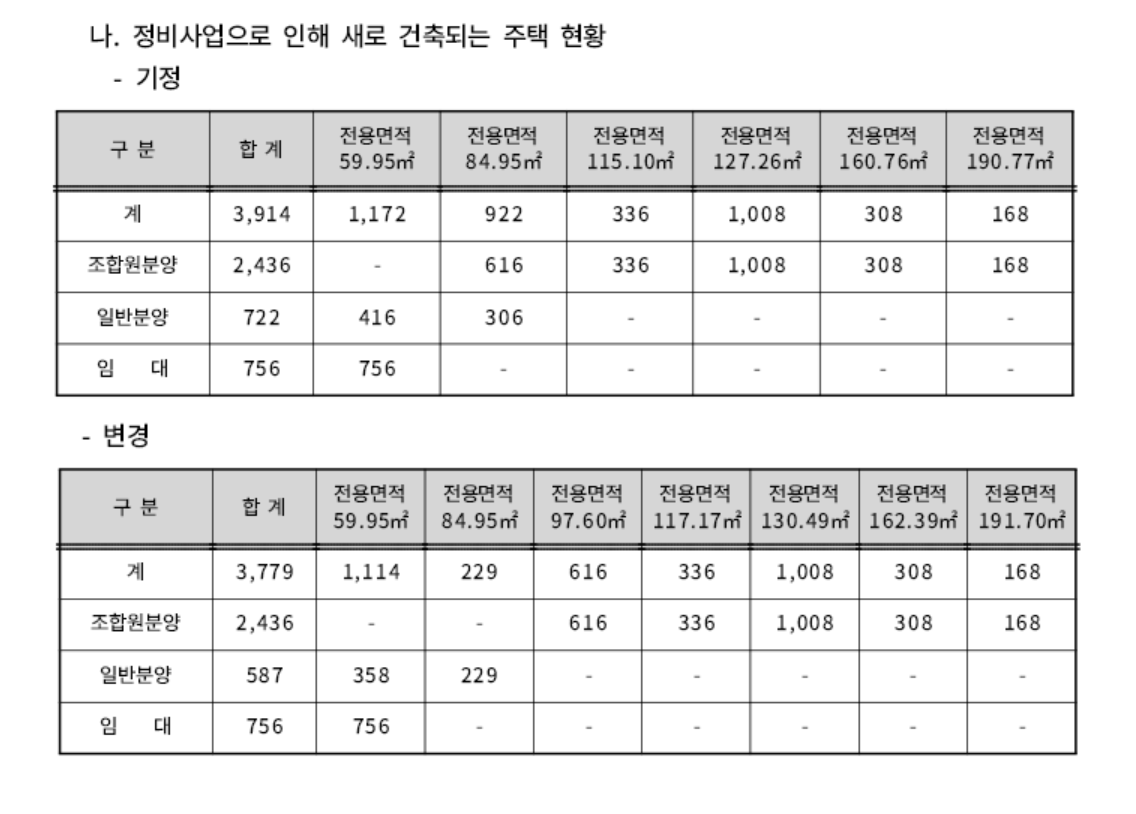
The burden on cooperative members was compounded further by a reduction in general pre-sale revenue — a result of expanding the mid-to-large unit allocation for members — alongside rising raw material and labor costs. The original plan had assigned the 616 existing 84-square-meter households to new 84-square-meter units on a one-to-one basis, but the revised plan upgraded those allocations to 97-square-meter units. As a result, the number of units available for general pre-sale fell from 722 to 587, a reduction of 135 units. With this key revenue source significantly curtailed, each cooperative member's share of project costs increased accordingly.
At the briefing, the cooperative also disclosed projected reconstruction excess profit recapture levies — separate from the contribution fees — that members are expected to pay. The figures were calculated assuming a general pre-sale price of 94 million won per 3.3 square meters, yielding a total estimated levy of about 344.2 billion won, or an average of 131 million won per household. The cooperative cautioned that these are current estimates and could change significantly depending on actual home price appreciation at the time of completion, official assessed values and the final general pre-sale price.
The dual burden of contribution fees and reconstruction excess profit recapture levies is not unique to Daechi Mido — it is emerging across nearby redevelopment sites as well. Eunma apartment, directly across from Daechi Mido and currently accepting pre-sale applications from cooperative members, has also seen estimated contributions surge. Owners of 84-square-meter units there who choose the same size must pay a contribution of 430.21 million won, underscoring a broader trend of mounting financial pressure across major Gangnam redevelopment projects.
Experts advise that, as rising construction costs and falling proportionality ratios have become constants in reconstruction projects, prospective participants must carefully examine the practical viability indicators of each complex — including land share per household, floor area ratio and the volume of units available for general pre-sale.
Kim Je-gyeong, director of Tumi Real Estate Consulting, said contribution fees are structurally unavoidable when owners seek to receive a unit equivalent to what they currently hold, because construction costs must be covered. "Individual owners need to thoroughly check the complex's land share per household and project viability, and judge for themselves whether the contribution amount is actually within their means," Kim said.
Kim added that Daechi Mido is in relatively good shape compared with other complexes because its land share per household is on the larger side. "Projects with contribution fees of 1 billion won are already appearing all over the place — the era of average contributions hitting 1 billion won is not far off," Kim said.
hwshin@heraldcorp.com