Ministry of Health and Welfare adopts 3.6 trillion won fee restructuring plan at 19th Health Insurance Policy Deliberative Committee meeting; timing for remaining 900 billion won to be set by year-end
The government will begin disbursing 2.7 trillion won ($2.04 billion) of the 3.6 trillion won in national health insurance funds earmarked for strengthening regional and essential medical care, starting in January next year.
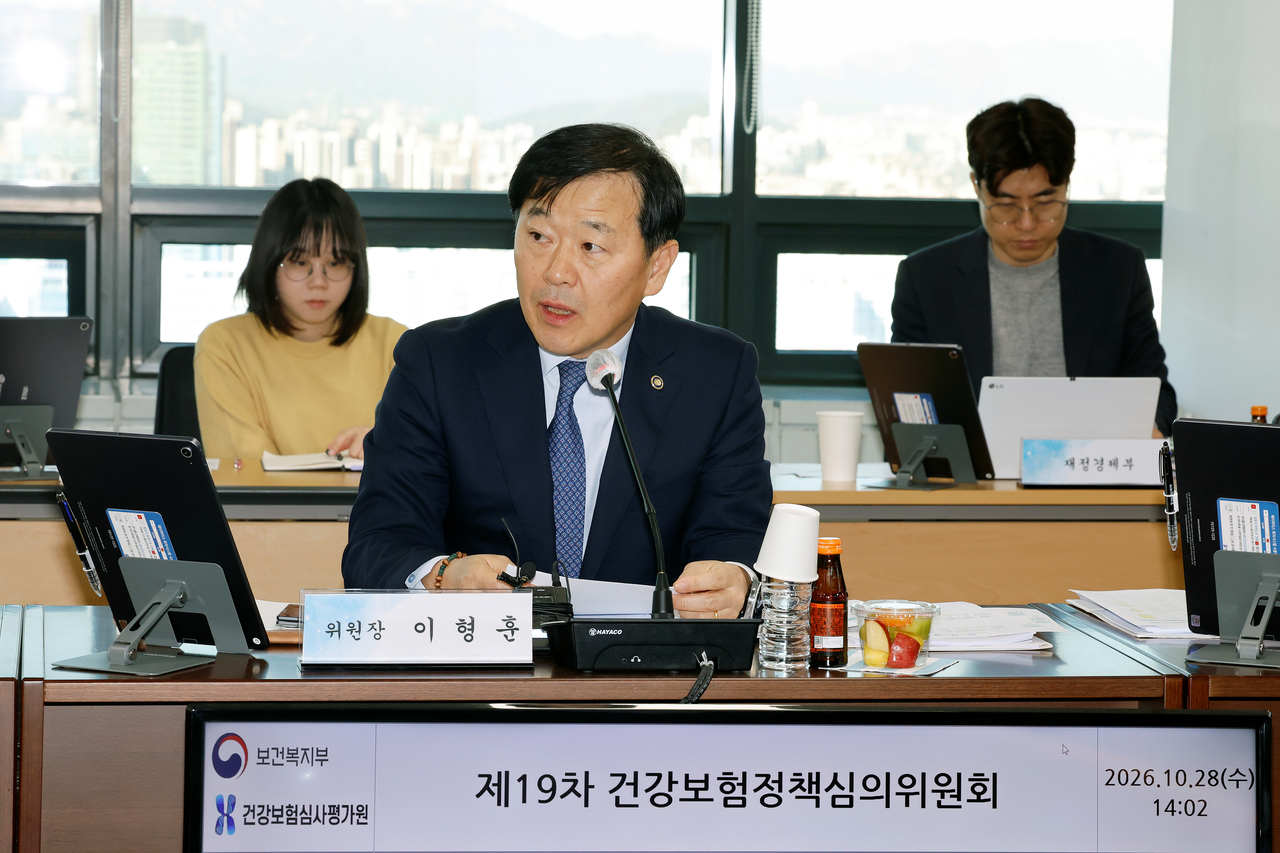
The Ministry of Health and Welfare convened the 19th Health Insurance Policy Deliberative Committee meeting Wednesday and adopted an implementation plan for restructuring national health insurance fee schedules, among other measures.
The implementation plan adopted Wednesday serves as a follow-up to the reform package finalized at the 12th committee meeting. Of the 3.6 trillion won annual investment plan for strengthening regional and essential care, the rollout timing for 2.7 trillion won has now been confirmed. The remaining 900 billion won will have its implementation schedule set by the committee before the end of this year.
Regional-preference fees of 400 billion won, final-treatment fees of 900 billion won to be deployed from next year
Starting in January, the government will apply "regional-preference fees" — higher reimbursements for providers outside the greater Seoul metropolitan area and in underserved zones within it, including Uijeongbu, Namyangju, Icheon and Pocheon in Gyeonggi Province and the northwestern and central parts of Incheon — beginning with childbirth and neonatal intensive care.
Of the 400 billion won allocated for regional-preference fees, 300 billion won will be applied next year as a priority, with the remainder to follow after additional deliberation.
The regional-preference fee, a 10 percent add-on, will first apply to inpatient care for deliveries and neonatal critical cases, then expand to surgeries and procedures from March.
Compensation for nighttime and emergency situations will also increase. For regional emergency centers, the current maximum surcharge for nighttime and holiday emergency critical surgeries stands at 350 percent; from next year it will rise to 470 percent.
Starting in January, consultation fees — frozen for 20 years — and inpatient fees, unchanged for more than a decade, will also be raised.
Two pilot programs currently under way — in-depth consultations of 15 minutes or more at tertiary hospitals and in-depth primary care consultations for children — will be converted into permanent services.
For in-depth consultations at tertiary hospitals in particular, the number of sessions per patient will increase from four to six per year — or eight per year for children under 8 — and the operating rules that had restricted consultations to specific days or times will be revised to allow them at any time.
The chronic disease management fee, previously available only to clinics with established chronic disease education and counseling systems, will be expanded to cover 13 disease categories — up from the current number — by adding rheumatism and chronic respiratory disease. A 20 percent fee surcharge will apply, rising to 30 to 50 percent for patients with two or more concurrent conditions.
A new top-tier nursing staffing category will be created for stroke and high-risk maternity intensive care units to strengthen compensation, and inpatient fees for isolation rooms and newborn nurseries will also be raised.
Acknowledging criticism that emergency-to-surgery "definitive treatment" is inadequately compensated, the ministry will increase reimbursements for critical and emergency surgeries, procedures and anesthesia by a combined 900 billion won annually.
For emergency inpatients requiring urgent care on holidays or at night — such as those on dialysis — the emergency treatment surcharge in emergency rooms will be raised by 50 percent. General anesthesia fees at general hospitals and above will increase by 10 to 50 percent, and the nighttime and holiday surcharge for critical surgeries, procedures and accompanying anesthesia will be raised from the current 100 percent to 150 percent.
Maternal and child care system strengthened; 'functional fees' introduced for emergency patient transfers
The ministry will also significantly expand compensation for maternal and child medical centers starting in January.
A new functional fee will be introduced for maternal and child centers that accept urgent transfer patients from central maternal and child centers and other facilities.
In line with the restructuring of the maternal and child care supply system, differentiated functional fees will apply to critical, regional and local maternal and child centers, with fee rates varying by gestational age.
For example, a critical maternal and child center that accepts a high-risk delivery patient under 34 weeks' gestation transferred from a central maternal and child center will receive an additional functional fee of 2.64 million won on top of the standard delivery reimbursement of about 4 million won ($3,020).
Critical maternal and child centers located outside the greater Seoul area or in one of the six underserved zones within it will receive an additional 660,000 won in regional-preference fees, bringing the total additional payment to 3.3 million won.
A new supplementary fee for neonatal intensive care inpatient compensation will also be established.
A critical maternal and child center accepting delivery or neonatal patients under 34 weeks' gestation transferred from a central maternal and child center will receive an additional 1.44 million won on top of the current neonatal intensive care daily inpatient fee of 957,000 won. This additional payment will apply for up to seven sessions.
Additional measures include gestational age-based tiered surcharges and a 50 percent surcharge on neonatal intensive care procedures at critical and regional maternal and child centers.
When all the planned surcharges are applied, the total inpatient reimbursement for high-risk deliveries under 24 weeks' gestation and neonatal intensive care — calculated over a 28-day period — will rise from the current 31 million won to 62.01 million won.
The ministry will also raise fees for specialized rehabilitation therapy requiring professional personnel by 10 percent starting in January. The number of facilities offering tailored intensive rehabilitation for children will expand from the current 47 to as many as 68.
Plans for restructuring the acute care supply system and building a rehabilitation care framework will be submitted as agenda items to the committee before year-end.
Conditional compensation for specimen testing contractors; fee adjustments to fund consultation and other charges
The ministry will provide conditional, differentiated compensation over two years starting next year to contracted and subcontracted medical institutions that meet quality improvement requirements for specimen testing.
Clinic-level contracting institutions that satisfy conditions such as result-sharing systems will be eligible to bill a clinical result analysis and management fee of 1,400 won per session, up to four times per patient per year. Subcontracted institutions that perform high-difficulty, low-frequency tests or tests referred from medically underserved areas will receive fees for those specific tests.
Next year, a portion of the funds linked to the conversion index increase — designated as "linked funds" — will be directed toward consultation fees at clinics and dental clinics, and toward meal and injection fees at hospitals. Under this arrangement, the relative value score for initial consultation fees will rise by 5.2 percent at clinics and 2 percent at dental clinics.
thlee@heraldcorp.com