Foreign crypto cards enter Korea via Visa network
Reporter tests Tether-loaded card at Gangnam stores
CJ Olive Young, Daiso, pharmacy — all cleared in under a second
From 1,000-won claw machines to AI subscriptions
Visa's 1% conversion fee, Tria's 0.5% fee — the hidden costs
"It would be pretty convenient for foreign tourists — no need to exchange currency, just tap your phone."
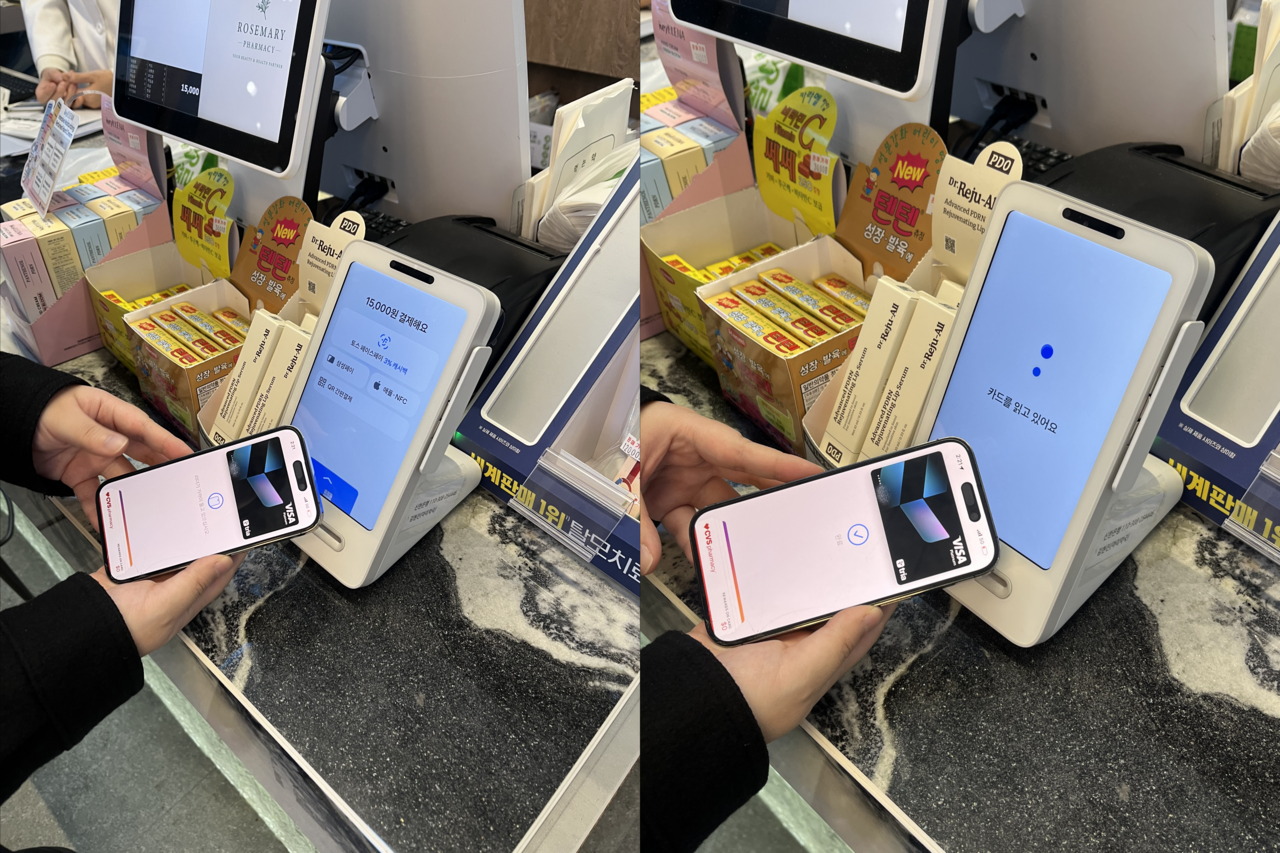
A pharmacist at a pharmacy near Sinnonhyeon Station in Seoul made the remark Wednesday afternoon while bagging artificial tears, acne ointment and liquid painkillers — 15,000 won ($11) worth of items a reporter had selected. The payment method was Tria, a crypto card registered on Apple Pay. Without a physical card, the reporter tapped a phone against a Toss payment terminal and the transaction was done in under a second.
The printed receipt read "overseas Visa card." The card had been loaded with Tether (USDT), a dollar-denominated stablecoin, yet the checkout experience was no different from using a regular credit card. That same day, the reporter also used the crypto card at a CJ Olive Young and a Daiso in the Gangnam area — both popular with foreign tourists. The card even worked at a 1,000-won claw machine at an arcade: one tap, instant payment.
Online purchases are also possible. After registering Tria as a payment method on the Coupang Inc app through the overseas card enrollment process, the reporter ordered a 5,000-won mouthwash, which arrived by Rocket Delivery that evening. Setting up the card was straightforward: pay a $20 annual fee with a domestic credit card, enter a promotional code received by email, then complete a know-your-customer identity verification. A Visa Platinum virtual card was activated in under 10 minutes.
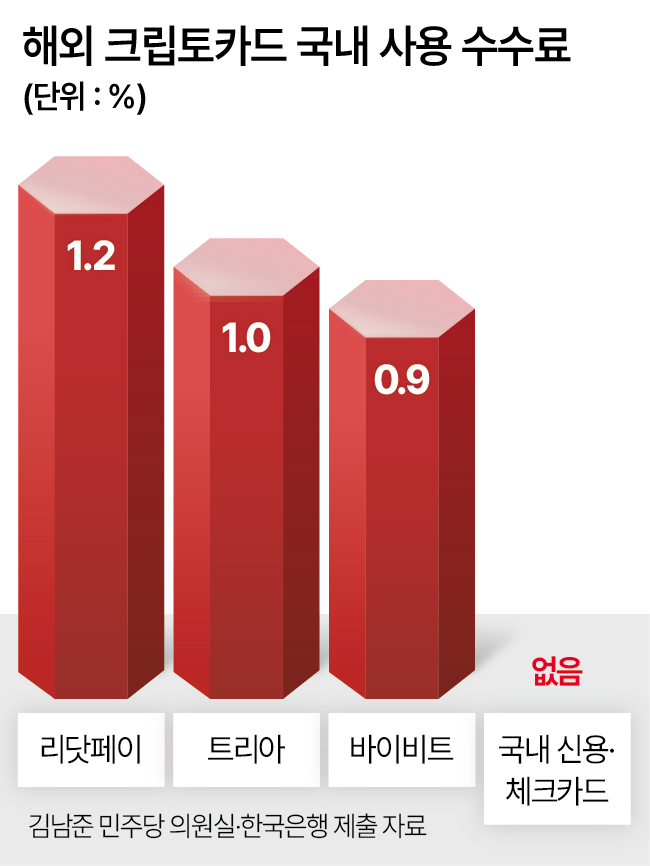
Cashback rewards accumulate with every purchase, but exchange rates and fees still demand scrutiny. After each transaction, a cashback notification popped up on the reporter's phone: 221.55 won after spending 15,000 won at the pharmacy, and 117.07 won after a further 8,000-won purchase there. The Tria Lite membership the reporter had signed up for returns 1.5 percent of spending up to $1,000 per month. Over the course of the day, total spending came to 53,000 won, yielding roughly 760 won in cashback.
The Tria app displayed each transaction's won amount alongside its dollar equivalent and the applied exchange rate. A 20,000-won purchase at CJ Olive Young showed a deduction of $15.35; the 15,000-won pharmacy charge appeared as $11.51.
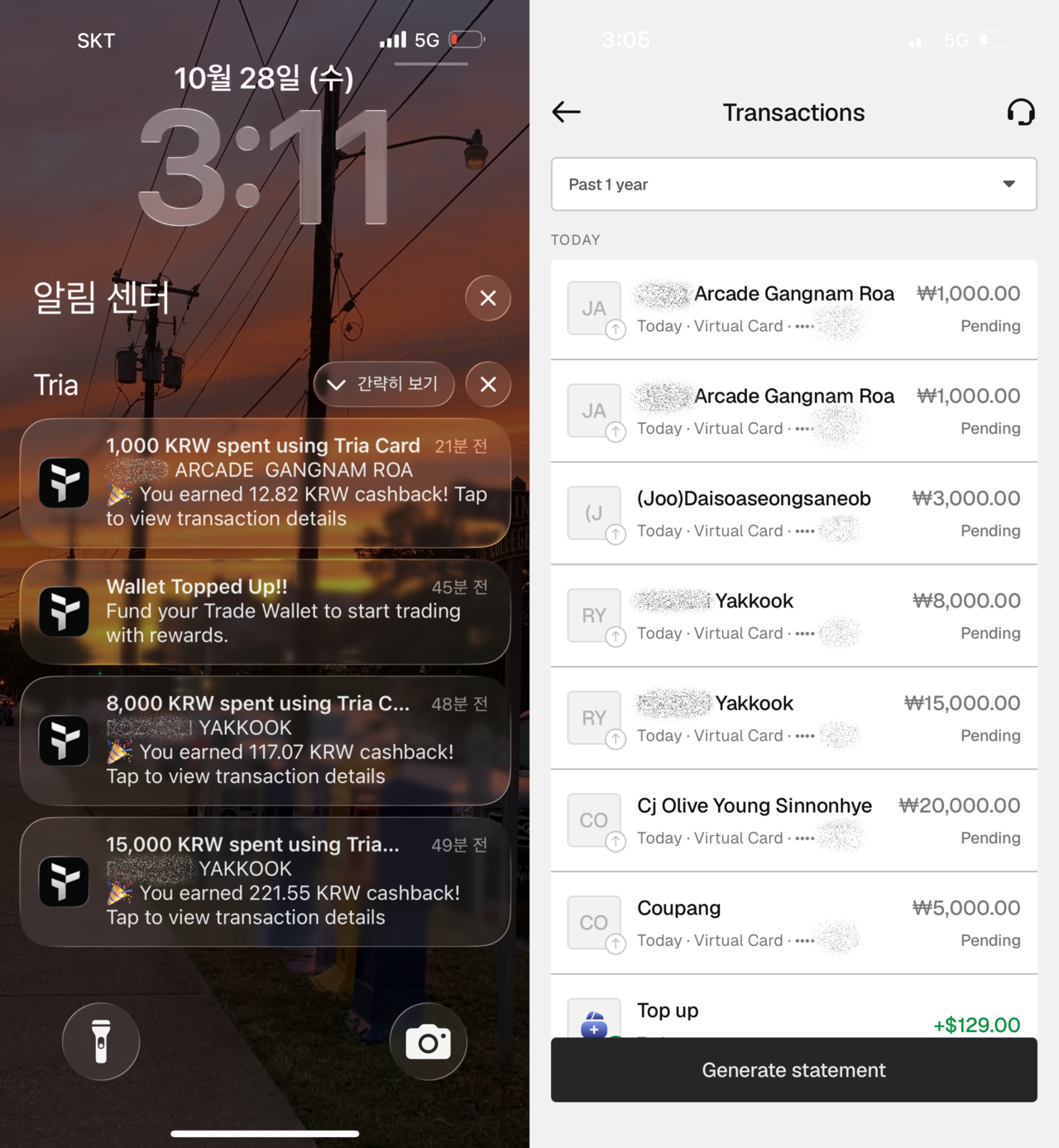
The cashback offset some of the fee burden, but it was hard to conclude the card is cheaper than a regular credit card. Every transaction carried a 1 percent Visa currency conversion fee and a 0.5 percent Tria fee, though Tria absorbed a $0.15 per-transaction convenience fee. Users also need to factor in the purchase price of the virtual assets loaded onto the card, the exchange rate applied at the time of payment, and gas fees — the network costs of transferring assets between wallets.
Despite those caveats, users cite cross-border payment convenience and rebate benefits as the card's main draws. The appeal lies in being able to spend virtual assets directly without first withdrawing them to a bank account or converting them to local currency.
Among salaried workers with an interest in virtual assets, word of mouth has been spreading about AI service subscription rebate promotions. One worker in their 30s, identified only as A, said monthly subscription costs prompted the decision to get a crypto card after spotting a promotion from an overseas exchange. "I paid for my Claude Pro subscription — $22 including tax — and got back $20 worth of the stablecoin USDG," A said. "My effective subscription cost dropped to just $2."
The cards are also discussed as a payment option for foreigners living in South Korea. Foreign nationals face restrictions on using real-name accounts at domestic exchanges, which can make it difficult to convert virtual assets into won. Industry officials say this has created demand among some foreigners to pay at domestic merchants using overseas crypto cards rather than resorting to over-the-counter trading.
"For people managing assets on-chain through decentralized finance, being able to use a portion of those holdings directly for payments is highly practical," one industry official said.
Beyond their convenience, crypto cards are quietly being shared in some circles as a way to sidestep transaction tracking and tax-related regulations, drawing calls for closer scrutiny.
One user, identified as B, said that during a trip to Japan, whisky worth several million won was purchased at a local liquor store using Tether instead of yen. "I could buy the goods on the spot without having to sell my Tether, withdraw it as won, or convert it to yen," B said. "And it didn't get flagged at customs."
The Bank of Korea has itself warned that crypto cards could be exploited as a channel for regulatory evasion. Using virtual assets held in personal digital wallets or on overseas exchanges for payments, the central bank has cautioned, could allow users to obscure fund flows and avoid tax-related obligations.
The cards have also been flagged as a potential vehicle for evading gift taxes in cross-border remittances. A Bank of Korea report published last year, titled "Key Issues and Policy Responses for Won-Denominated Stablecoins," cited a case in which a prepaid card from Linea Pay was issued under a pseudonym to avoid gift tax liability.
In that case, the asset holder loaded USDT procured through an unregistered currency broker onto the card and handed it to a son, who used it at domestic and overseas merchants and withdrew cash from ATMs abroad to cover expenses such as summer camp fees. To avoid detection by tax authorities, the holder also avoided making repeated payments at hagwon and similar establishments.
Industry officials believe demand for crypto card payments from foreign medical tourists is also significant. Some dermatology and plastic surgery clinics in the Gangnam area have been found to accept virtual assets directly into digital wallets as payment from foreign medical tourists.
"Foreign medical tourists who are comfortable with virtual asset transactions may find it convenient to pay for treatment with the coins they hold," one financial industry official said. "Beyond direct wallet transfers, crypto cards can be used at merchants that support international card networks, so related payment demand is likely to be considerable."
As the range of crypto card use cases expands, the global market is growing rapidly. According to Paymentscan, a digital asset payment data analytics platform, crypto card transaction volume stood at $1.15 billion as of Wednesday — roughly 2.5 times the $463.7 million recorded for all of October last year.
Meanwhile, as overseas operators extend payment services into South Korea, domestic companies are struggling to commercialize similar offerings due to regulatory gaps. Industry voices are calling for the second phase of the Digital Asset Basic Act to clearly define the legal status of stablecoins and the scope of their use in payments.
Kim Jeong-hyeon, chief executive of virtual asset wallet developer Baerae, said the framework law must at minimum establish principles around stablecoins and provide a legal basis for their use as a payment instrument before related businesses can move forward. "If a structure can be created where merchants receive payment in won-denominated stablecoins regardless of which virtual asset the customer uses, practical utility will increase significantly," Kim said.

kyoung@heraldcorp.com