Firms with 100-plus workers to comply by 2028, smaller businesses phased in through 2030; early adopters eligible for fiscal support; fund-type pension scheme to be expanded with private financial firms
The government plans to require all workplaces to hold retirement benefit reserves at external financial institutions by 2030, moving to prevent unpaid retirement pay caused by corporate insolvencies or financial difficulties.
To ease the burden on small businesses, the government will also provide matching support for reserve contributions and cover a portion of business loan costs. It plans to reform the system to encourage collateral-backed loans instead of early withdrawals from retirement pension accounts, and to expand private financial firms' participation in the fund-type retirement pension scheme.
The Ministry of Employment and Labor, the Ministry of Economy and Finance, the Financial Services Commission and the Financial Supervisory Service announced the plan — titled "Measures to Strengthen Retirement Pension Functions" — on Thursday, following consultations with the National Assembly's Climate, Energy, Environment and Labor Committee and the ruling party. The measures build on the joint labor-management-government declaration of Feb. 6, which called for mandatory external retirement benefit reserves and the revitalization of fund-type retirement pensions.
If an amendment to the Act on the Guarantee of Workers' Retirement Benefits passes the National Assembly this year, the government plans to begin phasing in the mandate after a one-year preparation period — starting with workplaces of 100 or more employees in 2028, expanding to those with 10 to 99 employees in 2029, and covering workplaces with fewer than 10 employees in 2030. Under the external reserve system, companies set aside funds at outside financial institutions in advance to cover retirement payments owed to workers. This addresses the limitations of in-house reserves, where corporate financial difficulties or insolvency can make it impossible to pay out retirement benefits. Last year, unpaid retirement pay totaled 822.9 billion won ($616 million), accounting for 41.1 percent of all unpaid wages.
The government will also provide fiscal support to encourage small businesses to adopt retirement pensions early and to bolster retirement benefit accumulation for low-wage workers. Small and medium-sized enterprises that adopt external reserves ahead of the deadline will receive a 10 percent subsidy on contributions for workers earning less than 130 percent of the minimum wage. Those newly introducing retirement pensions will receive a 2 percentage point reduction on business loan interest rates. Fiscal support of 6 billion won for early-adopting workplaces and a 6.2 billion won program to cover business loan costs have been included in the Ministry of Employment and Labor's 2027 budget proposal.
The government based the three-year phased rollout and support measures on a survey of 1,500 workplaces that have yet to adopt retirement pensions. It is also pursuing a plan to automatically enroll workplaces that have not completed external reserves in "Blue Seed," a public fund-type retirement pension. Regular inspections will be expanded, and penalties including fines will be strengthened where necessary.
As retirement funds will be entrusted to specialized institutions, the responsibility of the trustee is as important as investment performance. The government plans to enshrine a beneficiary-first principle in law and to establish the trustee's liability for damages and the beneficiary's right to claim compensation in cases of breach of duty.
Safeguards against operational accidents or losses will also be put in place. Trustees will be required to maintain an operational risk reserve — the government's plan sets this at 0.25 percent of total reserves — to be held in a separate account and used to cover beneficiary losses and respond to incidents. Functions requiring independent verification, such as asset custody, net asset value calculation and performance evaluation, will be mandatorily outsourced. Core responsibilities such as investment policy decisions, risk management and the selection and oversight of subcontractors will remain directly with the trustee.
The government will also change how retirement pensions are paid out to ensure the funds serve as retirement income. Currently, many account holders make early withdrawals or take a lump sum upon retirement, undermining the scheme's purpose as a source of old-age income security.
The government plans to revise relevant laws and regulations to allow account holders who need large sums — for housing purchases or living expenses — to secure funds through collateral-backed loans without cashing out their retirement pensions. It also plans to introduce a default-to-annuity rule, under which retirement benefits will be paid as a pension unless the recipient explicitly requests a lump sum. Relevant information, including projected payout amounts and tax implications for both annuity and lump-sum options, will be provided in advance to help beneficiaries make informed decisions.
Tax incentives for long-term annuity receipt will also be expanded. The government is pursuing a plan to apply a 15 percent tax credit rate on retirement pension contributions by young workers, regardless of income level. Over the long term, the government aims to establish retirement pensions as a pillar of a multi-layered pension system that, alongside the national pension, supports old-age income security.
The government is also pushing to revitalize the fund-type retirement pension scheme to improve investment returns. Under the fund-type system, a specialized third-party trustee manages the reserves on behalf of participants, with any gains or losses accruing to the participants.
Calls to overhaul the pension management framework have grown, as retirement pensions have been overly concentrated in principal-guaranteed products, keeping long-term returns at around 2 percent.
Kim Jeong-ho, chair of the National Assembly's Climate, Energy, Environment and Labor Committee and a member of the Democratic Party, said it was "a very meaningful achievement that labor, management and government have aligned on the phased mandate for retirement benefits and the revitalization of fund-type retirement pensions," adding that "it is now very necessary to translate this into concrete institutional reforms and legislative outcomes."
Under the existing contract-type system, employers sign agreements with financial institutions, and participants in defined contribution or individual retirement pension accounts typically choose their own investment products. The fund-type system allows reserves to be managed by a professional investment institution, reducing the burden on participants who struggle with product selection and management. Actual returns, however, will vary depending on investment strategy and market conditions.
The government has classified the fund-type scheme into three categories based on the entity establishing it: a "financial institution open type," in which a financial firm sets up a separate trustee corporation; a "joint type," established by multiple employers or labor-management associations; and a "public institution open type," operated by a public institution. Workplaces will be allowed to operate both contract-type and fund-type schemes simultaneously, or to maintain multiple fund-type arrangements. The government is also pursuing a plan to designate a specific fund-type scheme as the default option, subject to the consent of worker representatives.
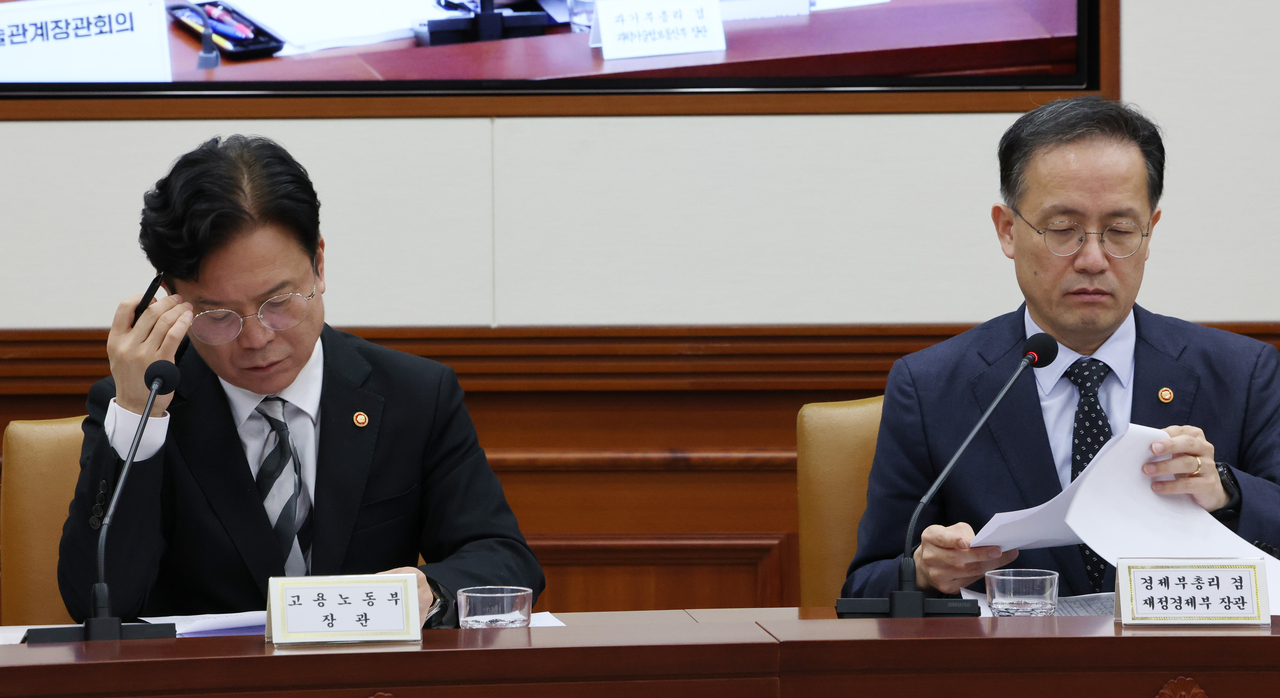
Fund management institutions will be required to undergo a rigorous licensing process, including review by an authorization committee composed of labor and management representatives, experts and government officials, before receiving approval from the minister of employment and labor. A two-stage process — preliminary and full authorization — will apply. Employment and Labor Minister Kim Young-hoon said the government "categorized the entities that can establish fund-type retirement pension trustees into three types and designed each to fit its characteristics," adding that "since the reserves are workers' retirement funds, we have placed the protection of beneficiary rights as the top priority and recognized strict trustee responsibilities."
The performance evaluation system for the 47 existing contract-type retirement pension providers will also shift to a quantitative, returns-focused assessment. The plan is to evaluate long-term investment performance and annuity payout records, and to expand the public disclosure of returns by provider, broadening participants' ability to choose. The aim is to promote competition among financial firms by enabling better-performing providers to attract more participants.
The current 70 percent cap on risky asset investments in individual retirement pension accounts will also be gradually eased, as a measure to expand participants' investment choices and improve long-term returns. To reduce the problem of funds sitting idle after maturity, the notification timing for the default option will be moved up from four weeks after maturity to two weeks before maturity.
As of the end of last year, total retirement pension reserves stood at 501.4 trillion won, up 69.7 trillion won from the previous year. Last year's return rate, however, was limited to 6.47 percent. Early terminations of retirement pensions in 2024 reached 15 trillion won, while mid-term withdrawals reached 3 trillion won. Only 16.5 percent of retirement benefit accounts last year received payouts as annuities; 83.5 percent took lump sums.
The government plans to prepare an amendment to the Act on the Guarantee of Workers' Retirement Benefits reflecting these measures next month and push for its passage in the National Assembly before the end of the year.
thlee@heraldcorp.com