The British government has urged every household to stockpile at least three days' worth of food and essential supplies, asking citizens to prepare for scenarios in which war or cyberattacks knock out the power grid and communications networks. Amid growing Russian threats against Europe, Britain has launched one of its largest public emergency-preparedness campaigns since the Cold War — and sales of survival goods are already surging.
According to The Guardian and Reuters, the government officially announced the "Be Ready" campaign Thursday, calling on households nationwide to assemble emergency supplies sufficient for 72 hours.
The recommended stockpile goes beyond water and canned food to include cash, flashlights, spare batteries and a wind-up radio — items chosen with the assumption that a major power outage could suspend card payments, internet access and mobile phone service.
The government plans to run the campaign for three years, with the aim of raising the public's ability to respond to emergencies.
The two-page emergency preparedness guide the government released focuses on enabling households to maintain basic living conditions for at least 72 hours without outside support.
Water and food top the list of essentials. The guide recommends 3 liters of drinking water per person per day — 9 liters over three days — and notes that additional water should be set aside separately for cooking and hygiene.
For food, the guide calls for shelf-stable items such as canned goods and dried foods that can be consumed even if electricity or gas supply is cut off.
Other recommended items include a first-aid kit, blankets, a flashlight, a portable battery pack, hygiene products and copies of important identification documents.
Two items in particular stand out: cash and a wind-up FM radio. Cash is included because credit card and mobile payments could be disrupted if the power grid or communications networks fail. The wind-up radio would allow people to receive official guidance broadcasts without electricity or an internet connection.
The government advises households to build up their stockpile gradually during regular shopping trips rather than buying everything at once, in an effort to avoid panic buying and excessive financial strain.
The campaign recalls Cold War-era British civil defense efforts. In 1980, the government ran a public campaign called "Protect and Survive," which instructed households on how to build makeshift shelters and stockpile food in the event of a nuclear attack. That guidance included advice on creating spaces to shelter from radioactive fallout and called for a 14-day food supply.
Britain has provided household emergency preparedness guidance since May 2024. The new campaign differs in that it involves active, nationwide promotion — an expansion of the existing guidance.
The low level of public preparedness is also a factor behind the large-scale campaign. A government survey published this year found that only 13 percent of respondents felt their household was sufficiently prepared for an emergency, while 84 percent said it was important for the government to provide more information on how to respond to a crisis.
The government noted that France, Ireland, the Netherlands and other European countries operate similar household emergency preparedness systems.
The campaign has drawn particular attention because it comes amid growing Russian hybrid warfare threats. Hybrid warfare combines conventional military operations with cyberattacks, information warfare and sabotage of infrastructure to undermine an adversary's security and social functions.
British Defense Minister Wes Streeting warned Thursday at the opening of a defense factory in Telford, West Midlands, that Russia and other hostile states were threatening Britain's critical infrastructure.
Streeting said it was more accurate to describe such threats as "state-sponsored terrorism" than to use terms like "hybrid warfare" or "gray-zone threats."
He said the threats were not hypothetical or distant but were increasingly becoming a reality in Britain, and called for strengthening the country's overall crisis-response capacity alongside national defense.
The government's list of potential targets includes the power grid, communications networks, financial payment systems and logistics supply chains. A disruption to power generation or transmission could trigger large-scale blackouts, while a failure of communications and payment systems would disrupt everyday economic activity such as banking and shopping.
Russian threats to undersea communications cables and energy transport infrastructure are also a concern. The Royal Navy has been tracking Russian intelligence-gathering vessels operating near the undersea cables and pipelines connecting Britain to the European continent, amid fears those facilities could come under attack.
Europe has already seen large-scale disruption caused by infrastructure failures. In April last year, voltage instability in the power grid triggered widespread blackouts across Spain and Portugal, affecting about 55 million people and disrupting transport, communications and commercial operations.
In Britain, Storm Goretti left tens of thousands of households without power in January this year, with some areas taking more than three days to have electricity restored.
Cybersecurity risks are also growing. A recently discovered vulnerability in the widely used PHP programming language prompted 32 British government websites to be temporarily taken offline as a precaution, and the National Cyber Security Centre sent about 50,000 alerts to potentially affected institutions.
While that incident is distinct from confirmed hostile-state attacks, it illustrated how vulnerabilities in digital systems can lead to disruptions in public services.
The government said that alongside the Russian threat, improving resilience against extreme weather events and natural disasters is also a key objective of the campaign.
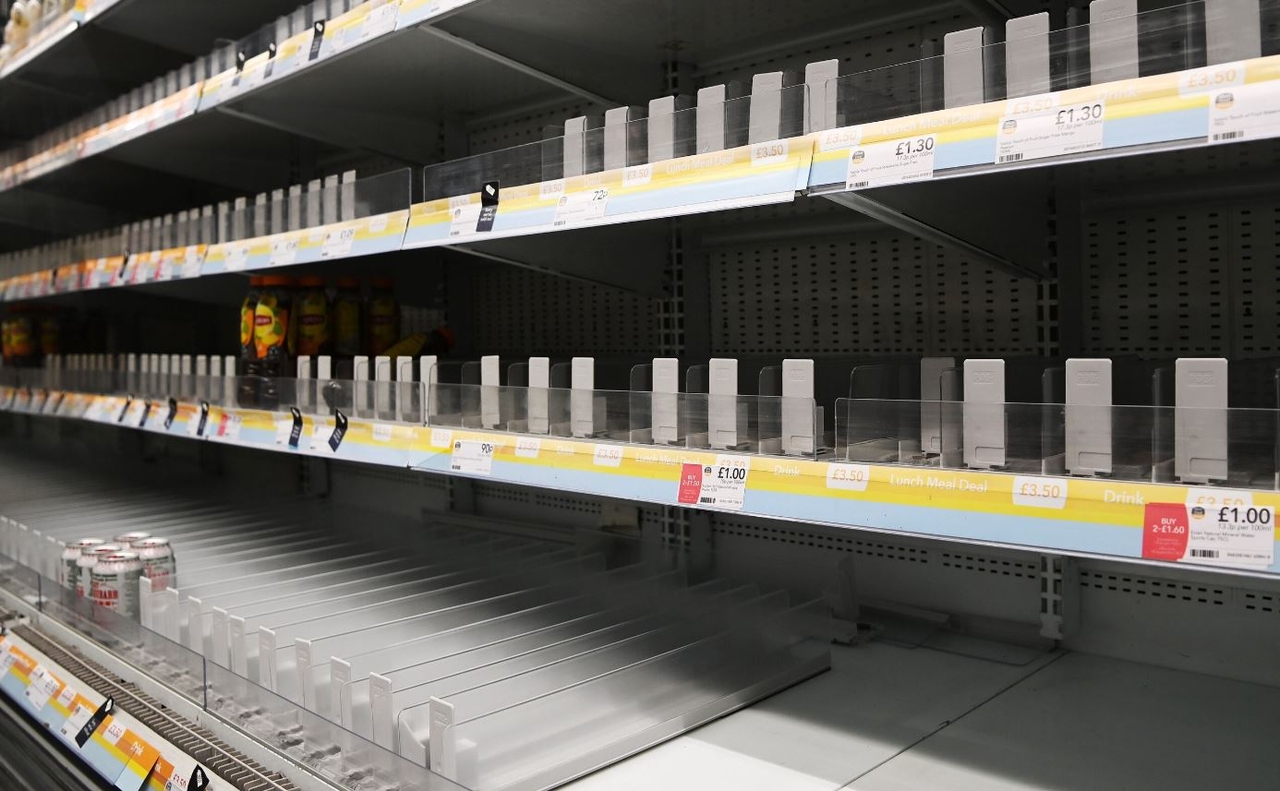
The government's announcement has in fact prompted a surge in purchases of emergency food and survival supplies. Jack Brown, co-owner of British emergency supplies retailer Sgt Prepper Shop, told The Guardian that within 24 hours of the campaign's launch, the store received the equivalent of a full month's worth of orders. Brown said the sudden flood of orders made him think his phone had malfunctioned or been hacked.
Dan Goss, operator of another emergency supplies retailer, Start Prepping UK, said website traffic had risen 700 percent since news of the government's campaign plans emerged in August.
However, the surge appears to have been limited to specialist emergency supply retailers — no widespread panic buying at grocery stores has been reported.
Experts said a three-day emergency stockpile was a realistic and reasonable target. Sarita Robinson, a doctor in the psychology department at the University of Lancashire, said that when the government explains a crisis situation clearly, citizens are more likely to take active steps to prepare, and that such guidance does not necessarily cause panic.
The campaign has also drawn political criticism, with some arguing the government is shifting the burden of emergency preparedness onto the public. Kemi Badenoch, leader of the main opposition Conservative Party, said the government should focus on securing the country's critical infrastructure, borders and armed forces before telling people to stockpile supplies.
Badenoch said rural residents already prepare for power cuts and limited access to shops as a matter of course, and called on the government to fulfill its core responsibility of protecting the public.
Prime Minister Andy Burnham rebuffed the criticism. In a BBC Radio interview on Friday, Burnham said unexpected events were becoming increasingly frequent and that it was necessary for citizens to take basic precautions.
He said calm judgment was essential in a crisis, and added that he personally planned to stock up on canned beans and soup as his emergency supplies.
The government said the campaign was not intended to transfer responsibility for crisis response onto the public, but rather to ensure that emergency responders could be directed first to the most vulnerable. According to the Cabinet Office, more than 500 public institutions, businesses and charities have agreed to help promote the campaign.
The government plans to publicize the emergency preparedness guidelines through radio and social media, with a particular focus on households with young children and elderly residents who are more vulnerable in a disaster. It is also encouraging people to register with water, electricity and gas suppliers so those companies can identify households that should receive priority support in an emergency.
The campaign reflects the government's assessment that war, cyberattacks and climate disasters could disrupt the everyday functions of a modern society that depends on electricity and communications. As threats to national infrastructure grow, debate is expected to continue over how much emergency preparedness the government can reasonably ask of its citizens — and what roles the state and the individual should each play in a crisis.
rainbow@heraldcorp.com