Divisions persist within ruling party over labor exemptions
Two competing bills introduced but no consensus reached
Government weighs regulatory workaround via enforcement decree
Assembly special committee still in early stages; year-end passage unlikely
Prospects for passing the so-called "mega special zone" bill — the legislation underpinning President Lee Jae-myung's three flagship mega-projects — before the end of the year are growing dim. The sticking point is a proposed exemption from the 52-hour workweek for research and development workers, which has drawn fierce resistance from labor groups.
The Democratic Party is heading into National Assembly deliberations without having resolved internal and external disagreements over the bill's labor exemption provisions, according to political sources Tuesday.
Within the party, two camps remain at odds: one argues that sufficient social dialogue must take place before moving forward, given labor's opposition, while the other insists the bill should be pushed through quickly to stimulate regional investment.
A Democratic Party lawmaker on the National Assembly's Climate, Energy, Environment and Labor Committee said by phone that reconciling the differences "won't be easy, given how far apart the positions are," adding that the outcome would depend on how social dialogue unfolds.
Earlier, the Democratic Party introduced two separate bills. Rep. Park Sang-hyeok introduced legislation on Oct. 20 that included labor exemptions, while Rep. Choi Gi-sang introduced a separate bill the following day that excluded them. The party said it plans to merge the two bills during the Assembly review process to produce a final version.
Park's bill would exempt R&D workers in special zones who meet certain criteria from working-hour regulations, and would also expand flexible working-hour arrangements, extend the permitted duration of fixed-term employment contracts, and ease restrictions on dispatched workers. Labor groups have pushed back sharply, arguing that such exemptions could erode fundamental labor rights.
A lawmaker on the Democratic Party's Mega Growth Special Committee explained the rationale for introducing two bills. "We couldn't introduce only a bill that stripped out all the exemption provisions just to preempt labor opposition, not knowing how far social dialogue would go or whether any agreement would be reached," the lawmaker said. "The Ministry of Trade, Industry and Energy has long pushed for labor exemptions, but introducing only a bill that includes them risked a labor backlash — so we introduced both versions separately."
Opinion within the party is also divided on how fast to move. One ruling party official said the success of the three mega-projects is directly tied to the success of the Lee administration, and called for pressing ahead with the bill rather than "wavering out of concern for labor opposition."
A Democratic Party floor official took a different view, saying the focus is on reaching a consensus through thorough deliberation before year's end rather than fixating on a legislative deadline. "The National Assembly special committee is still just getting started," the official said, signaling that resolving the labor exemption dispute and building social consensus would take priority over swift passage.
Amid the continuing disagreement over labor exemptions, the government is also understood to be exploring an alternative approach — amending enforcement decrees rather than enacting a special law that would create new exceptions to the 52-hour rule. The move is seen as an effort to give companies more flexibility in managing working hours within the existing legal framework, while avoiding a direct confrontation with labor groups.
President Lee had directed officials at the second plenary session of the Regulatory Rationalization Committee held at Cheong Wa Dae on Friday to explore whether the semiconductor industry's request for R&D working-hour exemptions could be addressed by modifying existing enforcement decrees or simplifying procedures. "It appears there is room for the minister of employment and labor to act through enforcement decrees," he added.
A separate lawmaker on the climate and labor committee said that since Lee's remarks, "the atmosphere has calmed somewhat" as an alternative path around the labor exemption controversy has emerged. However, voices within the party still note that further discussion is needed on how much of industry's demands can be met through decree amendments, and whether labor exemptions should ultimately be included in the bill.
A ruling party consultative meeting between lawmakers on the climate and labor committee and the Ministry of Employment and Labor is scheduled for Thursday. However, observers widely expect the session to amount to little more than a ministry briefing, given that the committee and the ministry currently hold the same position and are unlikely to accelerate efforts to bridge differences.
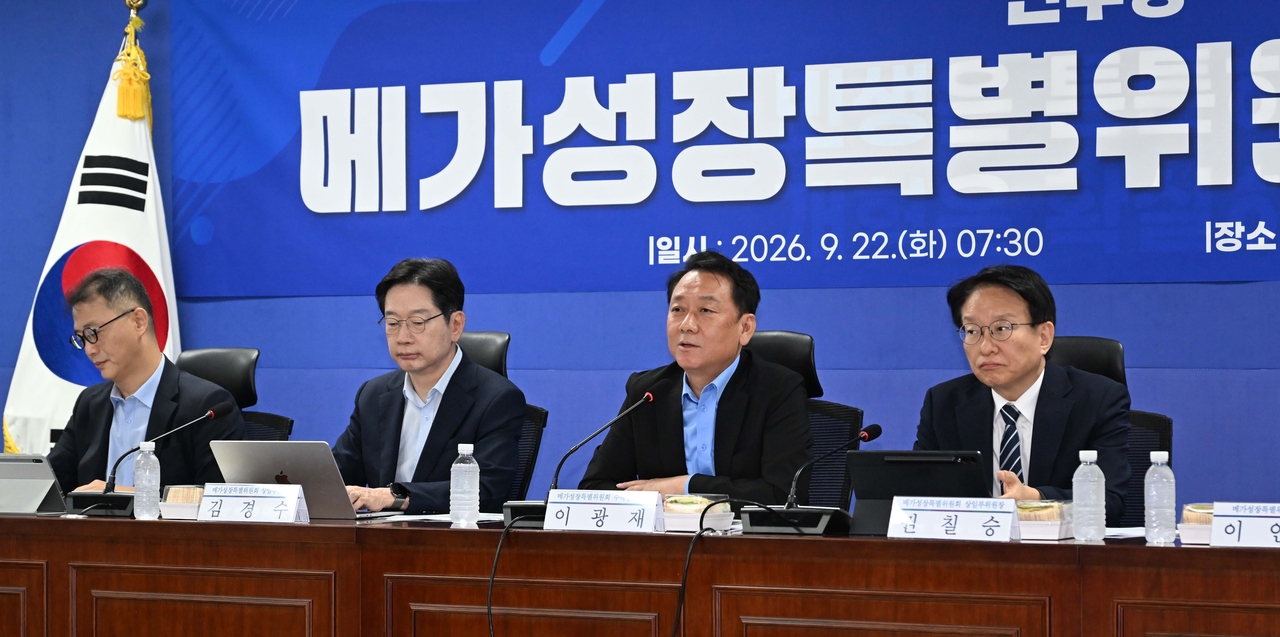
Meanwhile, at a ruling party-government meeting of the Mega Growth Special Committee held at the National Assembly on Monday, the Democratic Party agreed to push for the establishment of a dedicated National Assembly special committee to advance the legislation. Policy committee Chairman Kwon Chil-seung told reporters after the meeting that the party plans to set up a separate special committee rather than routing the bill through the National Assembly's National Policy Committee as in the past, and that the process would involve consultations between the ruling and opposition parties.
thanks@heraldcorp.com
addressh@heraldcorp.com