Korean language performance, inference efficiency surpass global models
Kakao has unveiled two AI models designed to understand user intent and retrieve relevant information, as the company moves to continuously upgrade its model capabilities and strengthen the search performance of its personalized AI agent.
Kakao said Thursday it had released two embedding models — collectively called "Kanana-2-embedding" — as open-source on Hugging Face. The models serve as foundational technology for the company's personalized AI agent.
The two models are Kanana-2-3b-embedding, with 3 billion parameters, and Kanana-2-1.3b-embedding, with 1.3 billion parameters. The release follows Kakao's open-source publication of four Kanana small language models in July.
An embedding model converts the meaning of text into numerical representations to find information relevant to a user's query. While a standard language model interprets a question and generates an answer, an embedding model identifies the information needed for that answer by measuring semantic similarity between the query and available data. A key feature is that users can retrieve relevant results even when they cannot recall the exact wording of what they are looking for.
Kakao said embedding models are considered core technology for developing personalized AI agents. For example, when a user searches for "that quiet restaurant we talked about before," the model can surface past information stored under similar meanings — such as "a good place for conversation" — without the user having to enter the restaurant's name.
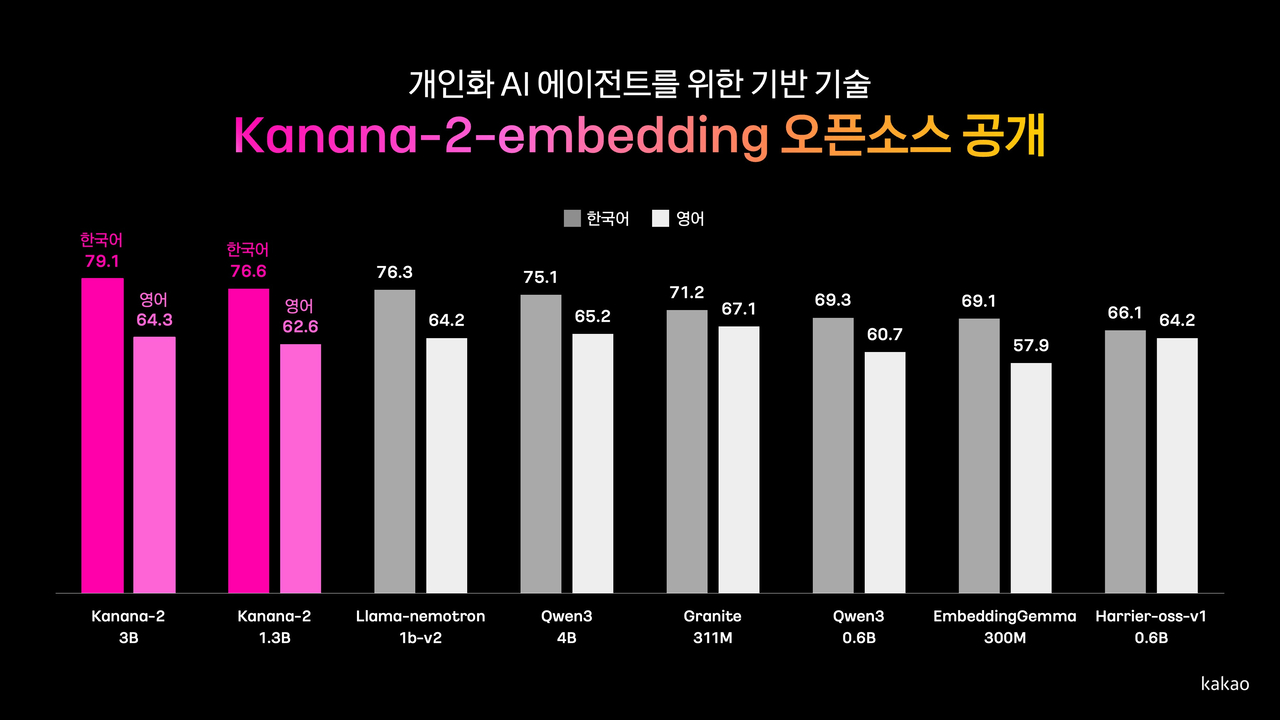
In benchmark evaluations against comparable global models — including llama-nemotron-embed-1b-v2 and Qwen3-Embedding-4B — the two newly released models recorded the highest Korean-language performance. English-language performance was on par with those models, and inference efficiency exceeded that of Qwen3-Embedding.
The models also improved on search performance compared with the previous Kanana embedding series, with efficiency gains of tens of times or more in memory usage and inference speed.
Alongside this, Kakao trained its proprietary small language model, Kanana-2-SLM, to apply its language comprehension capabilities to information retrieval, producing the 3B model. The 1.3B model was built using knowledge distillation, a technique that transfers what a larger model has learned to a smaller one.
Both models also incorporate a technology that allows efficiency to be adjusted to suit different service environments. Kakao adopted the Matryoshka Representation Learning, or MRL, technique, which enables the number of dimensions used in an embedding vector — a numerical representation of a text's meaning — to be scaled up or down as needed.
Both models are released under the Kanana Open License, which permits commercial use subject to its terms. Researchers and companies at home and abroad can now directly test the models and use them to develop personalized AI agents and semantic search services.
"For an AI agent to be genuinely helpful to users, the ability to find the right information from a large pool of data is just as important as the ability to answer questions," said Noh Byeong-seok, performance leader for the Unified Foundation Model team at Kakao. "Through this release, we aim to help researchers and developers apply embedding technology with strong Korean-language capabilities to their services, and we will continue research to improve search performance and efficiency."
chami@heraldcorp.com