South Korea's stock market has been swinging sharply higher and lower in recent sessions, pushing volatility back to elevated levels. Sidecar circuit breakers have been triggered five times on the main bourse this month, and analysts warn that turbulence is likely to persist as the FOMC meeting, key economic data releases and major tech earnings all converge in the days ahead.
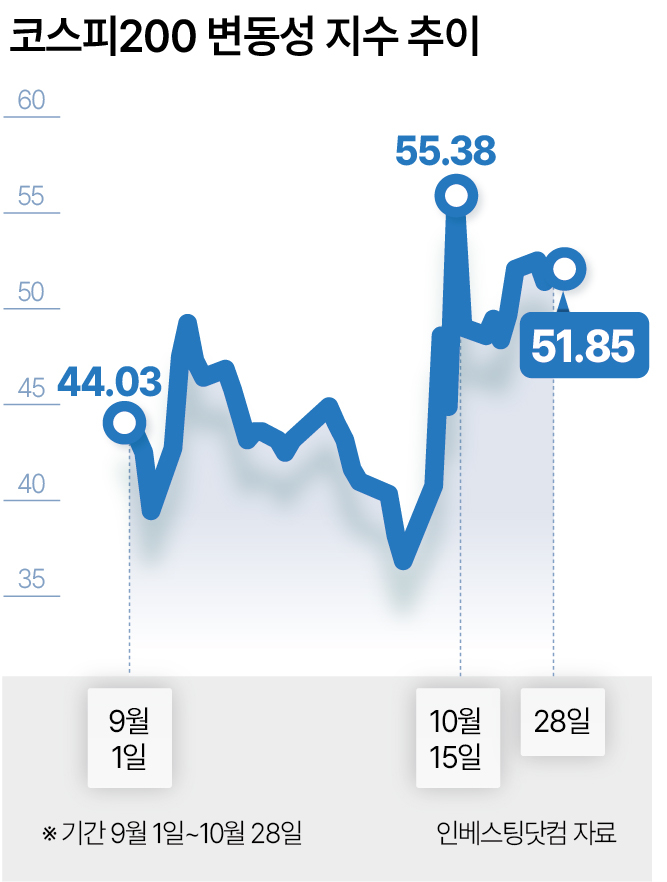
According to Investing.com, the KOSPI 200 Volatility Index, known as the VKOSPI, closed Wednesday at 51.85, up 1.01 percent from the previous session. The VKOSPI measures expected price swings over the following 30 days based on KOSPI 200 options prices, and tends to spike when equities sell off sharply — earning it the nickname "the Kospi fear gauge."
The index has been climbing throughout the month. During intraday trading on Oct. 15 it surged as high as 57.22, closing that session at 55.38. Compared with the Sept. 1 reading of 44, the Wednesday close represents a gain of roughly 17.8 percent. It also stands well above the long-term average of around 20 that has prevailed since 2010 — more than double that benchmark.
The wild swings have set off a string of sidecar activations. Of the five triggers this month on the main bourse, three were buy-side and two were sell-side. The mechanism had not been activated even once in September, but this month it has fired in both directions.
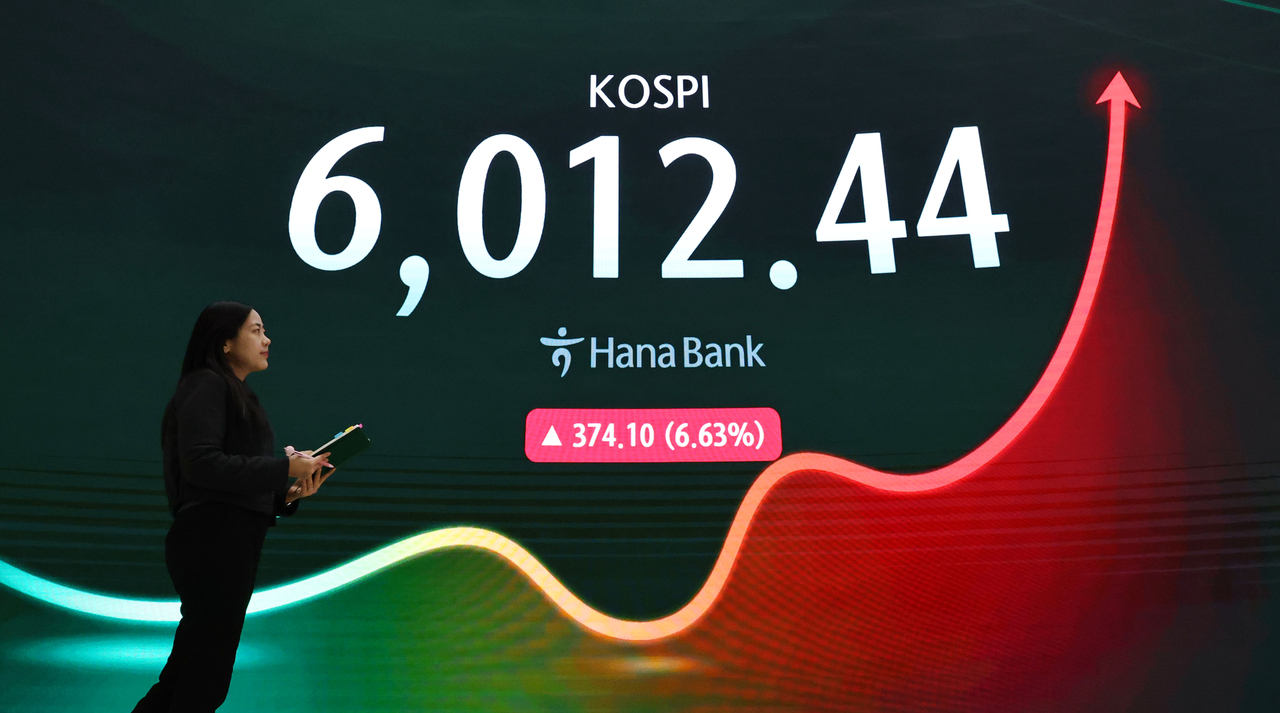
Daily price swings on the Kospi have also widened. The index plunged 7.57 percent in a single session on Oct. 15, then rebounded 3.09 percent on Tuesday. On Wednesday, the intraday gain exceeded 6 percent at one point. The sharp directional shifts have been driven largely by the trading behavior of foreign investors and by price moves in heavyweight semiconductor stocks such as Samsung Electronics and SK hynix.
Retail investors have been placing short-term directional bets on the index. On days when the Kospi surges, they buy inverse ETFs that profit from a decline; on days when it tumbles, they snap up leveraged ETFs in anticipation of a rebound.
According to Koscom ETF Check, retail investors net purchased 79.9 billion won ($59.8 million) worth of the KODEX 200 Futures Inverse 2X ETF and 69.7 billion won worth of the KODEX Inverse ETF on Wednesday. By contrast, on Oct. 22 — when the Kospi fell 201.89 points, or 3.52 percent — retail investors net purchased 75.5 billion won of the KODEX Leverage ETF.
The so-called "super week" — a stretch in which major domestic and overseas economic indicators and corporate earnings reports are clustered — has also amplified market volatility. Back-to-back releases from the Federal Open Market Committee, leading global technology companies and domestic chipmakers have left the market highly sensitive to each new data point.
Han Ji-young, a researcher at Kiwoom Securities, said the Kospi was likely to open lower Thursday, weighed down by short-term profit-taking after Wednesday's 6-percent-plus surge and by mixed after-hours share price reactions to Microsoft and Alphabet earnings. "During the session, the market is expected to shift toward sector differentiation as investors digest earnings events from Samsung Electronics' conference call and other major industry players including Hyundai Motor, Samsung SDI and Hanwha Aerospace," Han said.
Beyond short-term catalysts, the structural composition of South Korea's stock market is also a source of elevated volatility. Both South Korea and Taiwan have heavy exposure to the semiconductor industry, yet their markets show markedly different levels of volatility — a gap that reflects South Korea's concentration in memory chips versus Taiwan's focus on foundry, or contract chip manufacturing.
Shin Seung-woong, a researcher at Shinhan Securities, said global investment banks' 2028 operating profit estimates for SK hynix are widely dispersed, while forecasts for TSMC are comparatively clustered. "The coefficient of variation — a measure of relative dispersion in estimates — stands at 25.3 percent for SK hynix, roughly 2.5 times the 10.1 percent recorded for TSMC," Shin said. Memory chip earnings are inherently more volatile, swinging with the broader economic cycle and industry conditions, which makes future performance harder to predict, Shin added.

moon@heraldcorp.com