Third-quarter sales fall to 920,000 units — third straight quarter below 1 million
Production disruptions prompt lower sales and operating margin targets
Service network tops 1,000 locations; installment financing cited as edge
Hyundai Motor has lowered its annual sales and operating margin targets, citing production disruptions at domestic factories and weaker sales in the Middle East. The company said the revision does not signal a deterioration in its core competitiveness, and outlined a strategy of installment financing, service network expansion and new model launches — rather than price cuts — to counter Chinese automakers and Tesla gaining ground in the South Korean market.
Hyundai Motor held a third-quarter earnings conference call Thursday, reporting consolidated sales of 45.11 trillion won ($33.8 billion), down 3.4 percent from the same period last year. Operating profit rose 5.5 percent to 2.68 trillion won, lifting the operating margin 0.5 percentage points to 5.9 percent. Net profit for the period fell 24.2 percent to 1.93 trillion won. Compared with the previous quarter, sales declined 8.3 percent and operating profit dropped 6.1 percent.
Operating profit grew despite the sales decline, helped by a favorable exchange rate and cost-reduction efforts. The average won-dollar rate in the third quarter was 1,423 won, up 2.8 percent from a year earlier. Hybrid vehicle sales reached 167,414 units, accounting for 18.2 percent of total sales.
Global wholesale sales in the third quarter came to 920,710 units, down 11.3 percent year on year — the lowest since the first quarter of 2022, when semiconductor shortages held sales to 902,945 units. Sales have now fallen short of 1 million units for three consecutive quarters this year, following 976,219 units in the first quarter and 991,885 in the second.
Annual sales target cut to 4 million units; operating margin guidance lowered to 5.5–6.5%
Hyundai Motor cut its annual wholesale sales target from about 4.16 million units to 4 million units, and lowered its consolidated operating margin guidance from 6.3–7.3 percent to 5.5–6.5 percent. The company kept its sales growth target at 1.0–2.0 percent but trimmed its automotive investment plan from 17.8 trillion won to 16 trillion won.
Lee Seung-jo, executive vice president and head of Hyundai Motor's planning and finance division, said the sales target revision reflected a drop in domestic factory output caused by strikes and parts supply disruptions, which reduced export volumes to key markets, as well as weaker sales in the Middle East amid continued geopolitical uncertainty.
Raw material costs remain a pressure point. Lee said prices for copper and certain other raw materials have continued to rise due to global AI investment expansion and geopolitical supply issues, and that cost burdens from raw materials would persist through the fourth quarter. Cost optimization efforts in the automotive division reduced the impact of rising raw material prices by about 500 billion won, Lee added.
Lee cited broader industry uncertainty as the backdrop for the lower margin guidance. "Looking at guidance from global automakers, management uncertainty is growing, with differences by company and region," Lee said. "Many companies have revised their annual outlooks downward as they feel the direct impact of intensifying competition, including Chinese automakers expanding their influence in the European market."
Lee added that the guidance revision should not be read as a sign of weakening fundamentals. "This adjustment is not a sign that our core business competitiveness or earnings power has deteriorated," Lee said. "Please view it as a realistic reflection of the production shortfalls and raw material price increases that accumulated throughout the year and were difficult to control."
'Frequent price changes harm customer value' — shareholder return policy also under review
As Chinese-made vehicles rapidly expand their share of the South Korean market, Hyundai Motor said it will not respond with price competition. "Adjusting prices frequently undermines customer value," Lee said. "Instead, we are responding by strengthening our installment financing competitiveness." Lee added that rival automakers lack captive finance subsidiaries, whereas Hyundai Motor keeps monthly payments low at a level competitors cannot match.
The company also highlighted its service network as a competitive advantage. Hyundai Motor operates more than 1,000 service locations in South Korea, compared with 17 for Tesla. The number of registered vehicles per service location stands at about 290 for Hyundai Motor, versus 1,000 to 2,000 for Tesla, the company said.
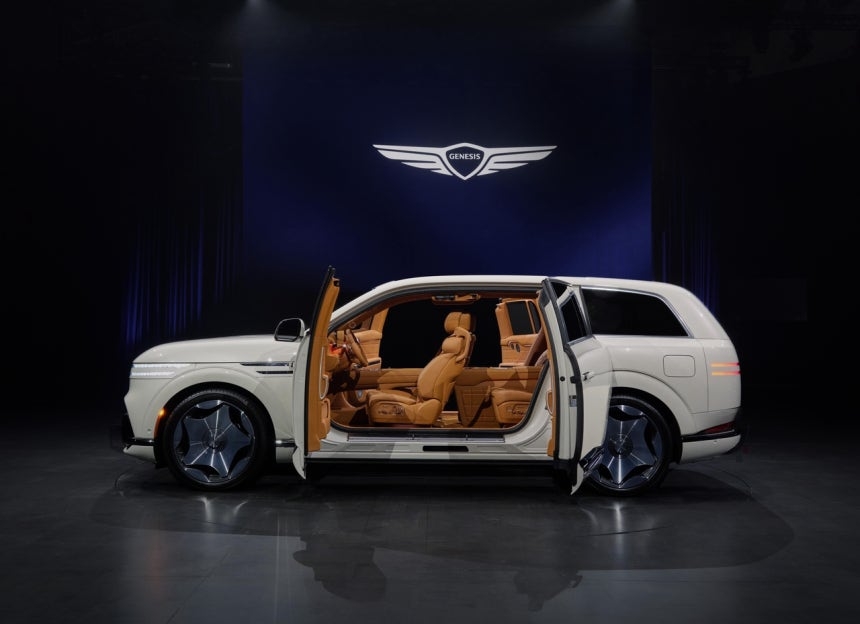
Hyundai Motor also plans an aggressive new-model push. In South Korea, the company will launch the Avante hybrid, the new Tucson, the GV90 and the GV80 hybrid in the fourth quarter, followed by a Santa Fe facelift in December. In the United States, it will introduce the Tucson and GV80 hybrid, with the GV90 set for release in early next year. In Europe, sales of the Ioniq 3 have begun, with a Europe-exclusive Tucson and the Bayon also on the way. The Ioniq V is headed to China, while India will receive the Bayon and the Ioniq P.
"We will launch so many new models that it may seem like too many," Lee said. "Pricing will be determined by considering both competitor pricing and market acceptance."
Hyundai Motor left open the possibility of revising its shareholder return policy. In August 2024, the company unveiled a value-up program committing to buy back and retire 4 trillion won worth of treasury shares over four years, maintain a total shareholder return ratio of 35 percent, and guarantee a minimum dividend of 10,000 won per share.
Asked whether the buyback plan would continue, Lee said the business environment had changed significantly since 2024. "Tariffs alone, which we did not anticipate, came to about 4 trillion won last year, and we expect a similar level this year," Lee said. "We are thinking about what the best course of action is given the changed business environment, and we will communicate with the market once we have reached a conclusion."
Dividends will be maintained at existing levels. "Until we communicate a new plan to the market, we should honor the minimum dividend of 10,000 won," Lee said. "We are also aware that the market is calling for a balance between buybacks and dividends, so we will listen carefully to shareholders and work through the issue."
Hyundai Motor will pay a quarterly dividend of 2,500 won per share on both common and preferred shares for the third quarter. The dividend record date is Nov. 30, with payment scheduled for Dec. 30.
eyre@heraldcorp.com