Cohabitation housing inheritance deduction: what to watch out for
49 days at a different address nearly cost one heir the deduction
How to protect yourself from paying more tax than you owe
Proving cohabitation is essential to claim the up-to-600-million-won deduction
Contemporary records of shared daily life must back up the claim
Senior-center eligibility rules and caregiving documents are key
Housing costs, food, transportation — money seems to drain away just by breathing. Yet one more expense is quietly embedded in everyday life and often goes unnoticed: taxes. Drawing on real consultations with tax-saving specialists, this column — "The Tax Advice Desk" — breaks down the tax dilemmas ordinary people face and explains them in plain language.
If two people actually lived under the same roof, can cohabitation still be denied simply because their registered addresses were different?
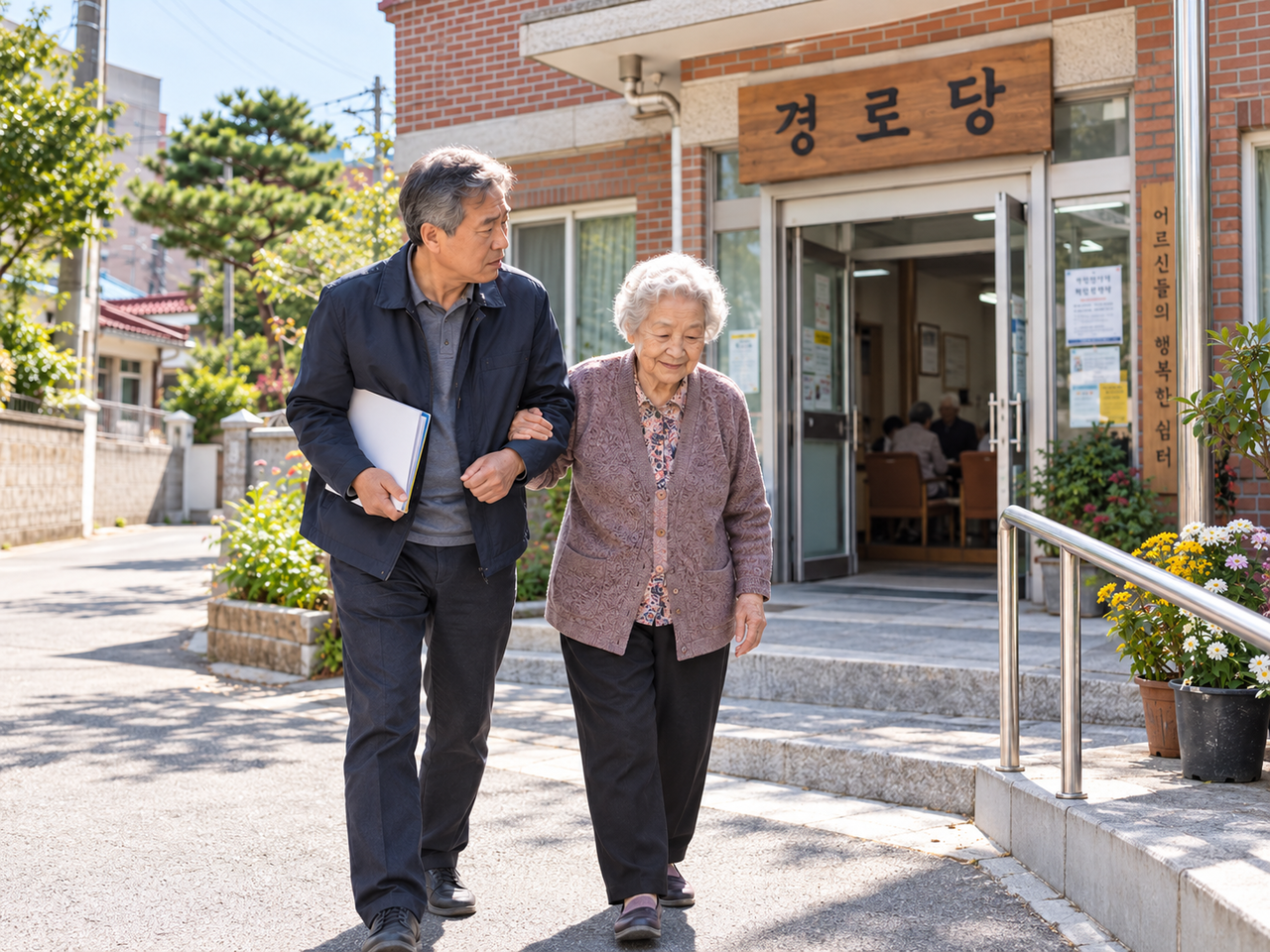
Lee Se-sang, 66, a retired teacher, spent 40 years caring for a mother with physical and hearing disabilities. Even after moving to a rented apartment in Gyeonggi Province in 2014 to be closer to work, Lee drove the mother every morning to a senior center in Heukseok-dong, Seoul — a place where she could meet old friends and ease her loneliness.
The problem was the senior center's eligibility rules. Staff told the family that a resident had to be registered at a local address to use the facility, so Lee temporarily transferred the mother's registered address to Heukseok-dong on four separate occasions between 2015 and 2018, totaling 49 days. Only the address changed; the mother continued to eat and live at Lee's home throughout. When redevelopment of the Heukseok-dong building was completed in late 2018, the two moved into the new apartment together.
When Lee's mother died in April 2024, Lee inherited an apartment valued at 1.6 billion won ($1.2 million) and an older sister received a bank deposit of 200 million won. While researching inheritance tax, Lee learned that heirs who meet certain conditions — including living with a parent for at least 10 years — can claim a "cohabitation housing inheritance deduction" of up to 600 million won.
The 49 days of mismatched registered addresses proved to be a stumbling block. Lee ultimately paid inheritance tax of 329.8 million won without the deduction. After gathering evidence to prove that Lee and the mother had in fact lived together throughout, Lee succeeded in recovering about 200 million won in overpaid tax. How did Lee manage to have cohabitation recognized despite those 49 days of differing addresses?
Tax accountant Kim Hye-ri, known online as "Guksae Unni," walked through the requirements for the cohabitation housing inheritance deduction and explained how to reclaim tax already paid by proving actual cohabitation.
Q. If I cared for a parent for more than 10 years, can I claim the cohabitation housing inheritance deduction?
A. The length of time you lived together is not the only factor. The cohabitation housing inheritance deduction is a regime that allows a child who lived with a parent for an extended period to deduct up to 600 million won from the taxable value of the inherited home. It does not reduce the tax bill by 600 million won directly.
To qualify, you must confirm that you lived continuously with the parent for at least 10 years counting back from the date the inheritance opened, and that throughout that period you met the one-household, one-home requirement as a single registered household unit.
Any period during which the heir was a minor is excluded from the 10-year count. Even if you lived with the parent from childhood, only the years after reaching adulthood count toward the requirement.
You do not need to have lived in the same house for the entire 10 years. For inheritances that opened after 2011, periods of shared life during moves together can be combined. What matters is whether you were genuinely living together.
This means that time spent in a temporary rental during reconstruction or redevelopment can count toward the cohabitation period, provided you lived there together. However, if there was a period when you lived apart from the parent, the cohabitation periods before and after that gap generally cannot simply be added together.
In addition, the child inheriting the home must also meet statutory requirements as of the date the inheritance opens — for example, owning no home of their own or jointly holding only one home with the parent. The qualifying child must actually receive the property.
The deduction is calculated as the value of the inherited home and its attached land minus any debt secured against that real estate by the parent, up to a maximum of 600 million won. For past inheritances, the deduction conditions and limits are assessed under the law in force on the date the inheritance opened.
Q. How much more inheritance tax would I owe if I failed to claim the cohabitation housing deduction?
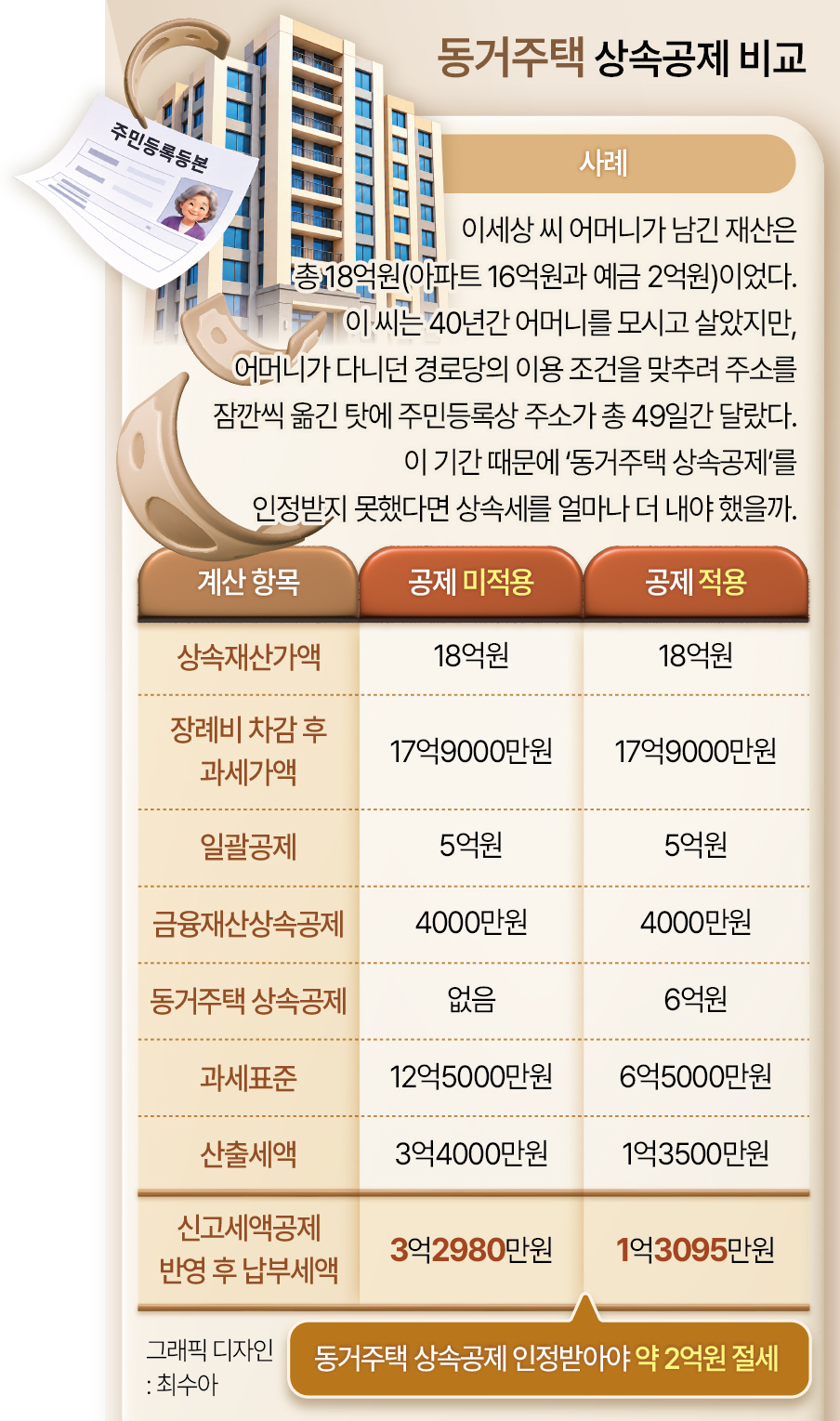
A. In Lee's case, the difference in inheritance tax depending on whether the cohabitation housing deduction applies comes to 198.85 million won.
The estate comprised the apartment valued at 1.6 billion won and a bank deposit of 200 million won, for a total of 1.8 billion won. After deducting funeral expenses of 10 million won, the taxable inheritance value stood at 1.79 billion won. Applying a flat deduction of 500 million won and a financial-asset inheritance deduction of 40 million won brought the tax base to 1.25 billion won. The calculated tax came to 340 million won, and after a 3 percent filing credit the tax payable was 329.8 million won.
Adding the 600 million won cohabitation housing deduction reduces the tax base to 650 million won. The calculated tax then falls to 135 million won, and after the filing credit the tax payable is 130.95 million won. All else being equal, whether those 49 days of differing addresses are recognized as genuine cohabitation determines a tax difference of about 200 million won.
Q. Lee lived with the mother for 40 years — why did the tax office focus on just 49 days of a different address?
A. The tax office took the view that cohabitation was interrupted during the 49 days when Lee and the mother had different registered addresses. The key distinction is between two situations: one where the parties actually lived apart but qualify for a statutory exception, and one where only the address differed while they continued to live together.
Tax law does provide exceptions that treat certain temporary separations as continuous cohabitation — for example, military service, relocation for study, a job transfer, or a period of medical treatment or recuperation lasting at least one year. Using a senior center, however, did not in itself constitute a recognized statutory reason for separation.
That was precisely the disputed point in Lee's case. The tax office declined to treat senior-center use as a qualifying exception, and found that the medical records — consisting mainly of intermittent outpatient visits — were insufficient to support a separation-for-treatment exception.
Lee's position, by contrast, was that only the address had moved and that the two had in fact continued to live together throughout. Demonstrating that with objective documentary evidence — explaining why the address was transferred and showing that shared daily life continued during that period — was therefore critical.
Q. If I lived apart from a parent because of work, is that automatically recognized as an exception?
A. A work-related reason alone does not guarantee automatic recognition.
You must be able to show that a job change, transfer, or posting made living apart unavoidable. It is advisable to prepare documents that together demonstrate the reason for the posting, the work location, and the period of residence — such as the transfer order, an employment certificate, a workplace confirmation letter, and the lease agreement from that time.
Q. Lee submitted fuel receipts, transit card records and medical documents — was that still not enough to prove actual cohabitation?
A. Those materials can play a supporting role, but they have limits when it comes to fully establishing actual cohabitation.
Lee's family submitted fuel card statements and bus records to show that they drove the mother to the Heukseok-dong senior center on the way to work each morning. The tax office found, however, that the fuel transactions were concentrated mainly in Gyeonggi Province and Incheon, making it difficult to confirm trips to and from the Heukseok-dong center directly, and that public transit records alone could not establish whether the mother was traveling with Lee.
Photographs taken later to reconstruct the commute route also had their limits. The tax office noted that the detour time on the way to work appeared long and that the lights in the senior center shown in the photos were off. More fundamentally, reconstructed photographs are not contemporaneous records of daily life during the period when the addresses differed.
Medical records can help explain the mother's health condition and the need for care. The tax office found, however, that intermittent outpatient visits alone were insufficient to establish the exception for separation due to treatment or recuperation lasting at least one year.
Supporting documents should also address who was actually living at the registered address, why the address was transferred, and where the mother was living and who was providing care at the time.
Q. If the registered addresses were different but the parties actually lived together, how can cohabitation be proved?
A. Registered address records are an important starting point for assessing cohabitation.
Begin by obtaining certified copies of both the parent's and your own resident registration history, including all past address changes, and map out the timing of moves and separations alongside the dates of home purchases and disposals. If the inheritance has already opened, work back from that date to confirm the cohabitation period and the home-ownership status throughout.
If there were periods when the addresses differed, gather materials that explain where each person was actually living and why the address was transferred. Useful documents can include the lease agreement, evidence confirming who was actually residing at the registered address, utility and maintenance bills, mail records, records of accompanying the parent to medical appointments, bank transfer records for living expenses, facility usage rules, statements from relevant parties, and disability or caregiving records relevant to the circumstances at the time.
Any written statement of facts should specify the writer's relationship to the family, describe only what the writer personally witnessed or knows, and include the relevant dates and locations. Inconsistencies or exaggerations across documents will undermine credibility. As Lee's case illustrates, memories of a long shared life must be backed up by contemporaneous documents and records of daily living.
Q. If the deduction was missed and inheritance tax has already been paid, how can the money be recovered?
A. If you met the deduction requirements but omitted the deduction from your filing, you can submit a request for correction asking the tax authority to recalculate the tax. The general deadline is within five years of the statutory filing deadline. The deadline and the date from which it runs can vary depending on the grounds for the request, however, so start by reviewing the original return and payment records.
If the tax office rejects the correction request, you can consider filing an objection or a request for a tax tribunal ruling. Lee went through a rejected correction request and a dismissed objection before the Tax Tribunal ultimately recognized the deduction. Each stage of the appeals process has its own deadline, so if you receive a rejection notice, check the deadline immediately.
Q. What kinds of evidence actually helped secure recognition of cohabitation?
A. In August, the Tax Tribunal ruled that the cohabitation housing inheritance deduction applied to Lee's case and ordered the inheritance tax to be recalculated. What proved decisive was presenting, together, documents explaining why the address was transferred and showing where the mother was actually living.
Central to the ruling was a written statement — supported by resident registration records — confirming that a tenant was living at the address to which the mother's registration had been transferred. This directly rebutted the tax office's assumption that the mother had been living there. The family also submitted the senior center's bylaws and a statement from a center official to explain that a local registered address was required to use the facility, lending weight to the argument that the address transfer was for senior-center access, not an actual move.
The Tax Tribunal also examined the mother's established life in the area and the family's caregiving arrangements.
The mother had lived in Heukseok-dong since before 1968 and had maintained ties with neighbors there, providing credible context for the wish to keep attending the familiar senior center even after the move. Accounts that relatives living in Heukseok-dong had helped with some of the trips to the center further supported the family's version of events.
The tribunal also took into account that the mother had been registered as a person with physical and hearing disabilities since the age of 69 and required daily care, and that there was no evidence anyone else had been primarily responsible for that care. Submitting a comprehensive set of materials — covering why the address was transferred, who was actually living at the registered address, and the mother's health condition and caregiving situation — is what makes a claim of actual cohabitation persuasive.
[By Yoo Hye-rim / Kim Hye-ri, deputy head tax accountant at Tax Corporation HKL]

forest@heraldcorp.com