No-label rules vary by production origin and product type
Consumers urged to check QR codes and embossed container markings for product details
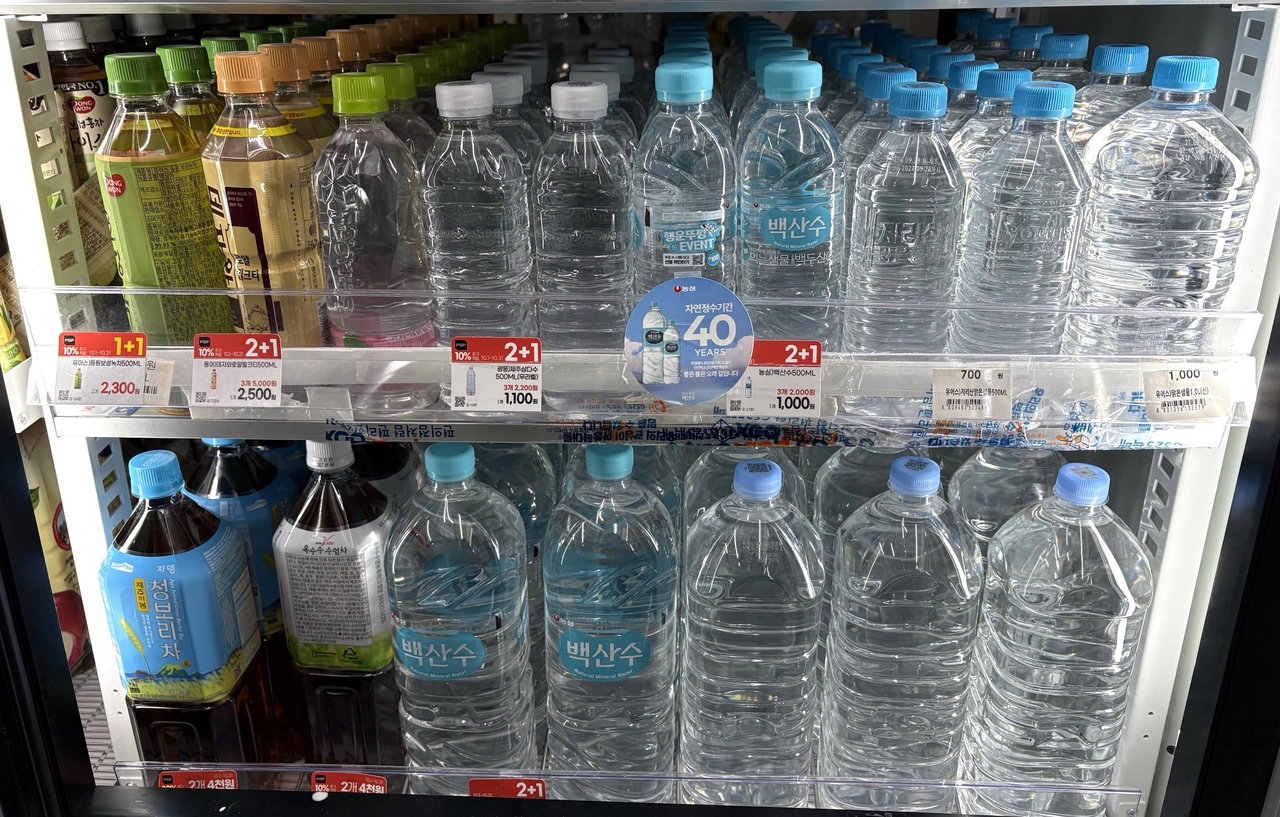
South Korea's no-label regime for bottled water took effect this year, but labeled and label-free products continue to coexist on store shelves because the rules apply differently depending on where the water is produced and how the product is classified.
According to industry sources and the Ministry of Climate, Environment and Energy, the no-label requirement has applied since Jan. 1 to bottled water sold online and in multipacks at offline retailers. Single bottles sold individually at convenience stores, supermarkets and hypermarkets are covered by a transition guidance period running through the end of this year. That timeline reflects feedback from retailers, who said they need time to upgrade point-of-sale systems and barcode scanners to handle QR codes on bottle caps in place of traditional label barcodes.
The no-label regime was introduced to reduce the use of plastic shrink-wrap labels on water bottles and to make recycling and waste sorting easier. Based on annual output of 5.2 billion bottles in 2024, the Ministry of Climate, Environment and Energy estimates the fully implemented system could cut plastic use by roughly 2,270 metric tons a year.
To help the regime take hold, the government has signed MOUs with the retail industry and expanded cooperation. The three major hypermarket chains are now prioritizing no-label products on their shelves. To ease checkout friction for single-bottle purchases, they are also rolling out QR code scanning systems, pre-registering product information at registers and providing printed barcodes at checkout counters.
Beyond the single-bottle transition period, however, the scope of the rules also varies by production origin and legal product category, prolonging the mixed-product situation on shelves. Imported bottled water produced as a finished product overseas is not subject to the same no-label obligation as domestically manufactured products. Products legally classified as "mixed beverages" are similarly exempt.
The shift is already leaving a mark on market dynamics. According to market research firm NielsenIQ, 500-milliliter products accounted for 46.6 percent of offline bottled water sales nationwide over the 12 months from October 2025 through September 2026 — up 3.3 percentage points from the prior year. At convenience stores, where single-bottle purchases are particularly common, the 500-milliliter share rose 4 percentage points to claim more than half of sales, at 54.3 percent.
A comparison of 12-month cumulative sales between the July 2024–June 2025 period and July 2025–June 2026 shows that Jeju Samdasoo's share of convenience store sales fell 1.6 percentage points, while Icis dropped 1.0 percentage point. Baeksan water, by contrast, gained 2.0 percentage points over the same period.
Industry officials advise consumers to check product details — including the item name and water source — since no-label domestic products and labeled imports or mixed beverages may sit side by side on the same shelf. Even after labels are removed, essential product information remains accessible through QR codes, embossed markings on the container, printing on the bottle cap and outer packaging on multipacks.
Jeju Samdasoo has been preparing for the no-label transition for several years. The brand launched a no-label product, Jeju Samdasoo Green, in March 2021, and in September 2023 released a no-label single-bottle product with a QR code on the cap. Since May this year, all products manufactured for domestic sale have been produced without labels.
soho0902@heraldcorp.com