Inspect for overheating, unusual noises and pipe conditions before starting the boiler; use sleeping bags or hot water bottles to stay warm while camping
As the heating season approaches, residents are urged to take extra care to prevent fires and safety accidents by inspecting boiler pipes and checking for abnormalities before starting their units.
According to the Ministry of Interior and Safety on Friday, residential boilers caused a total of 790 fires over the past five years (2021–2025), resulting in 31 casualties from smoke and toxic gas inhalation or burns.
Residential boiler fires tend to concentrate between November and January. November — when boilers are first switched on for the season — sees 87 fires on average, about 1.3 times the monthly average of 66, making it a particularly high-risk period.
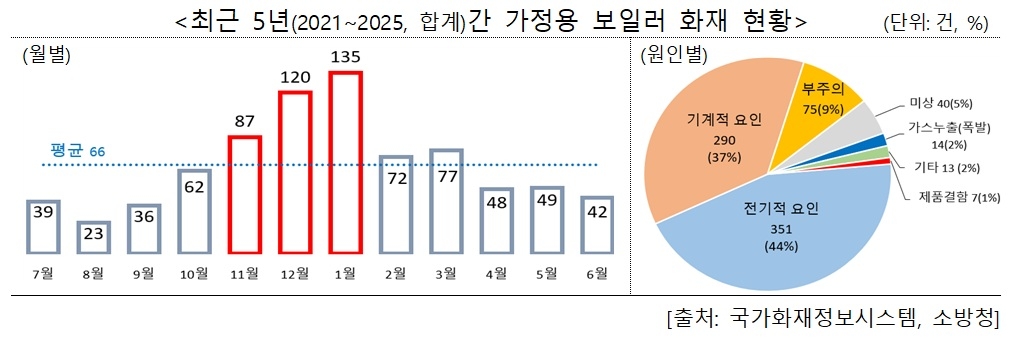
Looking at the causes of fires during the same period, electrical faults such as poor contact were the most common at 351 cases (44 percent). Mechanical factors — including boiler overheating and aging equipment — accounted for 290 cases (37 percent), followed by careless use or installation at 75 cases (9 percent) and gas leaks at 14 cases (2 percent).
According to the 2020 Population and Housing Census, 82 percent of households in South Korea use individual heating boilers powered by city gas, oil or electricity.
Because individual heating systems are installed and managed by each household, they require thorough maintenance — not only to prevent fires caused by overheating, but also to guard against carbon monoxide poisoning, which can occur if toxic exhaust gases are not properly vented or accidentally flow back indoors.
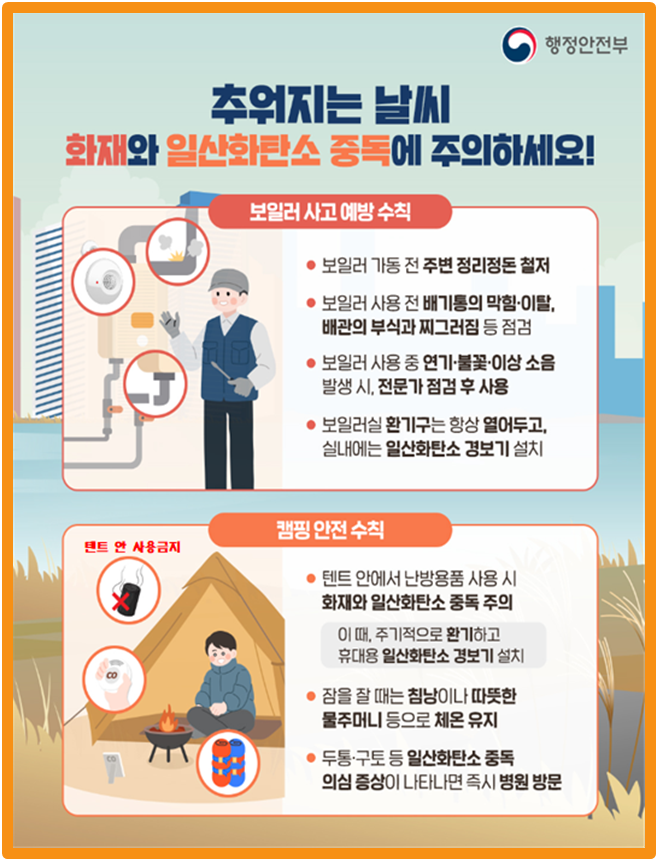
To prevent boiler-related fires and poisoning incidents, residents should clear away flammable materials such as paper from around the unit before starting it, and carefully check that the exhaust duct is neither blocked nor dislodged and that pipes are free of corrosion or deformation.
The boiler room's ventilation opening should be kept open at all times to allow harmful gases to escape freely, and a carbon monoxide detector must be installed indoors.
If smoke, flames or unusually hot air come from the boiler while it is running — or if indicator lights flicker or fail to turn on, or if unfamiliar noises, vibrations or odors are detected — residents should have the unit inspected by a qualified technician immediately.
As camping has grown in popularity, the risk of carbon monoxide poisoning from using heating devices inside tents has also increased, requiring particular caution.
For safe camping, people should avoid using heating devices that produce large amounts of carbon monoxide — such as charcoal burners — inside tents, and instead maintain body warmth using sleeping bags or hot water bottles.
If heating devices must be used, campers should ventilate the tent frequently and install a portable carbon monoxide detector to guard against accidents.
If symptoms of carbon monoxide poisoning appear — such as headache, dizziness, nausea or weakness — move immediately to a well-ventilated outdoor area, breathe fresh air and seek medical attention.
The Ministry of Interior and Safety urged the public to "carefully check for signs of overheating, unusual noises or other abnormalities before starting the boiler, and to pay close attention to ventilation when using heating devices in enclosed spaces, so that everyone can enjoy a warm and safe winter."
thlee@heraldcorp.com