Reports and suspected abuse cases both up from prior year, according to government report; labor exploitation cases climb 9.5%; Ministry of Health and Welfare vows to strengthen response system
Reports of abuse against people with disabilities totaled more than 6,600 cases last year, up about 10 percent from the previous year, according to a government report released Friday.
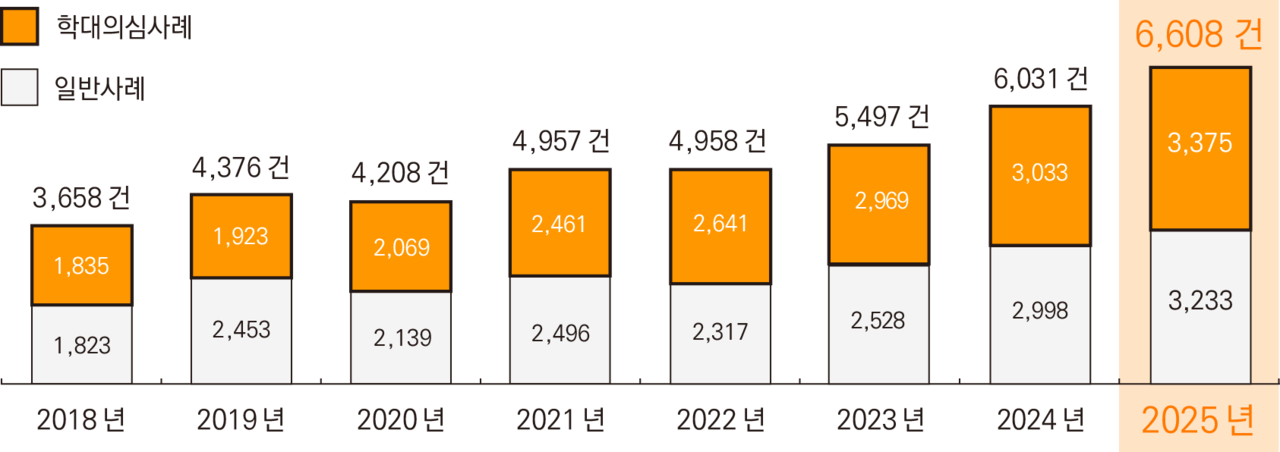
The 2025 Report on the Status of Abuse Against People with Disabilities, published by the Ministry of Health and Welfare and the Central Disability Rights Advocacy Agency, showed that disability abuse-related reports filed with regional advocacy agencies nationwide reached 6,608 cases. Of those, 3,375 cases, or 51.1 percent, were classified as suspected abuse.
The remaining 48.9 percent, or 3,223 cases, were categorized as general cases — covering disability discrimination, welfare consultations or information inquiries, and personal disputes.
Both the total number of reports and suspected abuse cases rose from the previous year, by 9.6 percent and 11.3 percent, respectively.
Among suspected abuse cases, 895 reports, or 26.5 percent, were filed by mandatory reporters — including social welfare workers, dedicated civil servants, medical professionals and emergency responders — while 2,480 reports, or 73.5 percent, came from non-mandatory reporters such as neighbors and acquaintances, nearly 2.8 times the mandatory reporter figure.
Reports filed by the victims themselves reached 806 cases, up 31.7 percent from the previous year. Self-reports by people with intellectual disabilities rose 53.1 percent to 493 cases.
The high volume of reports from non-mandatory reporters and the sharp increase in self-reports by people with disabilities point to growing public and personal awareness of abuse and rights issues affecting people with disabilities.
An amendment to the Welfare of Persons with Disabilities Act will take effect in February next year, raising the ceiling on fines imposed on mandatory reporters who fail to report known cases of abuse or sex crimes against people with disabilities from 3 million won ($2,250) to 10 million won.
The Ministry of Health and Welfare is revising subordinate regulations, including the criteria for imposing fines, ahead of the amended law's implementation.
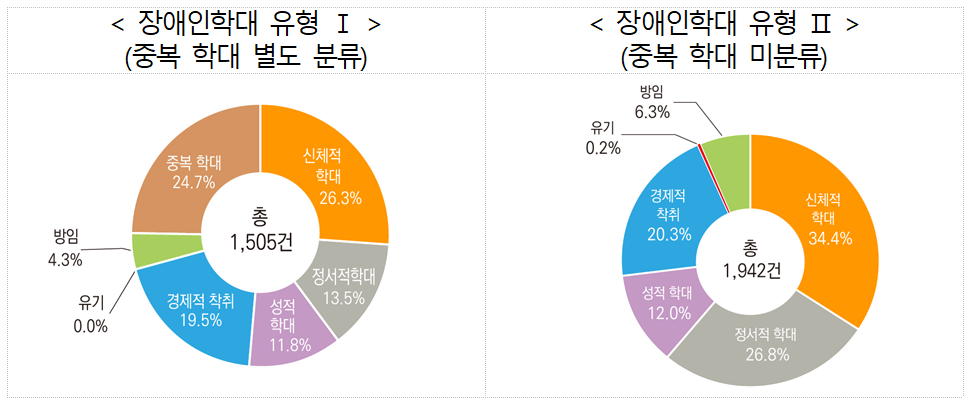
Of the suspected abuse cases, 1,505, or 44.6 percent, were confirmed as abuse — 56 more than the previous year. Confirmed abuse cases have risen each year, from 1,418 in 2023 to 1,449 in 2024.
By disability type, people with developmental disabilities — including intellectual and autism spectrum disorders — accounted for 76.2 percent of abuse victims, or 1,147 cases.
Victims with intellectual disabilities numbered 1,055 cases — 601 female and 454 male — while victims with autism spectrum disorder numbered 92 cases, with males accounting for the majority at 76 cases compared with 16 female. Victims with intellectual disabilities skewed female, while those with autism spectrum disorder skewed male.
In terms of age, those in their 30s or younger made up 65.2 percent of all victims. Among them, victims in their 20s numbered 370 cases, up 12.8 percent from the previous year.
The most common locations where abuse occurred were the victim's own residence at 47.6 percent, disability welfare facilities at 12.8 percent, and the abuser's residence at 6.4 percent.
Regional disability rights advocacy agencies conducted 15,274 counseling and support sessions for the 1,505 confirmed abuse cases last year, providing assistance with housing, legal matters and welfare services, the agency said.
When cases in which a victim experienced multiple types of abuse were counted separately for each type, physical abuse was the most common at 668 cases, followed by emotional abuse at 521 cases and economic exploitation at 394 cases.
Among economic exploitation cases, 81 involved labor exploitation — such as forcing victims to work without pay — and 75.3 percent of those victims, or 61 cases, were people with intellectual disabilities. Labor exploitation cases rose 9.5 percent from the previous year.
Repeat abuse cases numbered 238, up 49 from the previous year. People with developmental disabilities accounted for 88.2 percent of repeat abuse victims, or 210 cases.
The data also showed that abuse occurring repeatedly and on a daily basis tended to persist over longer periods.
The Ministry of Health and Welfare said it would continue to improve the system and response framework as reports of disability abuse and repeat abuse cases continue to rise.
The government drew up a comprehensive plan in April to prevent abuse and strengthen human rights protections at residential facilities for people with disabilities, prompted by a sexual violence case at Saekdongwon, a residential facility for people with severe disabilities.
The plan calls for regularizing inspections of residential disability facilities twice a year, with priority-managed facilities subject to additional unannounced inspections and special oversight.
Cha Jeon-gyeong, director general for disability policy at the Ministry of Health and Welfare, said early detection and reporting are critical in cases of disability abuse, and that support for recovery and prevention of repeat abuse must continue after an incident occurs. "We will keep strengthening the system and support framework to enhance frontline response capacity and protect victims," Cha said.
thlee@heraldcorp.com