Temporary teaching credentials for outside experts under review
Expanded high school electives raise questions over solo instruction and grading rights
Teachers say subject expertise alone is not enough
Unions call for more educators and training instead
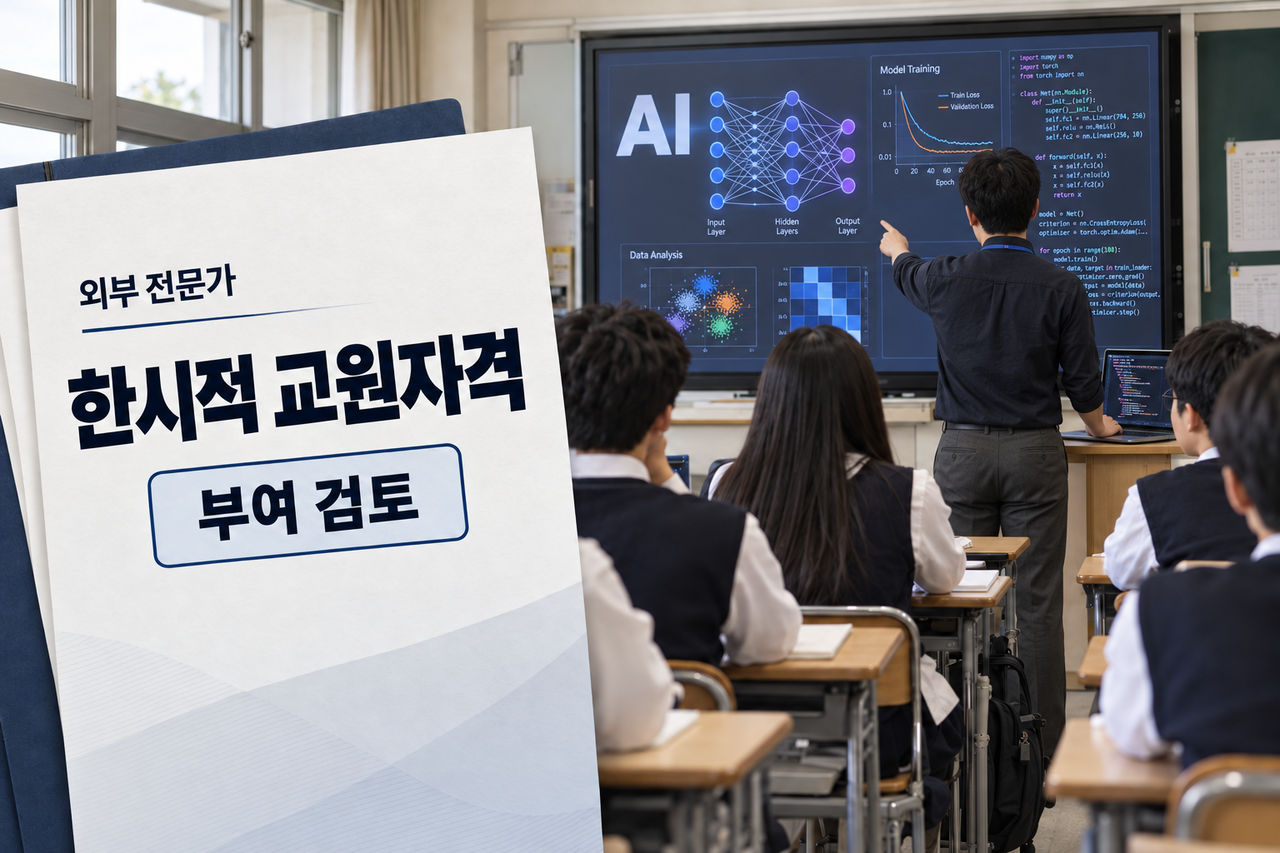
South Korea's National Education Commission is reviewing a plan to grant temporary teaching credentials to outside experts without teaching licenses. The proposal stems from growing demand for instruction in AI and other emerging industries, as well as an expansion of elective courses under the high school credit system — prompting calls to tap a broader pool of outside specialists. Teachers are uneasy. They argue that subject-matter expertise alone is not sufficient grounds to hand someone responsibility for student instruction and assessment.
According to education circles, the commission is examining the measure as part of its long-term national education development plan. At a workshop on Oct. 14, participants also discussed allowing credentialed outside experts to teach and assess students independently — without a licensed teacher present — during their contract period.
The discussion grew out of a shortage of qualified teachers to cover the expanding range of electives introduced under the high school credit system. The idea is to bring in specialists from industry — in fields such as AI, the arts and vocational education — to offer courses that schools struggle to staff on their own.
Beyond the classroom: teachers say expertise isn't enough to grant grading authority
Teachers draw a sharp distinction between allowing outside experts into the classroom and granting them full teaching credentials. Jung Jae-seok, chair of the North Jeolla Province Teachers' Union, pushed back against the proposal. "A teaching credential is the minimum professional standard — it verifies whether someone can design a curriculum, conduct assessments, understand student development, manage behavior and provide career counseling," Jung said. "Being knowledgeable in a particular field does not qualify someone to take on those responsibilities."
The accountability that comes with student assessment — which feeds directly into university admissions — is another flashpoint. A Seoul high school teacher, identified only as A, said the stakes are high. "High school grades are tied to university entrance, so you have to account for grading errors, grade appeals and complaints from parents," the teacher said. "Problems related to assessment can linger even after a contract ends. The division of responsibility between outside experts and the school needs to be settled first."
Teachers also raised concerns about what would happen if the opening of the profession extended to elementary schools, and called for hiring more educators and reducing teaching loads before any such change. If outside instructors take over subject-specific classes, they warned, homeroom teachers would have less capacity to monitor students' academic progress and personal well-being together.
An elementary school teacher, identified only as B, said the real solution lies in expanding the number of dedicated subject teachers. "The reason we look to outside instructors is that the teaching load is too heavy," the teacher said. "We should expand shared curricula between schools and itinerant teachers, and broaden the subjects current teachers are trained to cover." The teacher added that outside expertise should be channeled through existing arrangements such as industry-academic joint teachers and collaborative instruction, rather than through new credentials.
Teachers unions say hire more educators first; commission delays draft release
The Korean Federation of Teachers' Associations also issued a statement opposing the discussion of opening the profession to outsiders. "A track record in the arts or vocational fields alone cannot be taken as proof of the expertise needed to teach and assess students," the federation said. It added that the commission should also consider how to manage the placement and role of outside specialists when demand for certain subjects declines due to technological change.
Federation Chair Song Su-yeon said the credential system exists to guarantee professional competence, not to make hiring easier. "A teaching credential is the standard by which the state guarantees that someone has the expertise to be responsible for a student's growth — it is not a tool for conveniently filling staffing gaps," Song said. "The commission should focus on properly training and supporting the educators the system needs, not on finding ways to bypass the processes of preparation and verification."
This is not the first time the debate over opening the teaching profession has surfaced. In 2021, Park Chan-dae, then a Democratic Party of Korea lawmaker, introduced legislation to appoint the specialist personnel needed for the high school credit system as fixed-term teachers. Teachers' organizations opposed the bill at the time, arguing it would undermine professional standards in education and the fairness of the appointment process.
The commission had already pushed back the release of a draft "2028–2037 National Education Development Plan" from the end of October to sometime before year's end, saying additional discussion and input from relevant agencies were needed on key issues including university admissions reform. The final plan is scheduled to be completed by the end of March next year.
Park Young-hwan, a commission member who also chairs the Korean Teachers and Education Workers' Union, said many issues still require thorough deliberation and public consultation. "What schools and the public want is not a rushed announcement but a well-developed draft," Park said.
A commission official said the national education development plan under discussion contains a number of contentious issues. "We will carefully review each of them, carry out a public consultation process and then make an announcement," the official said.
brunch@heraldcorp.com