After more than a year of scouting Seoul, the couple locked in a Seongsu-dong Trimaje unit in the late-2 billion won range
Dropped the deal — and forfeited their deposit — just before signing, sensing a better opportunity
Learning about seller financing pushed their budget all the way into the 4 billion won range
This article was originally published in HeralDeep, a members-only content service of The Herald Business, as part of the series "How Director Kim Bought a Home in Seoul." Subscribe to read more first-hand accounts of buying a home in Seoul. Names and certain details have been changed to protect the identities of those involved.

"We're walking away. That's 120 million won ($89,900) gone."
Earlier this spring, a couple in their 20s — known by the Instagram handle "Siori" (@c.ori.money) — had agreed to buy a unit of about 20 pyeong at Trimaje in Seongsu-dong, Seoul, for a price in the late-2 billion won range. They paid a 100 million won deposit upfront and handed the seller an additional 20 million won as compensation for the extended settlement period needed to offload their existing home. The paperwork for a land transaction permit application was ready to go.
Then, at the very last step, they changed their minds — even knowing they would not get the money back.
"At the time, tax reform discussions were ongoing, and we thought better listings would come onto the market in the Gangnam area," Siori said. "We couldn't afford to miss a chance to grow our assets by tens of billions of won."
The couple had been working their way up to Seoul after selling apartments in Suji, Yongin and Bundang, Seongnam in Gyeonggi Province. Their destination turned out to be Banpo. How did two people hunting for an apartment in the 2 billion won range end up buying into Banpo at 4 billion won?
☞ Click here to read Part 1 of the couple's journey into Gangnam.
Armed with 2 billion won cash, they spent more than a year scouting Seoul
Siori and the spouse began looking for their next home right after buying their first one.
Both the Suji and Bundang apartments ultimately rose sharply in value, but the couple still felt some regret about those early choices. They believed that if they had compared more neighborhoods and complexes the first time around, they could have bought something better from the outset.
"I wasn't 100 percent satisfied with our first home," Siori said. "So this time we took our time and spent more than a year visiting properties in person."
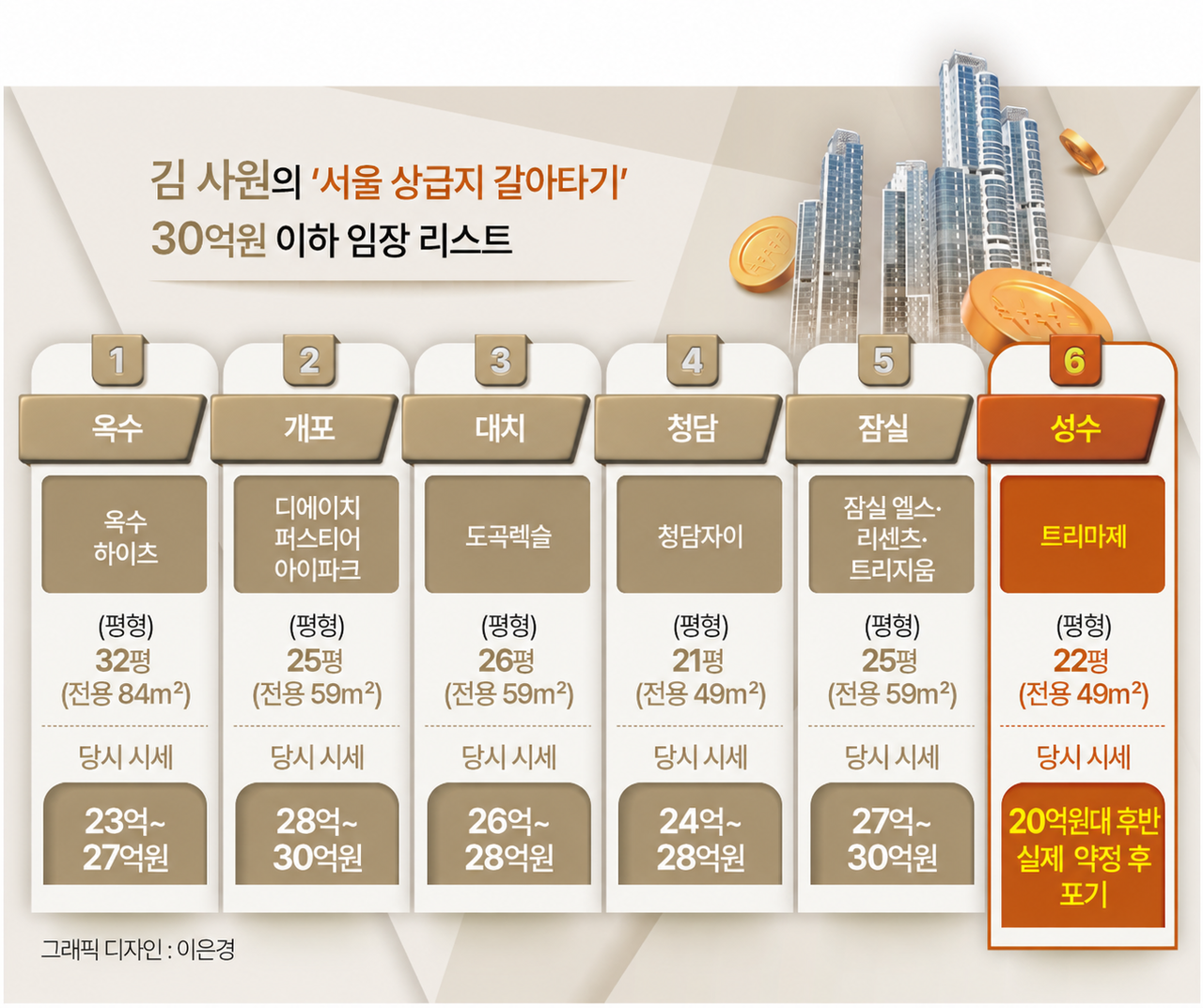
From the start, the target was Seoul. The couple toured Oksu, Jamsil, Gaepo, Daechi, Cheongdam and Seongsu-dong, among other neighborhoods. In Oksu they looked at an 84-square-meter unit at Oksu Heights; in Gaepo, a 59-square-meter unit at DH Firstier I'Park. Daechi Dogok Rexle, Cheongdam Xi, and the Elce, Ricenz and Trizium complexes in Jamsil also made the shortlist.
Each neighborhood offered a different trade-off between size and age for the same budget. In Oksu the couple could afford an apartment in the 30-pyeong range, but the further into Gangnam they looked, the smaller the available units became. Beyond price, they weighed long-term asset value and livability.
At the time, the couple expected to have about 2 billion won in cash after selling their existing homes. They planned to top that up with a bank mortgage to break into a more desirable part of Seoul, but tightened lending regulations stood in the way.
Through its June 27 package last year, the government capped home-purchase mortgage loans for properties in the Greater Seoul area at a maximum of 600 million won. A follow-up Oct. 15 package introduced a tiered limit based on property price: buyers of homes priced between 1.5 billion and 2.5 billion won could borrow up to 400 million won, while those buying homes above 2.5 billion won were limited to 200 million won. For the apartments the couple had been eyeing in the late-2 billion won range, the maximum loan available was just 200 million won.
"Compared to people in their 40s and 50s, I have far less cash, but I do have the advantage of a high income. Leverage is the way to buy a better home — and they took that away. At the time I was truly devastated. I was so upset I cried."
The couple even looked into auctions as an alternative, going so far as to visit a court to research how to use auction-purchase financing. After much deliberation, they decided to buy a home they could hold for the long term — and that was when Seongsu-dong caught their eye.
'Let's hold it for 10 years' — why they chose Trimaje at 2.8 billion won
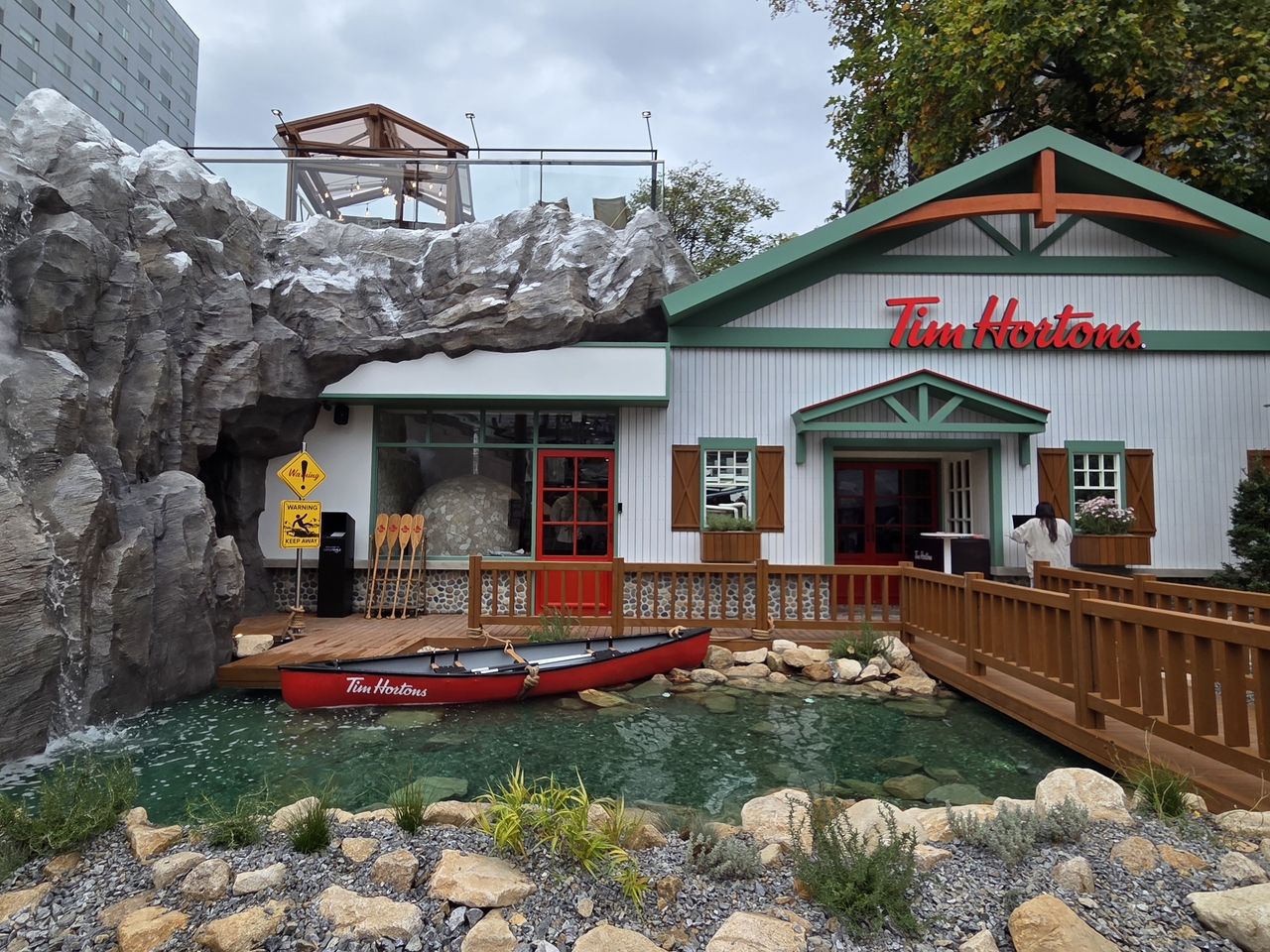
The reasoning behind choosing Trimaje was straightforward. Siori believed that once development of the Seongsu Strategic Redevelopment Zone was complete, the area would be transformed into a large-scale new residential district, fundamentally raising its profile. Even the neighborhood's weak school district — often cited as a drawback — could improve as new housing communities took shape.
Above all, it was the Han River view that clinched it. Trimaje juts out toward the river compared with nearby redevelopment sites, meaning its view was likely to hold its value even after surrounding development was finished. Since the couple had always planned to hold the property for about 10 years, that made it attractive enough.
"If we buy a 3 billion won home, our next move up has to be into the 4 billion won range, and it's hard to save an extra 1 billion won in five years on earned income alone," Siori said. "So this time we wanted to get into a neighborhood whose value would grow significantly over the long term and hold it for about 10 years."
The unit they settled on was a roughly 20-pyeong apartment at Trimaje, agreed at a price in the late-2 billion won range. Negotiations with the seller moved relatively quickly. Around April or May this year, the couple reached a sale agreement and paid a 100 million won deposit. Because they needed to sell their existing home before paying the balance, they asked the seller for a long settlement window — and handed over 20 million won, equivalent to three months' rent, in exchange for the wait.
After that, the couple began preparing the land transaction permit application. All the relevant documents were in order; the only step left was to visit the real estate agency and put their seal on the paperwork.
But in the end, they never did.
What changed their minds were tax reform discussions that surfaced around July and August. As the government floated the possibility of overhauling real estate taxes, Siori reasoned that sellers across the Gangnam area might start listing properties to get ahead of a heavier tax burden.
The sticking point was money. Canceling the agreement meant forfeiting 120 million won. "We were literally one stamp away from closing, but I told the agent I thought we'd have to cancel," Siori recalled.
When Siori bought the first home, the total equity put in — including acquisition tax and renovation costs — was about 150 million won. In a single decision, the couple was now giving up an amount close to what it had taken to buy that first home just two years earlier.
But Siori could see that a different kind of opportunity might now be within reach.
While touring major Seoul neighborhoods such as Cheongdam and Jamsil, the couple had heard something from real estate agents: some sellers were willing to lend money directly to buyers.

A last-minute reversal — and 120 million won left on the table
Around that time, a term was beginning to circulate in Gangnam real estate circles: seller financing. Under this arrangement, the seller lends the buyer a portion of the purchase price and registers a collateral mortgage on the property, effectively acting as the lender. The buyer pays agreed interest to the seller and repays the principal within a set period.
Siori said the couple encountered listings offering such terms while touring Gangnam apartments including Dogok Rexle and Cheongdam Xi.
The figures being floated in Banpo were larger than expected. "At first, even when I heard that a seller would set up a collateral mortgage, I never imagined amounts like 2 billion or 3 billion won would be possible," Siori said. "But when I visited real estate agencies in Banpo, 1 billion won was common, and there were listings where sellers were offering to lend 2 billion or even 3 billion won."
Among the cases Siori encountered firsthand were elderly, asset-rich owners who had held Gangnam properties for decades. Unlike sellers who needed to immediately roll the full proceeds into another home, these owners had no pressing need to receive the entire balance at once.
Of course, not every listing works this way. The amount a seller can lend and the repayment period vary depending on the seller's financial situation, and buyers must also demonstrate their ability to repay. Still, for the couple, it was enough to completely reset the criteria by which they would choose a home.
'With 2 billion won cash, you should be looking at 4 billion won homes' — a new benchmark
Siori recalled advice once given by a "sunbae," or senior, at work: "When you buy a home, you should be buying at roughly twice the cash you have."
The couple expected to have about 2 billion won after selling their existing properties. By that logic, they could be looking at homes in the 4 billion won range.
Unlike the spouse, who was uncomfortable taking on large loans, Siori had always been willing to use leverage aggressively. The first Suji apartment had been bought with about 150 million won in equity and a mortgage of more than 500 million won.
Once again, the thinking tilted toward stretching the purchase budget. From that point on, the couple began seriously looking at apartments in the 4 billion won range.
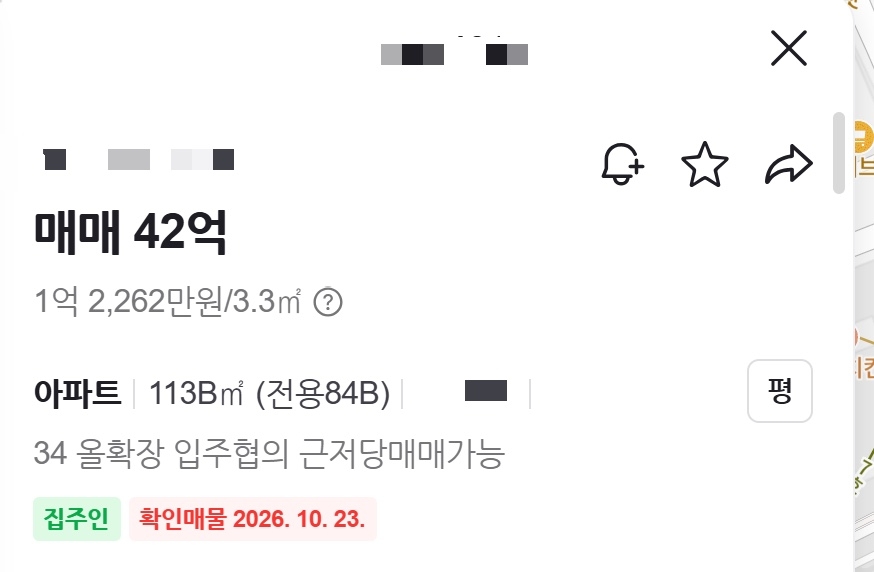
The couple stayed in regular contact with one Banpo real estate agency for about two months. Even while traveling abroad during the summer holiday, they checked new listings by phone and message whenever something came up.
A larger budget opened up more options, but price negotiations proved no easier. The criteria for choosing a home also shifted: rather than how expensive an apartment was, what mattered most was how much the seller was willing to lend, and for how long.
According to Siori, sellers offering financing typically asked for repayment within six months to a year. The couple, however, wanted a repayment period of two to three years or more, to give themselves time to arrange rental income or refinancing.
"We weren't choosing the complex — we were choosing the home where the seller would put up the biggest collateral mortgage and give us the longest repayment window. Honestly, there wasn't much to choose from."
Then, at last, they found a listing in Banpo that met their terms. The seller was willing to lend 2 billion won. At an annual interest rate of 5 percent, the monthly interest alone would come to about 8.33 million won ($6,240).
The spouse, who had once balked at a 350 million won mortgage, was strongly opposed again. Siori, on the other hand, felt that if they passed on this, another shot at Banpo might not come.
Once again, the couple found themselves on opposite sides.
The next installment follows Siori and the spouse as they pursue a Banpo apartment purchase with 2 billion won borrowed from the seller. How did a couple in their 20s plan to manage monthly interest payments of about 8.33 million won?
quq@heraldcorp.com