Court: comments amounted to negative opinion, not a statement of fact
Separate charge over 'human scum' remark dismissed after victim withdrew complaint
Victim expressed no desire for punishment during civil mediation proceedings
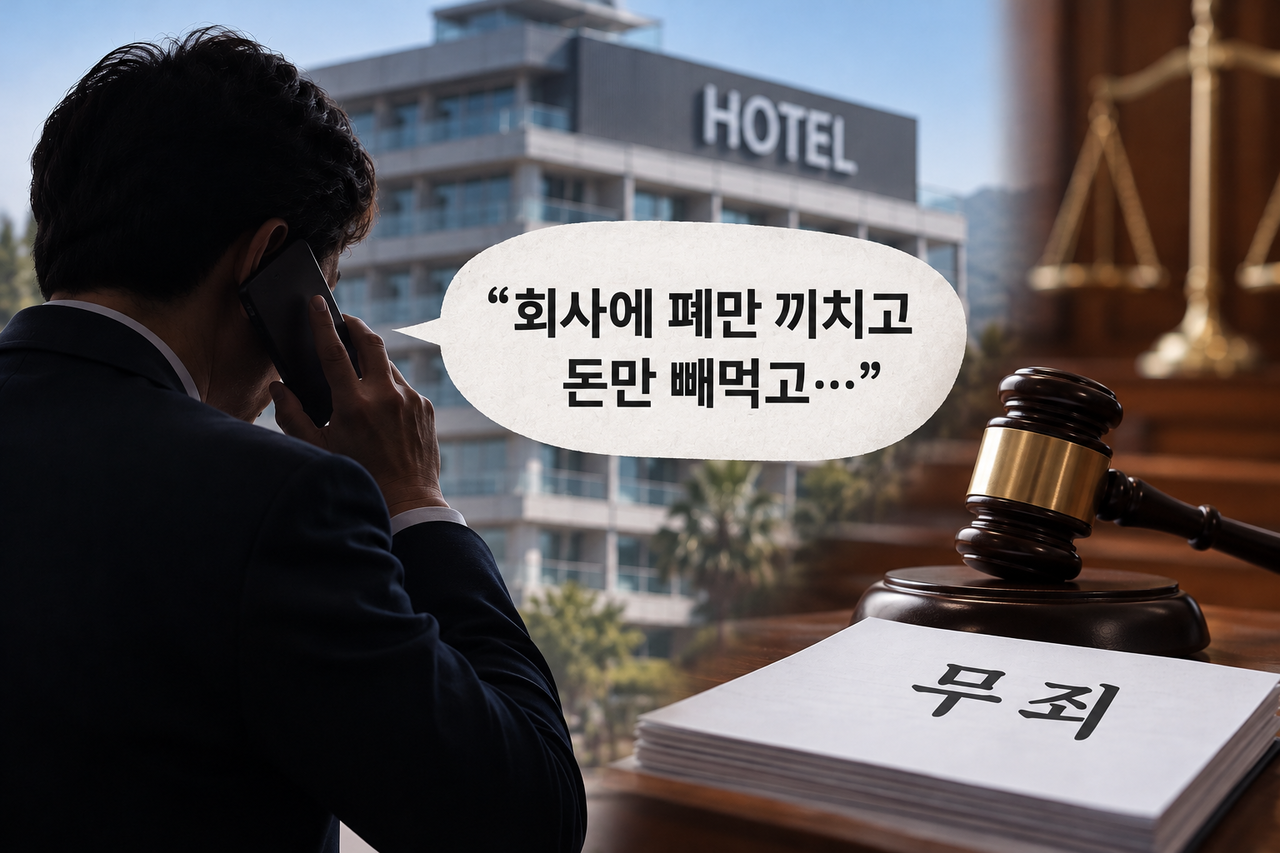
A hotel CEO who was criminally charged with defaming an investor — telling a third party that the investor had "only burdened the company and leeched off it" — has been acquitted.
The court ruled that the remarks did not constitute a statement of specific fact capable of lowering the investor's social standing, but were simply an expression of negative opinion or emotion.
Judge Oh So-hyeon of the Jeju District Court's Criminal Division 1 acquitted the CEO, identified only as A, on Sunday on the defamation charge. A separate defamation count was dismissed after the victim indicated no desire for punishment. The ruling was finalized Thursday, after prosecutors chose not to appeal.
According to the facts established by the court, A had entered into a management contract with a hotel management body and was operating the hotel when a dispute arose with B, an outside investor. B had signed a business partnership agreement with the hotel and served as vice president in the capacity of an outside investor.
In January 2024, A was found to have made disparaging remarks about B during a phone call with a hotel management body official. The remarks were prompted by B's apparent interest in investing in the hotel, followed by B's decision to assist the management body — which was at the time in a legal dispute with the hotel.
During the call, A was found to have said of B: "Using the excuse of being an investor to worm into the company, burdening it, leeching money off it, doing all sorts of nonsense and then slipping away."
Prosecutors determined the remarks defamed B and summarily indicted A in May last year. A requested a formal trial, and proceedings began in November of that year. A summary indictment is a procedure used for relatively minor offenses in which the prosecution — now known as the Office of Public Prosecution — requests a court to impose a fine without holding a separate trial, based solely on submitted documents. A formal trial may be convened if the court finds the summary procedure inappropriate or if either party contests the summary order.
The court found that A's remarks did not meet the threshold of stating specific facts as required under defamation law. Judge Oh said that under defamation law, "stating a fact" refers to a report or assertion about a concrete past or present circumstance capable of being proven by evidence, as distinct from an expression of opinion involving value judgments or assessments. The judge added that in determining whether an expression constitutes a statement of fact or an expression of opinion, courts must consider the overall context — including the ordinary meaning and usage of the language, the verifiability of the claim, the context in which the words were used, and the social circumstances surrounding the expression.
Judge Oh found that A appeared to have made the remarks while venting about the difficulties of running the hotel during the phone call. The judge ruled that A's remarks could not be seen as a sufficiently specific statement of fact likely to damage B's social standing or reputation, and were "merely an expression of A's negative and critical opinion or feelings toward B."
A also faced a separate charge of defaming C, another official connected to the hotel management body.
In November 2023, A was found to have referred to C — a former chairperson of the hotel management body's committee — during a phone call with B, calling C "the lowest of the low, a piece of trash" and saying it was "shameful and embarrassing to share ownership with someone like that." A reportedly harbored hostility toward C at the time, believing C had leaked information about hotel operations and was encouraging other co-owners to file lawsuits.
The court dismissed this charge without ruling on guilt or innocence, after C withdrew the complaint and expressed no desire for punishment during civil mediation proceedings with A's company. The court found that a civil mediation record submitted in June last year contained C's withdrawal of the complaint and statement of no desire for punishment, and that the submission of the mediation record was made with C's authorization.
Under the Criminal Act, defamation by stating facts is classified as an offense that cannot be prosecuted against the explicit wishes of the victim.
yg@heraldcorp.com