Machine guidance system uses satellites and sensors to guide construction equipment in real time
Global blasting industry shifts toward integrated digital platform competition
Smart mining platform followed by smart drilling technology development
Technology expected to be deployed in large-scale national construction projects
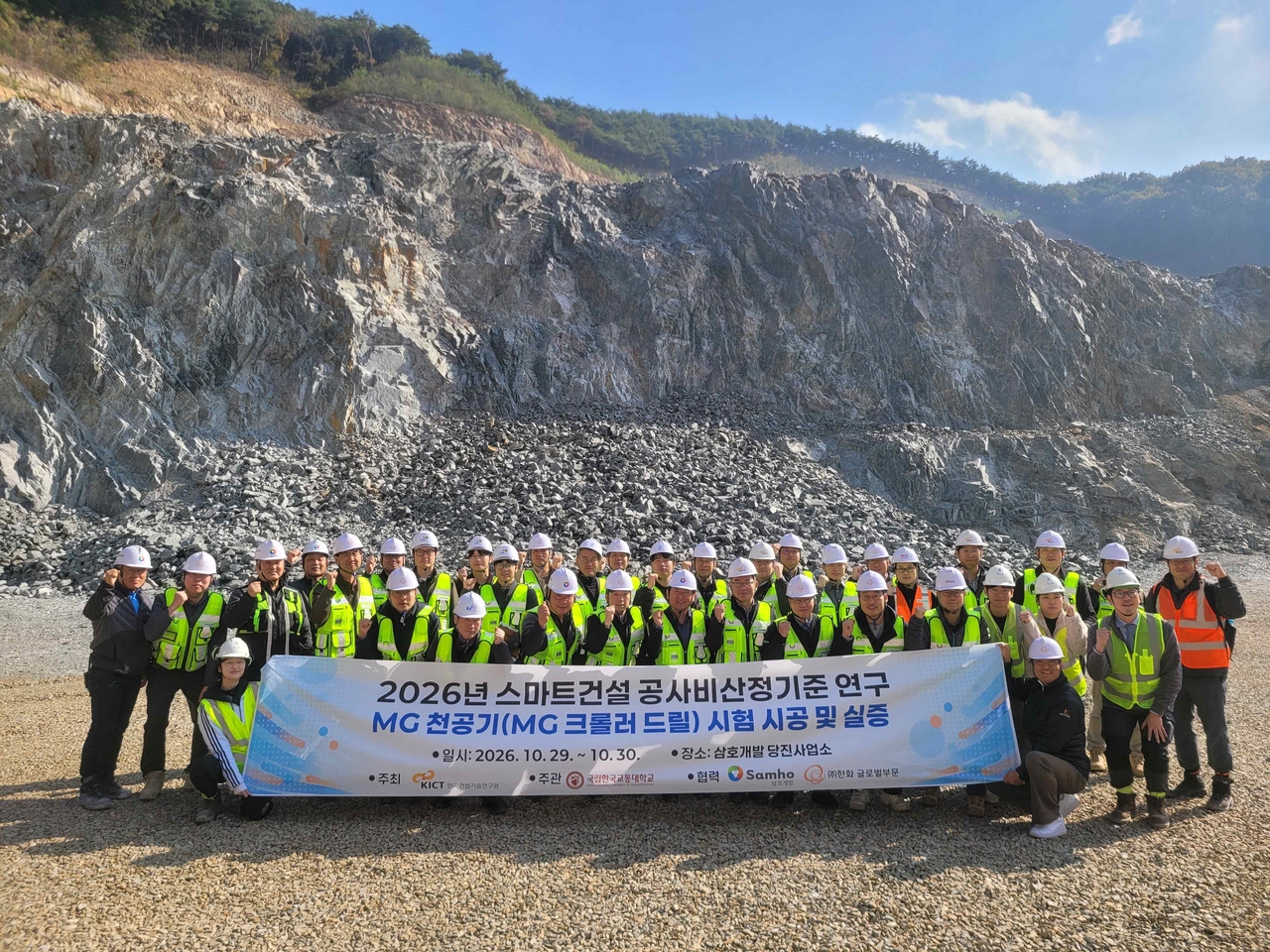
Hanwha's global division announced Monday that it has developed South Korea's first machine guidance (MG) smart drilling rig — a machine that bores holes into rock or workpieces — and completed field validation of the technology.
The company held a field demonstration at Samho Development's Dangjin site in South Chungcheong Province on Friday, with about 40 attendees from major public institutions including the Ministry of Land, Infrastructure and Transport, the Gadeokdo New Airport Construction Authority, the Daegu-North Gyeongsang Province Integrated New Airport Construction Promotion Group, the Public Procurement Service, Korea Expressway Corporation and Korea Land and Housing Corporation, as well as Korea National University of Transportation and representatives from the construction industry.
MG is a system that uses satellite navigation and various sensors to display a construction machine's position, angle and depth in real time on the operator's cabin monitor. Hanwha's global division developed the country's first smart drilling rig by integrating MG technology into a conventional crawler drill and has been supplying the equipment to domestic and overseas construction sites.
The MG smart drilling rig can be equipped with technology that feeds real-time field data from digital design files directly to operators without requiring significant investment in new equipment. Previously, workers had to manually cross-reference survey data with drilling positions one by one. Standardized digital work guidance also reduces performance variation caused by differences in operator skill levels, enabling stable gains in productivity and construction quality.
Smart drilling technology has increasingly been applied to large-scale site development projects such as new airports and industrial complexes, yet the current standard construction cost index contains no criteria reflecting the operational characteristics of smart drilling rigs. The industry has called on the government to establish a regulatory framework for calculating appropriate construction costs and applying the technology to public projects.
In response, the government launched a research initiative on smart construction cost calculation standards, under which the Korea Institute of Civil Engineering and Building Technology, Korea National University of Transportation and Hanwha conducted six months of field validation. Hanwha's global division supplied the MG smart drilling rig along with its operating technology and construction data, while Korea National University of Transportation measured and analyzed work hours, labor input and drilling precision.
The validation confirmed that deploying the smart drilling rig reduced preparation processes such as surveying and marking, cut labor requirements and decreased lost work time, resulting in overall productivity gains. The findings are expected to accelerate the adoption of smart drilling technology in large-scale national construction projects going forward.
The global blasting industry has been expanding beyond the simple supply of explosive products into competition over integrated services that connect various data digitally. Hanwha's global division has kept pace with this digital transformation by independently developing HATS, a smart mining digital platform that manages data across the entire blasting process.
"We will secure technological competitiveness against global explosives companies and expand differentiated digital services that provide integrated management from smart drilling through blasting result analysis," a Hanwha official said.
klee@heraldcorp.com