The city built OnSet, a generative AI auto-recovery program, in-house using conversational coding — covering 14 types of recurring administrative portal failures
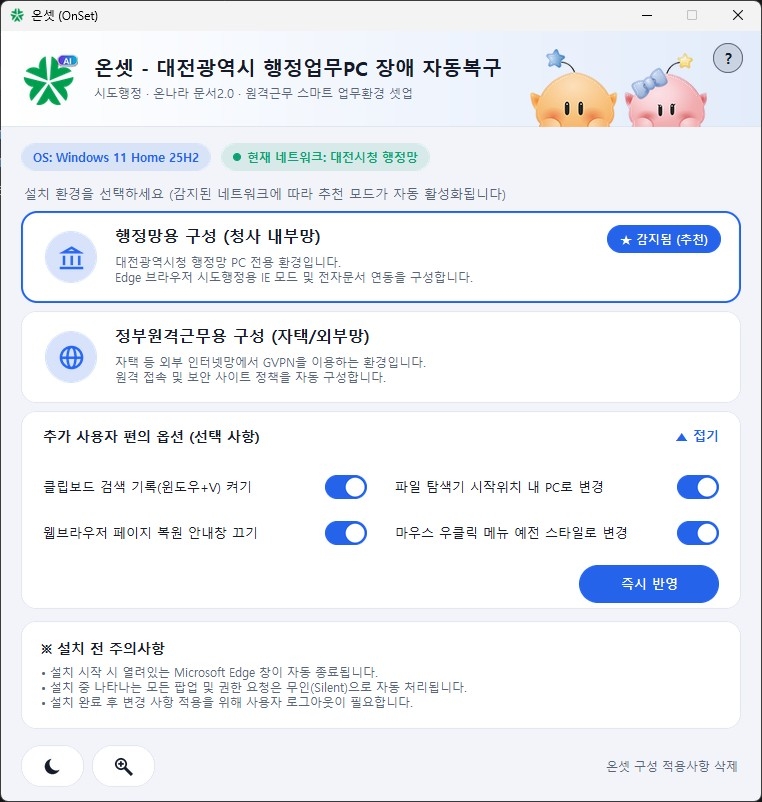
Daejeon has developed an in-house generative AI program called OnSet that fixes configuration errors on office computers with a single click, the city announced Monday.
The name OnSet combines the Korean words for "all" (on) and "settings" (set), reflecting the program's aim to cover every configuration need through AI. Designed as a first-aid tool for administrative work, it allows staff with no technical background to resolve errors on their own in about one minute.
Administrative offices have long struggled with errors that prevent access to internal portals and electronic approval systems — problems typically triggered by frequent security updates to Windows, internet browsers or document software, as well as conflicts between programs.
Each time an issue arose, staff had to call the support department and wait in line for remote assistance. When the cause was not immediately clear, a full system reset was sometimes required, delaying urgent approvals and causing significant disruption.
The program was built entirely in-house at no development cost by Park Byeong-su, an official in Daejeon's information technology division, using generative AI tools — without any outsourcing.
The work reflects a broader push by the Ministry of Interior and Safety to spread conversational, or "vibe," coding across government, with Daejeon's staff taking an early lead in applying that approach to produce a practical result.
OnSet handles 14 types of recurring failures with a single click: seven in the administrative portal category, four in the electronic approval category and three related to PC settings. It also automatically detects whether a staff member is working from the city hall office or from home, then installs the appropriate security settings and essential programs for each environment — ensuring uninterrupted work even during remote shifts when live technical support is harder to reach.
Daejeon began rolling out the program to all staff for use in the field this month.
"It is significant that a civil servant who best understands the inconveniences of frontline work used generative AI to build a solution directly, without any additional budget," said Lee Gil-ju, Daejeon's AI innovation officer. "We will continue to actively integrate AI technology into internal administrative work to improve staff efficiency and deliver faster, more reliable services to residents."
kwonhl@heraldcorp.com