Chabot Mobility survey of 300 respondents
53% go with dealer recommendation without comparison
Only 42% select their own tint film
Eight in 10 new-car buyers have their window tinting installed through a car salesperson or dealer, a new survey shows. Consumers who personally compared and chose their own installer reported higher satisfaction, while nearly half said they plan to switch providers or film brands when they buy their next vehicle.
According to a "vehicle purchase and maintenance awareness survey" released Monday by mobility platform company Chabot Mobility, which polled 300 vehicle owners and people planning to buy a new car within a year, 77 percent of new-car buyers said they had tinting installed at the time of delivery or received it as a standard inclusion.
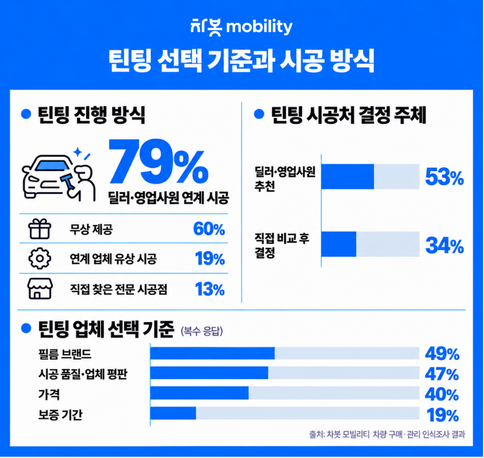
The most common installation channel was a free service provided by the dealer or salesperson, cited by 60 percent of respondents. Another 19 percent said they paid for installation at a shop referred by their dealer. Combined, 79 percent of tinting installations were arranged through a dealer. By contrast, only 13 percent of consumers sought out a specialist installer on their own.
Dealer dependence was also evident in how consumers chose their installer. Some 53 percent of respondents said they went with the shop recommended by their salesperson or dealer without making any independent comparison. Only 34 percent said they compared multiple providers before deciding.
The share of consumers who personally selected their tint film was also limited to 42 percent. Some 36 percent said they knew the film brand but left the specific product choice to the installer, while 23 percent said they did not know what film had been used.
The most common installation cost range was 300,000 to 500,000 won ($374), cited by 28 percent of respondents, followed by no charge (23 percent) and 500,000 to 800,000 won (21 percent). Items most frequently installed alongside tinting included dash cameras (55 percent), paint protection film (36 percent) and glass coating (32 percent).
Satisfaction levels varied markedly depending on how thoroughly consumers compared installers.
Overall satisfaction with tinting stood at 74 percent, but among consumers who ignored dealer recommendations and independently compared providers, the satisfaction rate was 100 percent.
The number of providers compared also made a clear difference. Every respondent who compared three or more shops said they were satisfied, while the satisfaction rate among those who compared one or two was 79 percent. Among consumers who installed tinting without any comparison, only 55 percent were satisfied — a gap of up to 45 percentage points.
The share of respondents willing to use the same installation method again also differed by comparison behavior. Among those who independently compared providers, 56 percent said they would repeat the process the same way. The figure was 50 percent for those who compared three or more shops, 37 percent for those who compared one or two, and only 27 percent for those who made no comparison.
Demand for switching providers or film brands was also notable. Some 46 percent of respondents said they would change their installer or brand for their next vehicle, outpacing the 36 percent who said they would stick with their current approach by 10 percentage points.
When choosing a tinting provider, consumers said film brand and installation quality were the most important factors. In a multiple-response question, film brand ranked first at 49 percent, followed by installation quality and shop reputation (47 percent), price (40 percent) and warranty period (19 percent).
Priorities differed by vehicle type. Among import-car owners, 64 percent said film brand was their top consideration, while 46 percent of domestic-car owners cited price as a key factor.
In terms of film brand awareness, 3M ranked highest at 80 percent, followed by Llumar (70 percent), Rayno and SolarGard (43 percent each) and Huper Optik (38 percent). Brand awareness, however, should be distinguished from assessments of actual product performance or installation quality.
Long-term tinting quality was also a significant concern. Some 75 percent of respondents said initial tinting quality matters more the longer a vehicle is driven, and 74 percent agreed that tinting affects air-conditioning use and driving efficiency.
Consumers also reported difficulty navigating the selection process. Some 70 percent said new-car delivery package prices vary so widely between providers that comparison is difficult. The inability to easily check film performance, installation costs and warranty terms in one place appears to be a key constraint on consumer choice.
Chabot Mobility partnered with global materials company 3M in August to launch "Chabot Package 3M Tinting," a bundled service combining tinting film, installation and after-care. Building on the survey findings, the company plans to expand a service that lets consumers directly compare prices and installation terms across products.
kwater@heraldcorp.com