President Lee addresses National Assembly on 2027 budget; 'people' cited 23 times, 'future' 16 times
New Future Response Fund to channel resources into youth, growth engines, regions and talent
107.2 trillion won in spending restructuring to run alongside record outlays
21.3 trillion won for AI, 39.5 trillion won for R&D; welfare system to shift to automatic disbursement
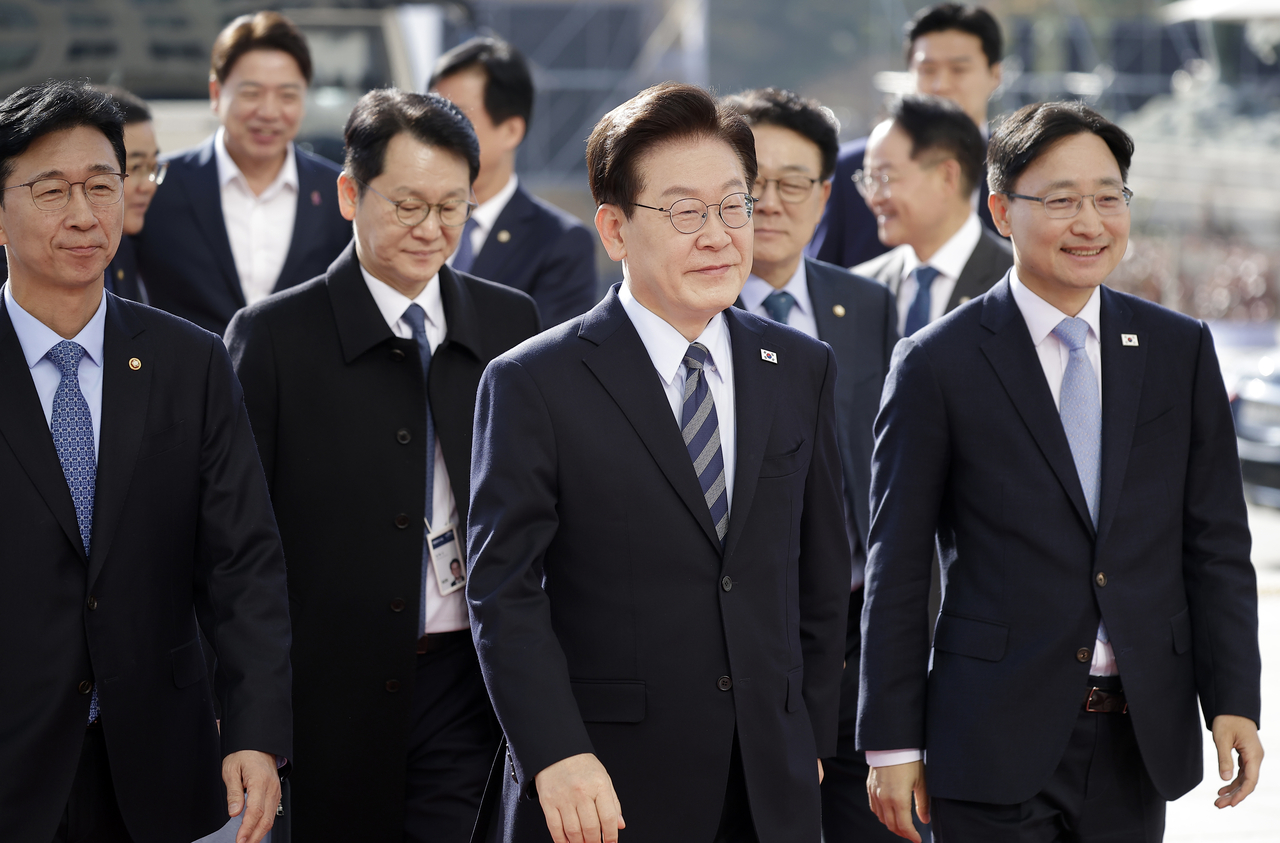
President Lee Jae Myung used a budget policy address to the National Assembly on Monday to declare a shift from what he called "growth for the few" — benefits concentrated among specific groups and a handful of companies — to "growth for all," in which every citizen and every region shares in the gains. The centerpiece of that vision, Lee said, is a newly created Future Response Fund.
The government's proposed total expenditure for 2027 stands at 820.9 trillion won ($614 billion), a record high and a 12.8 percent increase from this year. Even as it pursues the largest fiscal outlay in the country's history, the government plans to simultaneously restructure spending across 6,476 programs — including the elimination of more than 2,100 — cutting 107.2 trillion won to shore up fiscal soundness while preserving growth potential.
The words that appeared most frequently in Lee's speech were "growth" (36 times), "investment" (24 times), "support" (24 times), "people" (23 times) and "future" (16 times).
Particularly prominent in Lee's remarks was the Future Response Fund.
Lee described the fund as both a strategic investment platform to support a rebound in potential growth and an innovative fiscal stabilizer against widening swings in tax revenue. He said additional tax receipts would be concentrated in four areas — youth, future growth engines, regional development, and education and talent — to narrow disparities and lay the groundwork for sustained growth.
On the fund's buffer function, Lee said surplus resources would be deployed to bolster fiscal capacity during revenue shortfalls, guarding against the worst-case scenario of having to cut spending precisely when fiscal support is most needed during a downturn. The fund would also reduce the need to issue new government bonds, helping to stabilize financial markets, he said. Lee added that the IMF, the OECD and major credit rating agencies have all responded positively to the fund.
Investment aimed at the "future," Lee said, will be concentrated in AI and advanced technology. The government will commit 21.3 trillion won to AI — encompassing three mega-projects in semiconductors, physical AI and AI data centers — and provide 4.7 trillion won for a homegrown model development initiative called Frontier AI. The research and development budget will rise to a record 39.5 trillion won to nurture next-generation technologies, including a set of seven priority fields designated as "7 SEED." A new resource security fund worth 1.4 trillion won will also be established.
On the welfare side, the central reform is a shift from an application-based system to one that automatically disburses benefits once eligibility is confirmed. The standard median income will be raised by 6.7 percent, lifting the monthly livelihood benefit for a four-person household to 2.22 million won. The government will also expand basic pension support for low-income households and set up debt-relief support centers nationwide. For small-business owners, the government will carry out a special adjustment of long-overdue debts worth 5.4 trillion won — including 500 billion won in direct relief — and issue 25.6 trillion won in regional gift vouchers.
A youth budget of 43.3 trillion won has been set aside for young people and future generations, with new programs including the Child Independence Fund, a youth savings scheme, a childbirth support payment of up to 20 million won and a monthly child allowance of 200,000 to 300,000 won. The government will invest 33 trillion won in balanced regional development, pursuing the relocation of public institutions and full tuition support at regional national universities. The defense budget has been raised 8.2 percent to 73.3 trillion won.
"Whether we are tossed about by high and fierce waves and ultimately run aground, or whether we ride over them and turn crisis into opportunity, depends entirely on our choices and our response," Lee said. "For the future of the nation and the lives of its people, the government and the National Assembly — both the ruling and opposition parties — must join forces." He called on lawmakers to speak with one voice in securing the national interest amid fierce international competition, while working at home to narrow disparities, secure growth drivers and improve people's lives.
Lee added that "the key is execution and speed," and urged the Assembly to cooperate in finalizing the budget bill and its accompanying legislation by the statutory deadline of Dec. 2. "The government will listen with an open mind during the deliberation process and actively incorporate better alternatives," he said. "Trusting in the great people of this nation, we will communicate actively with the National Assembly and open the way to a new future for Korea."
sunpine@heraldcorp.com