- Researchers pre-designed platinum atomic sites to synthesize high-density catalyst with 14.9% platinum content
- Device ran stably for 500 hours; voltage degradation rate cut to one-quarter of commercial catalysts
South Korean researchers have developed a new catalyst technology that cuts platinum use by 63% while improving the durability of hydrogen production devices.
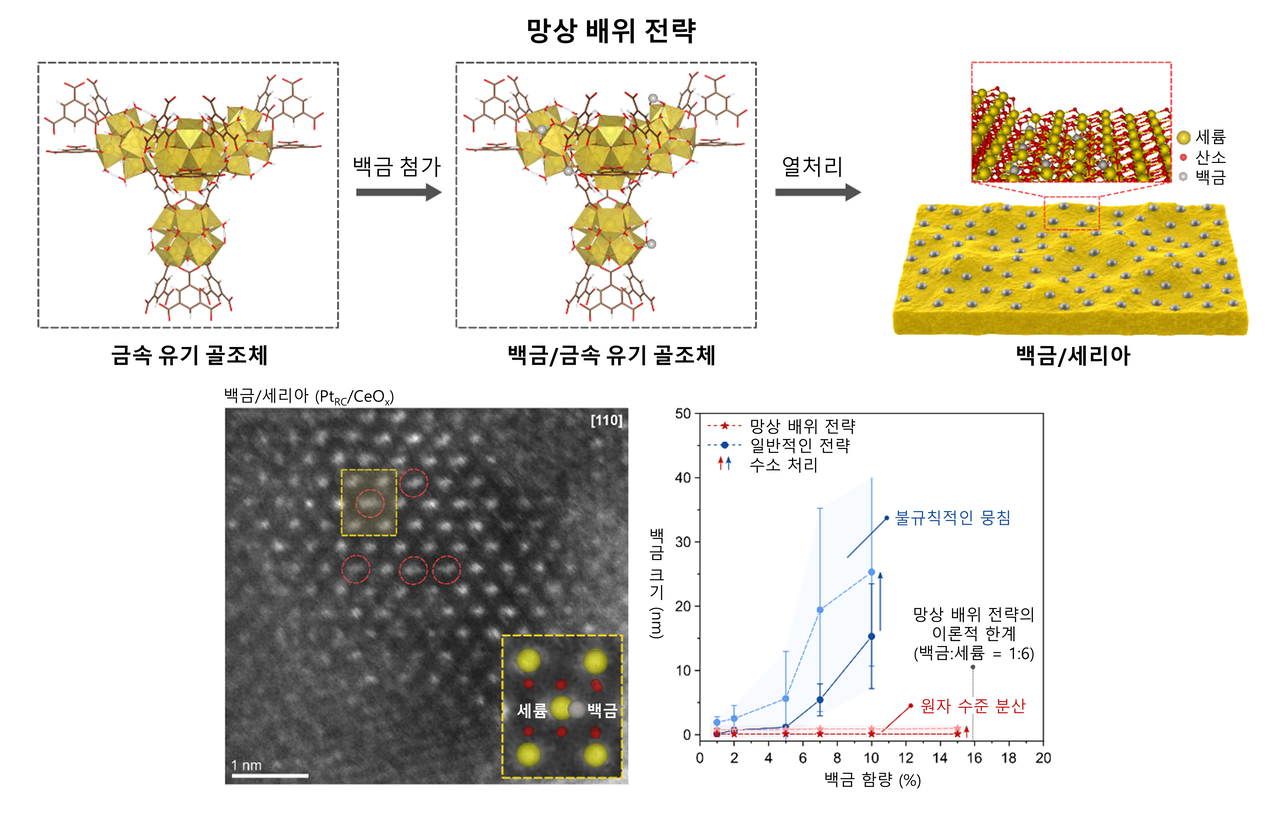
The Institute for Basic Science (IBS) announced Monday that a joint research team — led by Hyeon Tae-hwan, director of the Center for Nanoparticle Research, and Deputy Director Sung Young-eun, along with Korea University Professor Lee Byung-hoon and Kyung Hee University Professor Kim Min-ho — had developed a new method for synthesizing catalysts that disperses platinum evenly at the atomic level while raising its content to 14.9%.
Platinum is a high-performance catalyst material widely used in hydrogen production and automotive exhaust purification. Its drawback, however, is high cost: the more platinum used, the less economically viable the process becomes.
To address this, researchers have long pursued "single-atom catalysts" that disperse platinum one atom at a time. The challenge is that increasing platinum content causes atoms to cluster into larger particles, degrading both catalytic efficiency and stability. Existing technology has generally required keeping platinum content below 1%.
The research team found a breakthrough through a "reticular coordination" strategy that designates the position of each platinum atom before the catalyst is formed.
Using metal-organic frameworks — structures in which metals and organic compounds are regularly interconnected — the team fixed individual platinum atoms into a cerium-oxygen lattice, then converted the entire structure into ceria (cerium oxide) through heat treatment.
The resulting catalyst achieved atomic-level dispersion while filling 14.9% of its total weight with platinum.
Particularly notable was the suppression of platinum particle growth even after high-temperature treatment at 300 to 500 degrees Celsius in a hydrogen environment. While some platinum atoms formed small clusters, strong bonding with the ceria substrate preserved structural stability.
The team applied the catalyst to a proton exchange membrane water electrolysis device and ran it for 500 hours. The device maintained structural stability while using about 63% less platinum than conventional commercial catalysts.
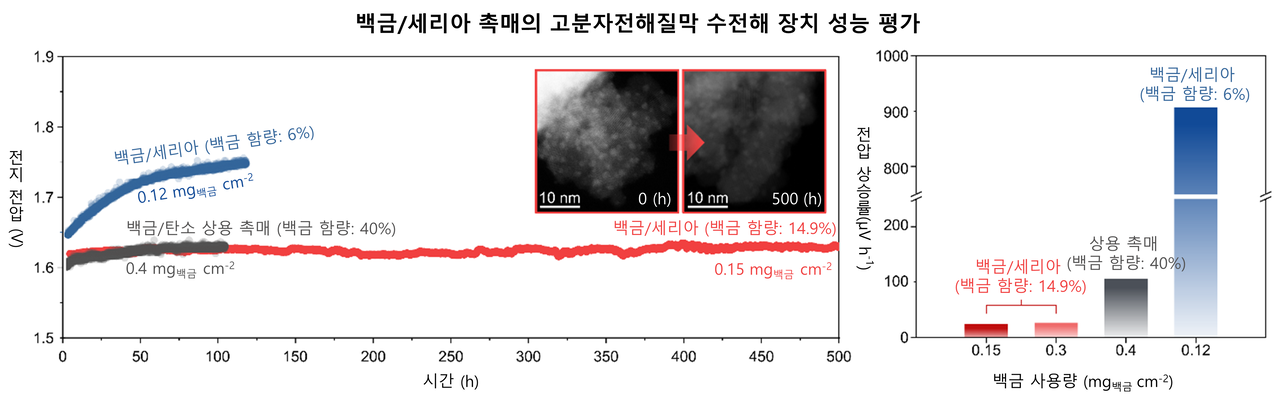
The rate of voltage increase — an indicator of device performance degradation — also fell to roughly one-quarter that of conventional commercial catalysts, confirming the potential to operate hydrogen production devices more stably with less platinum.
The technology is expected to find applications beyond hydrogen production, extending to automotive exhaust purification and chemical feedstock production.
The team plans to expand the approach beyond platinum to other precious metals such as iridium and rhodium. It will also test whether the strategy can suppress metal particle growth in high-temperature reaction environments, including dry methane reforming — which converts methane and carbon dioxide into hydrogen and carbon monoxide — and three-way catalytic converters that reduce harmful vehicle emissions.
"The results demonstrated in the hydrogen production device are an example of the potential of this synthesis strategy," said Hyeon, the center director. "We expect this work to contribute to developing catalysts that use precious metals efficiently and operate for longer periods."
The findings were published online Oct. 22 in the international journal Nature Synthesis.
nbgkoo@heraldcorp.com