Autumn napa cabbage output forecast up 18.5%, radish up 11.1%
Discount budget raised by 14 billion won from last year
Up to 40% off produce, 50% off seafood
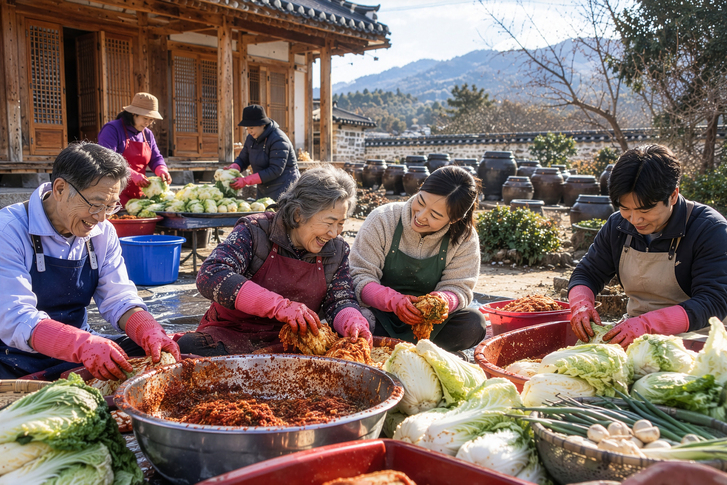
A bumper autumn harvest is expected to lower kimchi-making costs this year, with wholesale prices for napa cabbage and radish falling roughly 37 percent and 31 percent below their respective seasonal averages. To help farmers hurt by the price slump, the government has expanded its kimjang-season discount budget by 14 billion won ($10.5 million) from last year to 64 billion won, launching a "make one more head of kimchi" campaign to boost consumption.
The Ministry of Agriculture, Food and Rural Affairs and the Ministry of Oceans and Fisheries jointly announced the "2026 Kimjang Ingredient Supply Stabilization Plan" on Tuesday. The government will run supply management, discount support and consumption-promotion measures from Nov. 9 through Dec. 6.
According to the Korea Rural Economic Institute, autumn napa cabbage output this year is forecast at 1.214 million tons, up 18.5 percent from last year. Autumn radish output is expected to rise 11.1 percent to 372,000 tons. Favorable weather conditions have improved crop yields.
Demand for kimjang, however, is declining. The share of households planning to make kimchi at home this year fell to 58.6 percent, down 5.6 percentage points from 64.2 percent last year. The average batch size for a four-person household held roughly steady at 23.4 heads, compared with 23.5 last year. Total demand for kimjang cabbage is estimated at 583,000 tons, a 9.1 percent drop from last year's 642,000 tons.
With supply rising and demand falling, prices for cabbage and radish have remained soft. The Agriculture Ministry said at a briefing Monday that wholesale cabbage prices were about 37 percent below the seasonal average, while radish prices were about 31 percent lower. The Korea Rural Economic Institute also forecast that cabbage and radish prices during the kimjang season would stay below seasonal averages with little upward movement.
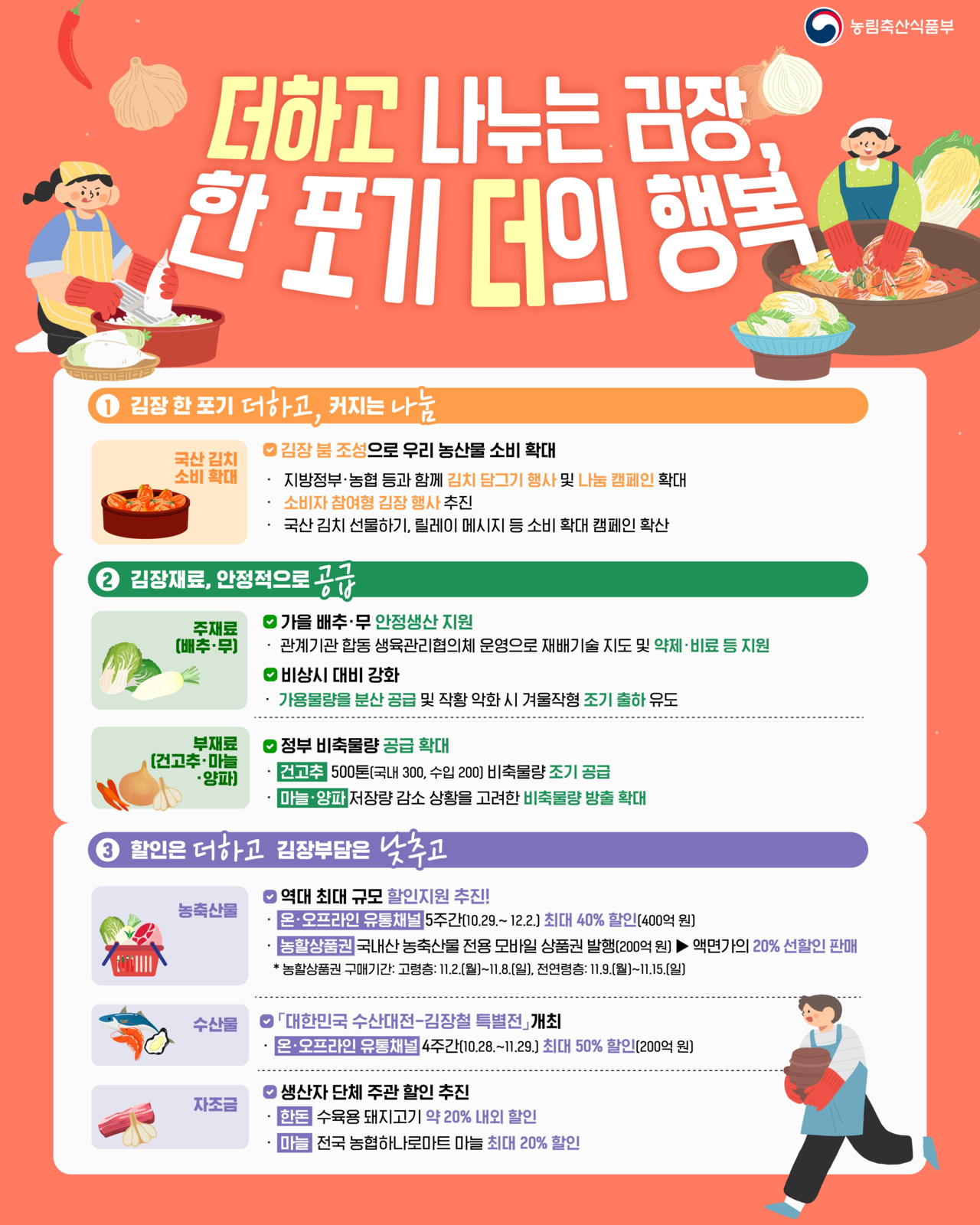
That backdrop explains why the government has shifted the focus of this year's kimjang plan from boosting supply to stimulating consumption. Last year's kimjang-season discount budget totaled 50 billion won — 30 billion won for produce and 20 billion won for seafood — but this year the government raised the produce allocation to 44 billion won, keeping the seafood portion unchanged at 20 billion won.
Of the 44 billion won earmarked for produce discounts, 40 billion won will fund discounts of up to 40 percent on kimjang ingredients and pork at large and mid-size supermarkets. The remaining 4 billion won will go toward issuing 20 billion won worth of agricultural discount vouchers at a 20 percent markdown. The voucher issuance volume has quadrupled from 5 billion won last year to 20 billion won this year.
Supermarket discounts run from Oct. 29 through Dec. 2. Agricultural discount vouchers will go on sale first for older consumers from Nov. 2 through Nov. 8, then to all shoppers from Nov. 9 through Nov. 15. Produce that has recently fallen in price — including cucumbers, zucchini, tomatoes, paprika and Shine Muscat grapes — will also be eligible for discounts.
For seafood, a special "Korea Seafood Festival — Kimjang Edition" running from Wednesday through Nov. 29 will offer up to 50 percent off sea salt, salted shrimp, anchovy fish sauce, oysters and other kimjang staples.
The government is also preparing for potential short-term supply disruptions caused by bad weather or other factors. It plans to secure 46,500 tons of cabbage and 9,000 tons of radish in advance and deploy them flexibly depending on market conditions. Not all of the stockpile will be released during the kimjang season; the government intends to hold reserves for emergencies and release them only when needed.
Government stockpiles of 500 tons of chili peppers, 515 tons of garlic and 1,500 tons of onions will be supplied proactively to processors and distributors. Stable production of cabbage, radish, green onions, chives and ginger will be encouraged through crop-management support and pest-control assistance.
The government will also expand kimchi-making events and sharing campaigns in partnership with local governments, the National Agricultural Cooperative Federation, public institutions and private companies. Plans include group kimchi purchases for employees, kimchi donations to vulnerable households, and kimjang experiences at rural tourism villages.
Some observers, however, noted that a consumption-promotion campaign alone may not be enough to counter falling prices at a time when kimjang demand is already shrinking.
Seo Jun-hwan, the Agriculture Ministry's director general for retail policy, said that even setting aside some cabbage at the production level would not be enough to prop up prices given this year's large autumn harvest. The ministry therefore chose to prioritize consumption expansion over supply-side intervention and increased the discount budget accordingly.
Seo said kimjang support measures "are inherently a stopgap by nature," adding that even when an appropriate cultivation area is secured, output can still rise or fall depending on growing conditions. Seo added that more fundamental solutions — such as restructuring agricultural production to better withstand climate change — would take time.
The government will also step up enforcement of country-of-origin labeling for kimjang ingredients and intensify pesticide residue testing. A total of 800 special pesticide residue inspections covering cabbage, radish, chili peppers and garlic will be conducted through Nov. 30, alongside focused checks on false origin labeling of imported kimchi and seasoning vegetables.
Agriculture Minister Song Mi-ryeong said that while kimjang vegetable supplies are generally ample this year, the minister is concerned about the hardship that falling prices are causing for farmers who have worked hard. Song urged the public to "make one more head of kimchi and share it" as a way to support struggling farmers and show care for their neighbors.
Oceans and Fisheries Minister Hwang Jong-woo said the ministry would do its utmost to ease the financial burden of kimjang shopping, including by offering kimjang seafood staples such as salted shrimp, anchovy fish sauce and oysters at discounts of up to 50 percent.
adastra@heraldcorp.com