President says renovation projects taking 10 to 30 years must accelerate; floor ratio, financial incentives promised for early movers
Church site exclusion in Jangwi Zone 10 draws sharp rebuke: 'There is no such thing as defying the law and getting away with it'
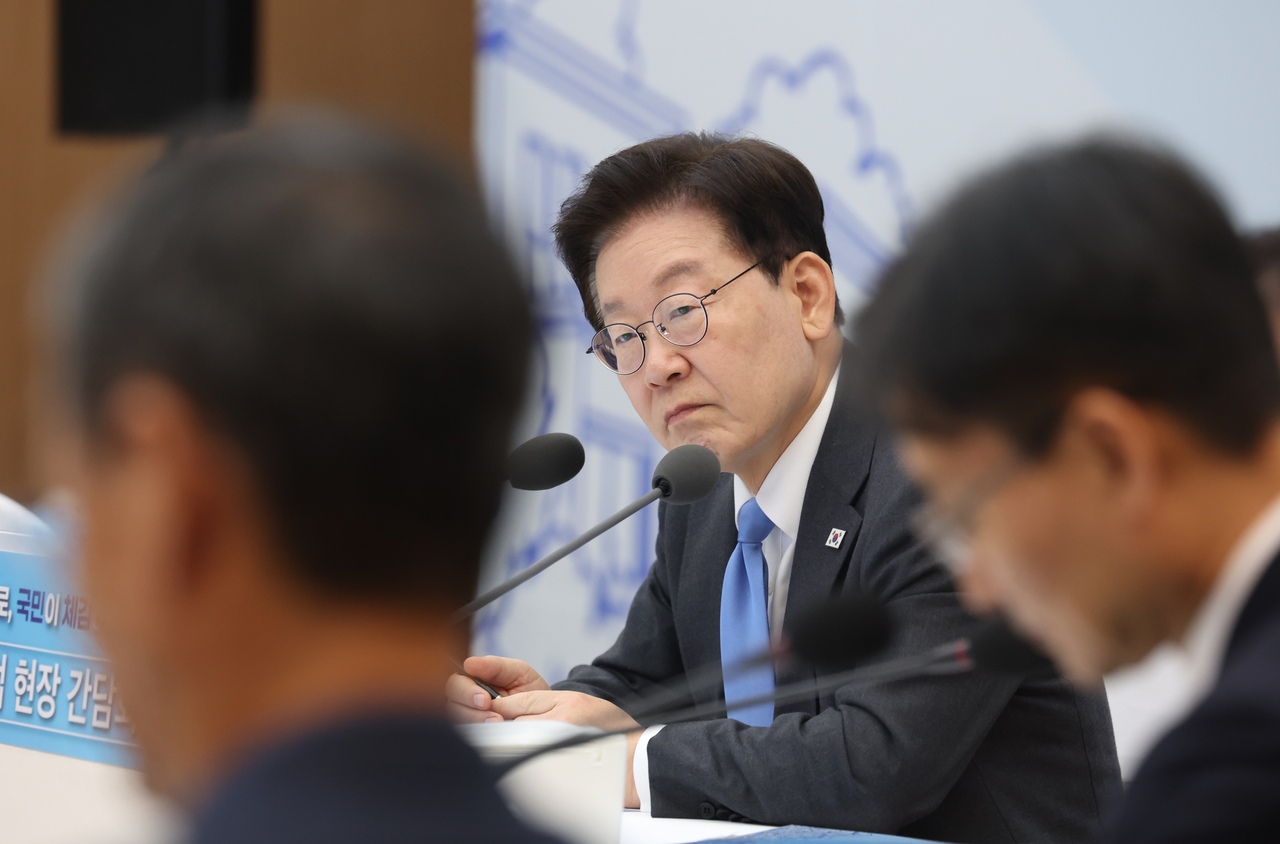
President Lee Jae Myung visited a public redevelopment site in the Jangwi-dong area of Seongbuk-gu, Seoul, on Wednesday, calling for shorter administrative procedures and swift passage of related legislation as he put housing supply at the center of his agenda. Lee also sharply criticized cases in which specific facilities or commercial properties had been excluded from project sites after refusing to cooperate, and urged local governments to enforce the law firmly and without exception.
Speaking at a forum held after an on-site inspection of the Jangwi Zone 9 public redevelopment project in Seongbuk-gu, Lee said renovation projects take far too long. "Even when I was mayor of Seongnam, I felt this — redevelopment takes too much time," he said. "Ten years is the baseline, and some drag on for 20 or 30. We need to move faster."
Lee said prompt National Assembly action would directly help projects on the ground. "I think swift passage of the bills currently pending in the National Assembly would go a long way toward speeding up progress at project sites," he said. "Since the government has committed to providing various incentives, I believe passing the related legislation would make a significant difference in both pace and project viability." He then asked Presidential Chief of Staff Lim Gwang-hyeon, who was present, to keep a close watch on the matter.
Lee attributed housing price instability in the Greater Seoul area to a supply shortage caused by a sharp drop in housing permits in recent years. "Starting in 2022, the number of housing permits plunged, and a supply cliff is now forming," he said. "Permit numbers have recently begun recovering, but people on the ground say the effects won't be felt until 2028 or 2029 at the earliest."
He said the government would push harder on decentralization and balanced regional development while also working to increase new land supply. "Redevelopment projects now need to pick up speed as well," Lee said. He added that streamlining administrative procedures to allow earlier progress across other zones was essential, and called for stronger incentives — including higher floor-area ratios and financial support — for projects that move ahead of schedule.
The Jangwi-dong area of Seongbuk-gu was designated a redevelopment promotion district in 2006, divided into 15 zones with a target of supplying 33,000 housing units. The project stalled for years due to the global financial crisis and disputes among residents. Jangwi Zone 9, which Lee visited, was among those that struggled before being converted to a public redevelopment model.
During a briefing by the Korea Land and Housing Corporation, Lee pressed officials on how the Sarang Jeil Church site came to be excluded from Jangwi Zone 10. "Was it excluded because enforcement couldn't be carried out?" he asked. "That makes no sense. There is no such thing in this world as defying the law and getting away with it by holding out." He then turned to Seongbuk-gu District Mayor Lee Seung-ro and said, "Going forward, enforcement must be thorough. In a nation governed by the rule of law, how can anyone prevail simply by digging in?"
Lee also called for active administrative intervention to prevent distorted urban development after hearing that parts of Jangwi Zone 4 and an existing apartment site within Jangwi Zone 3 had similarly been excluded. "When you carve out the parts that object, the shape of the city becomes distorted," he said. "When I was in Seongnam, a main road was excluded from a redevelopment zone and the layout looked strange — but we brought it back in and fixed it. This is exactly where administrative action is needed. Otherwise everything ends up misshapen."
sunpine@heraldcorp.com