60.8% of pension subscribers earn less than 4% annually
S&P 500 posted gains in 164 of 182 monthly one-year holding periods
Adviser stresses volatility management and tax-advantaged accounts
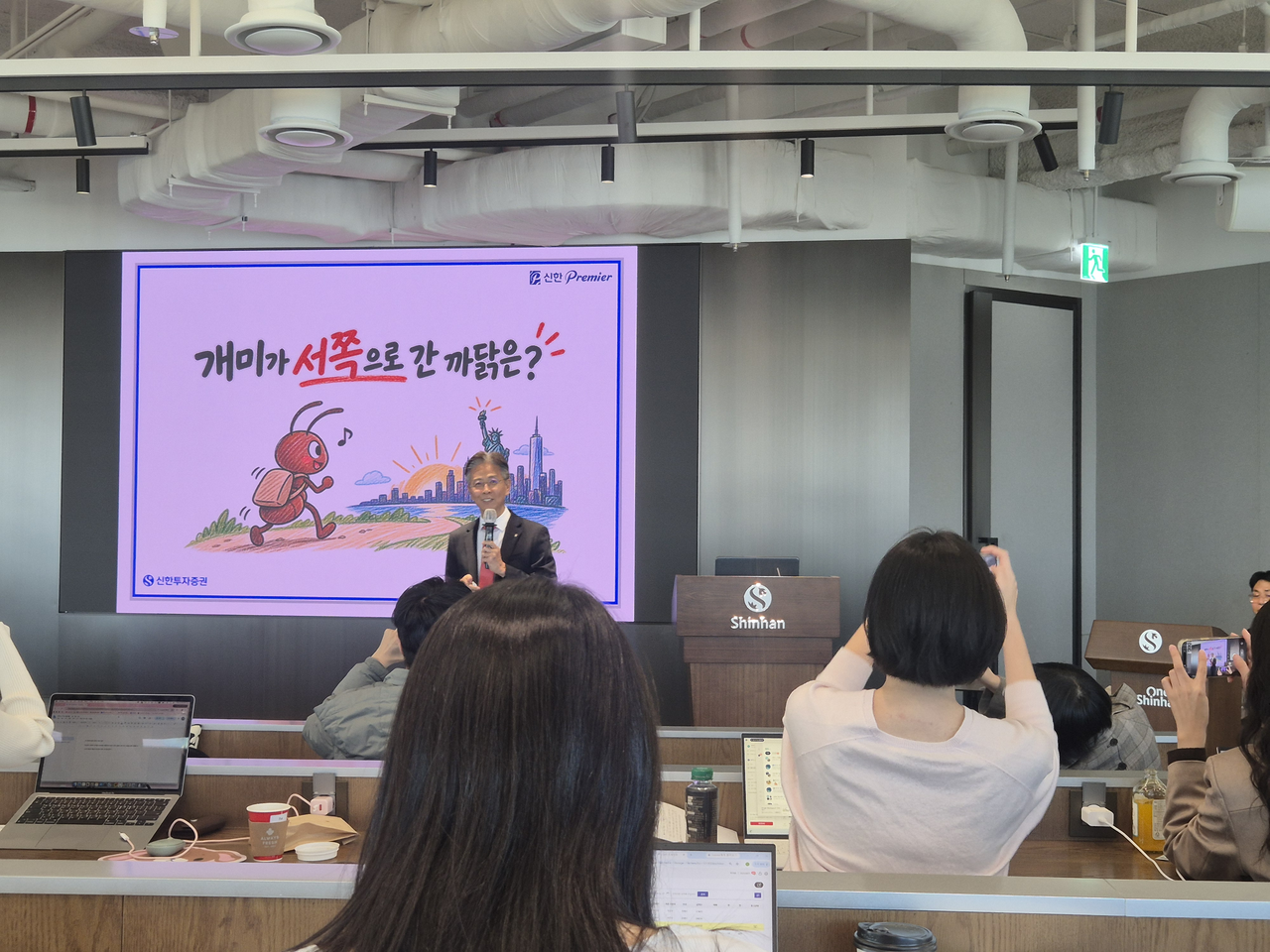
Raising a retirement pension's annual return from 3 percent to 6 percent can more than double accumulated assets over 25 years — yet six in 10 pension subscribers are earning less than 4 percent a year, according to Shinhan Securities.
Park Geun-bae, a managing director in Shinhan Securities' Shinhan Premier Pathfinder division, laid out volatility management, long-term investing and the use of tax-advantaged accounts as the three pillars of sound asset management at the "Smart Asset Management Strategy" seminar held Thursday at the company's Yeouido headquarters in Seoul.
Data from the Financial Supervisory Service's 2025 Retirement Pension Investment White Paper show that 60.8 percent of subscribers to defined-contribution and individual retirement pension plans earn annual returns below 4 percent. Park said a principal of 100 invested at 3 percent annually grows to 209.4 over 25 years, but adding 3 percentage points to that return more than doubles the final asset value.
Park recommended investing a fixed amount every month rather than making a lump-sum contribution at year-end solely for tax-deduction purposes. The approach keeps money working throughout the year, extending the investment period and compounding returns over the long term.
Park said managing the scale of losses is equally critical. A 20 percent loss requires a 25 percent gain just to break even; a 50 percent loss requires a 100 percent gain, and an 80 percent loss requires 400 percent. Park cautioned against leveraged investing and the practice of averaging down on individual stocks already in the red.
Park also presented data illustrating the rewards of staying invested. Assuming a hypothetical investor bought into the S&P 500 at the end of each month over the past 15 years and held for one year, 164 of the 182 entry points — or 90.1 percent — produced a positive return, with an average gain of 14.9 percent. Applying the same methodology to the Kospi yielded an average return of 13.3 percent.
Market corrections remained a recurring feature even over that long stretch. Of the 16 calendar years from 2011 through this year, the S&P 500 rose in 14 and the Kospi in 11. Over the same period, the average maximum drawdown was 12.6 percent for the S&P 500 and 17.9 percent for the Kospi. Park said investors should manage volatility through broad market diversification rather than concentrating on individual stock selection.
Park also highlighted after-tax return management through tax-advantaged accounts, introducing a strategy combining retirement pensions, personal pensions and individual savings accounts (ISA). Transferring ISA proceeds at maturity into a pension account allows 10 percent of the transferred amount — up to 3 million won ($2,240) — to qualify for an additional tax deduction. Park noted that frequent trading erodes long-term compounding gains through commissions and taxes.
"Successful asset management lies less in predicting market movements precisely and more in setting principles aligned with your investment goals and following them consistently," Park said. "It is important to keep volatility within a manageable range, use tax-advantaged accounts, and take a long-term view in managing your assets."

hajun825@heraldcorp.com